Posts Tagged ‘quantum theory’

Quantum State Superposition in the Precursor Field

January 1, 2017

I’ve been continuing to work on what a field would have to look like if it were the underlying mechanism for the particle zoo and force fields. One thing I haven’t discussed that will be noticed instantly by anyone who studies physics–this precursor field must allow quantum state superposition. I’ve so far posted a geometrical set of constraints, but I’ve always had an awareness that the model is incomplete–or won’t work at all–if I can’t provide some means for state superposition.

The trouble with inventing a theory like this is that the job is truly humongous. The number of details that have to be verified as correct is really beyond the reach of one person or even a team of people, so I’ve had to trudge on knowing that this whole thing will be laughed off in seconds by experienced theoreticians who spot a missing or wrong claim. This is definitely one of them, if I don’t provide a believable mechanism for quantum state superposition, nobody will bother to look.

So–I’ve spent some time thinking on this. I actually have enough worked out that I want to try a sim of the model, but then I thought–no, make sure quantum states can work with the model. Otherwise the sim will be a waste of time and probably not really even interesting. Probably the easiest and simplest quantum state superposition to think about is electron spin, which I’m going to take the liberty of modelling with a twist ring. There are two spin parameters in a twist ring, one of which is degenerate by rotation(*). To isolate the true degrees of freedom in a gauge invariant system, I will set the ring rotation direction as clockwise, for example, and then see just one degree of freedom in the axial twist direction along the rotation direction–it can be either clockwise or counterclockwise. I will call this the spin of the particle, either up or down.

Now, to specify a quantum state superposition, the particle spin can be either up or down or a linear combination of spin-up and spin-down. Does the unitary twist field theory precursor field allow this? I believe it is easy to say yes. Treat the loop as a transmission line with a discontinuity sheath surrounding the twist. The twist itself is a Fourier construction of standing waves that can encapsulate such a linear composition of the up and down spin. If the particle encounters a spin detector, an operator acts on the linear composition to filter the wave composition and resolve the spin state.

There’s my hand-wavy analysis, no proof by any stretch of the imagination. That is a chore that will have to wait. It looks viable to me, but I have so many other alligators in this swamp that this will have to do for now.

Agemoz

*Note that it’s only degenerate in R3 for purposes of this example. In reality, the R3 + I background state will be different for the two loop rotations, thus providing the required degrees of freedom for both spin and the particle/antiparticle duality.

Precursor Field Forces

December 18, 2016

It looks clear now (see previous posts) that the precursor field (my underlying field proposal that is hypothesized to give rise to the particle zoo and EM and other fields) has to have a discontinuity to enable twists. This is great for quantization as mentioned in the previous post, but is really ugly for the math describing the field. Could nature really work this way? I’m dubious, but all of my analysis seems to show this is the only way, I’ve only gotten here because I have seen no other paths that appear to work.

For example, it’s obvious to everyone that an EM field can’t be the basis for quantization or solitons–lots of historical efforts that many have looked at and ruled out. Twists in a background state is a geometrical definition of quantization. Lattice and computer sim schemes are ruled out (in my mind, anyway) because I think there should be observable ether-like consequences. Adding an I direction to the R3 of our existence is necessary since twists in R3 could not provide the symmetries required for guage invariance and exchange particle combinations. The I dimension, which is merely an element pointing direction that does not lie in a physical real axis of R3, enables twist quantization, and unlike photon ring theories such as DeBroglie’s, can enable twist trajectory curvature–a necessity to allow closed loop solutions that confine particles to a finite volume. There are many more necessary constraints on this precursor field, but the most problematic is the need for field discontinuities. Any twist in a unitary orientable vector field has to be surrounded by a sheath where the twist disconnects from the background state pointing in the I direction.

Requiring discontinuities needed for enabling field twists is an ugly complication. We know already that any quantizing field theory underlying particle creation/annihilation cannot be linear since dissipation destroys particle stability–solitons cannot be formed. Almost by definition this means that the field has to have discontinuities, but mathematically describing such a field becomes very problematic. Obviously, such a field will not be differentiable since differentiability, at least finite differentiability, implies linearity.

As I’ve mentioned in previous posts, the precursor field has two connections that act like forces. From these connections arise linear and curving twists, exchange bosons of fields, and so on. The first force acts only on a field element, and provides a restoring force to the background state. The second, neighboring affect force, provides an influence on immediately adjacent neighboring elements of the precursor field. The first force should not be conceptually complex–it just means that, barring any other effect, a field element vector will return to the background state.

The second force is more complex. I see at least two options how this force might work. It should be obvious this force cannot be proportionate to the dimensional rate of change of rotation because discontinuities would make this force infinite. In fact, to keep a particle from dissociating, there must be an adhesion to nearby elements–but NOT across a discontinuity. Otherwise, the force due to the discontinuity would be far greater than the force holding the elements of the twists, where each end is bound to the background state (or to the 0 and 2Pi phase rotation connection of the closed loop twist). If that happens the forces across the discontinuity would be far greater that the force tying down the twist ends to the background state and our particle, whether linear or closed loop, would immediately be shredded into nothing.

The other possibility for the second force is to make it only proportionate to the timewise rate of change of adjacent elements (sort of like induction in magnetic fields), but again, the discontinuity sheath would bring in potential infinities.  Right now this approach does not show promise at all for a bunch of reasons.

I think the only viable description of the neighborhood force would be an adhesion to nearby states who’s orientation is the same or very slightly different. That is, the angular delta from nearby elements causes a force to make that delta 0, but if there is a rip or tear then no force occurs). An important side question is whether the neighborhood connection is stronger than the restoring to I force. It’s not clear to me right now if it matters–I think field quantization works regardless of which is stronger.

This finally gives me enough description that I can mathematically encode it into a simulation. I realize that just about all of you will not accept a theory with this sort of discontinuity built into every single particle. Like you, I really am quite skeptical this is how things work. I hope you can see the logic of how I got here, the step-by-step thinking I’ve done, along with going back and seeing if I overlooked a different approach (eg, more dimensions, string theory, etc) that would be more palatable. But that hasn’t happened, I haven’t seen any other schemes that could work as well as what I have so far.

Agemoz

Precursor Field Does Not Have to be Discontinuous

December 3, 2016

In trying to ferret out the properties of a precursor field that would give rise to the particle zoo and EM fields and so on, I had been working out just what this field would look like if it could form a loop. I have so far determined that it would have to reside in a orientable, unitary R3 + I vector field, the same dimensionality as the quantum oscillator field, and that to achieve E=hv quantization, quanta would take the form of twists in a background state pointing in the I direction. I figured out that a twist would curve in R3 if it formed a loop around a central background state region, because regardless of the loop topology in R3, it would always pass through a field orientation tilt toward the central I background region.

Up to now, the concept seemed to be workable, but I always have struggled with the field twist concept. I knew that in R3, you cannot have a field twist without a field discontinuity along the twist axis, which really caused me to doubt the veracity of the unitary twist theory. I know of no instance in the real universe where there’s a true discontinuity–even in black holes. To have our existence form from particles made of twists and field discontinuities has always seemed unlikely to the extreme–I have several times nearly abandoned this work because non-analytic fields seemed non-intuitive, non-differentiable, and non-geometrical.

However, when I tried to detail the specific mathematical possibilities for describing a curved twist in the R3 + I field, I discovered something quite surprising. Every mathematician probably knew this already–but when vector fields are described in four dimensions (R3 + I), axial twists can form in three of the four dimensions and not cause a discontinuity. The I orientation gives the field surrounding the twist an extra degree of freedom that removes the necessity for a discontinuity.

However, this does cause a different problem with the unitary twist theory. We all know that trying to form a soliton out of photons (an EM closed loop solution) is impossible because nothing can curve a photon into a ring. A big problem with trying to describe quantized photons out of EM waves is the dissipation problem, why doesn’t a quantized photon just radiate into nothing, thus losing the apparent quantization and conservation of energy? Currently, Standard Model physics doesn’t really provide an answer to that, but in unitary twist field theory work, I had determined that the discontinuities in a precursor field had acted as a lock that prevents unraveling of the particle, and thus may be necessary for particle stability. You can’t unravel a quantized twist in R3 (causing a particle loop or linear twist to disappear) because you would have to somehow resolve the discontinuity to the background state–and that definitely can’t be done in R3. But in R3 + I, there is no discontinuity required, and thus I think any twist configuration could disappear, thus potentially destroying the energy present in the particle.

So–which is it? We need R3 plus I to achieve quantization and closed loop twists–but R3 + I means we don’t have to have discontinuities–a far more realistic and likely representation of our universe via a unitary vector field, but with the disadvantage that what now enforces quantization? Are there solutions in R3 + I that still depend on a discontinuity for stability and conservation of energy?

Looks like more study and thinking is needed.

I’ll bet there’s a few scientists out there wondering if I could achieve something a lot more significant if I’d put all this time and energy into something worthwhile!

Agemoz

Precursor Field Connection to Quantum Field Theory

November 8, 2016

I’ve done some pretty intense thinking about the precursor field that enables quantized particles to exist (see prior post for a summary of this thought process) via unitary field twists that tend to a background state direction. This field would have to have two types of connections that act like forces in conventional physics: a restoring force to the background direction, and a connecting force to neighborhood field elements. The first force is pretty simple to describe mathematically, although some questions remain about metastability and other issues that I’ll mention in a later post. The second force is the important one. My previous post described several properties for this connection, such as the requirement that the field connection can only affect immediate neighborhood field elements.

The subject that really got me thinking was specifically how one field element influences others. As I mentioned, the effect can’t pass through neighboring elements. It can’t be a physical connection, what I mean by that is you can’t model the connection with some sort of rubber band, otherwise twists could not be possible since twists require a field discontinuity along the twist axis. That means the connection has to act via a form of momentum transfer. An important basis for a field twist has to consist of an element rotation, since no magnitudes exist for field elements (this comes from E=hv quantization, see previous few posts). But just how would this rotation, or change in rotation speed, affect neighboring elements? Would it affect a region or neighborhood, or only one other element? And by how much–would the propagation axis get more of the rotation energy, if so, how much energy do other non-axial regions get, and if there are multiple twists, what is the combined effect? How do you ensure that twist energy is conserved? You can see that trying to describe the second force precisely opens up a huge can of worms

To conserve twist energy so the twist doesn’t dissipate or somehow get amplified in R3, I thought the only obvious possibility is that an element rotation or change of rotation speed would only affect one field element in the direction of propagation. But I realized that if this field is going to underlie the particle/field interactions described by quantum mechanics and quantum field theory, the energy of the twist has to spread to many adjacent field elements in order to describe, for example, quantum interference. I really struggled after realizing that–how is twist conservation going to be enforced if there is a distributed element rotation impact.

Then I had what might be called (chutzpah trigger warning coming 🙂 a breakthrough. I don’t have to figure that out. It’s already described in quantum theory by path integrals–the summation of all possible paths, most of which will cancel out. Quantum Field theory describes how particles interact with an EM field, for example, via the summation of all possible virtual and real particle paths via exchange bosons, for instance, photons. Since quantum field theory describes every interaction as a sum of all possible exchange bosons, and does it while conserving various interaction properties, all this stuff I’m working on could perhaps be simply described as replacing both real and virtual particles of quantum theory with field twists, partial or complete, that tend to rotate to the I dimension direction in R3 + I space (the same space described with the quantum oscillator model) of my twist theory hypothesis.

I now have to continue to process and think about this revelation–can all this thinking I’ve been doing be reduced to nothing more than a different way to think about the particles of quantum field theory? Do I add any value to quantum field theory by looking at it this way? Is there even remotely a possibility of coming up with an experiment to verify this idea?

Agemoz

Precursor Field Continuing Work

October 28, 2016

I suspect that groundbreaking work in any field which involves the old saw of 5% inspiration, 95% sweat applies to what I’m doing with the precursor field. It may be a rather big chunk of chutzpah to call my work “groundbreaking”, but it’s definitely creative, and is definitely in the “tedious work out the details” phase. To summarize what I am describing here, I have invented an area of study which I’ve encapsulated with a concept name of the “precursor field”. As discussed in many previous posts, the one-line description of this area of study is “If a single field could bring forth the particle zoo, what would it look like”. For the last bunch of posts, I’ve been working out an acceptable list of assumptions and constraints for this field. Not very exciting, but I’m trying to be thorough and make reasonable conclusions as I work step by step on this. Ultimately I want to derive the math for this field and create a sim or analysis to verify that stable particles resembling the particle zoo will emerge.

Up to now, as discussed in many previous posts, I’ve been able to show that the precursor field cannot be derived from an EM field like DeBroglie and others have done, they failed to come up with a workable solution to enable emergence of stable quantized particles. Thus, there has to be a precursor field from which EM field behavior emerges. I’ve been able to determine that the dimensions of this precursor field has to encompass R3 + I as well as the time dimension. The field must be orientable without magnitude variation, so a thinking model of this field would be a volume of tiny weighted balls. Quantum mechanics theory, in particular, non-causal interference and entanglement, force the precursor field to Fourier decompose to waves that have infinite propagation speed, but particles other than massless bosons must form as group wave clusters. These will move causally because motion results from the rate of phase change of the group wave components, and this rate of phase change is limited (for as yet unknown reasons). The precursor field must allow emergence of quantization of energy by having two connections between field elements–a restoring force to I, and a neighborhood connection to R3. The restoring force causes quantized particles to emerge by only allowing full rotation twists of the precursor field. The neighborhood force would enable group wave confinement to a ring or other topological structures confined to a finite volume, thus causing inertial mass to emerge from a twist in the field.

I’ve left out other derived details, but that should give you a sense of the precursor field analysis I’ve been doing. Lately, I’ve come up with more conclusions. As I said at the beginning–this is kind of tedious at this point, but needs to be thought through as carefully as possible, otherwise the foundation of this attempt to find the precursor field structure could veer wildly off course. I’m reminded of doing a difficult Sudoku puzzle–one minor mistake or assumption early on in the derivation of a solution means that a lot of pointless work will follow that can only, near the end of the puzzle derivation, result in a visible trainwreck. I would really like for my efforts to actually point somewhere in the right direction, so you will see me try to be painstakingly thorough. Even then, I suspect I could be wildly wrong, but it won’t be because I rushed through and took conceptual shortcuts.

OK, let me now point out some new conclusions I’ve recently uncovered about the precursor field.

An essential question is whether the precursor field is continuous or is somehow composed of finite chunks. I realized that the field itself cannot exist in any quantized form–it must be continuous in R3 + I. Thus my previously stated model of a volume of balls is not really accurate unless you assume the balls are infinitely small. I make this conclusion because it appears clear that any field quantization would show up in some variation of a Michelson-Morley experiment, there would be evidence of an ether–and we have no such evidence. I thought maybe the field quantization could be chaotic, e.g, elements are random sized–but then I think the conservation of momentum and charge could not strictly hold throughout the universe. So, the precursor field is continuous, not quantum–thus making the argument that the universe is a computer simulation improbable.

The necessity for twists to allow quantized stable particle formation from a continuous field means that this field is not necessarily differentiable (that is, adjacent infinitesimals may have a finite, non infinitesimal difference in orientation). Quantization has to emerge from the restoring force, but cannot pre-exist in the precursor field.

I realized that the emergence of twists within a volume (necessary to form stable solitons) puts a number of constraints on the connecting force (one of the two connections necessary for the precursor field). First, the connection cannot be physical, otherwise twists cannot exist in this field–twists require a discontinuity region along the axis of the twist. Thus, the connection force must work by momentum transfer rather than direct connection. Another way to put it is there cannot be “rubber bands” between each infinitesimal element. Momentum transfer doesn’t prohibit discontinuities in field orientation, but a physical direct connection would.

Secondly, the neighborhood connection can only work on adjacent infinitesimals. This is different than an EM field, where a single point charge affects both neighborhood and distant regions. EM forces pass through adjacent elements to affect distant elements, but the precursor neighborhood force can’t do that without presupposing another independent field. This discovery was a very nice one because it means the field math is going to be a whole lot easier to work with.

Third, the precursor field must be able to break up a momentum transfer resulting from a neighborhood force. It must be possible that if the action of one infinitesimal induces a neighborhood connection, it must be possible to induce this connection force to more than one neighboring infinitesimal, otherwise the only possible group wave construction would be linear twists (photons). A receiving infinitesimal could get partial twist momenta from more than one adjacent infinitesimal, thus the propagation path of a twist could be influenced by multiple neighbors in such a way to induce a non-linear path such as a ring.

Lastly (for now, anyway!) the restoring force means that sums of momentum transfers must be quantized when applied to another field infinitesimal. I realized it’s possible that a given infinitesimal could get a momentum transfer sum greater than that induced by a single twist. In order for particle energy conservation to work, among many other things, there must be a mechanism for chopping off excess momentum transfer and the restoring connection force provides this. The excess momentum transfer disappears if the sum is not enough to induce a second rotation. I can see from simple geometry that the result will always be a single path, it’s not possible for two twists to suddenly emerge from one. I think if you study this, you will realize this is true, but I can’t do that subject justice here right now. I’ll think about a clear way to describe this in a following post, especially since this work will set the groundwork for the field math.

I’ve come up with more, but this is a good point to stop here for now. You can go back to more interesting silly cat videos now 🙂

Agemoz

Precursor Field and Renormalization

September 25, 2016

As I work out the details of the Precursor Field, I need to explain how this proposal deals with renormalization issues. The Precursor Field attempts to explain why we have a particle zoo, quantization, and quantum entanglement–and has to allow the emergence of force exchange particles for at least the EM and Strong forces. Previous efforts by physics theorists attempted to extend the EM field properties so that quantization could be derived, but these efforts have all failed. It’s my belief that there has to be an underlying “precursor” field that allows stable quantized particles and force exchange particles to form. I’ve been working out what properties this field must have, and one thing has been strikingly apparent–starting with an EM field and extending it cannot possibly work for a whole host of reasons.

As mentioned extensively in previous posts, the fundamental geometry of this precursor field is an orientable 3D+I dimensional vector field. It cannot have magnitude (otherwise E-hv quantization would not be constrained), must allow vector twists (and thus is not finite differentiable ie, not continuous) and must have a preferred orientation in the I direction to force an integral number of twists. Previous posts on this site eke out more properties this field must have, but lately I’ve been focusing on the renormalization problem. There are two connections at play in the proposed precursor field–the twist quantization force, which provides a low-energy state in the I direction, and a twist propagation force. The latter is an element neighborhood force, that is, is the means by which an element interacts with its neighbors.

The problem with any neighborhood force is that any linear interaction will dissipate in strength in a 3D space according to the central force model, and thus mathematically is proportionate to 1/r^2. Any such force will run into infinities that make finding realistic solutions impossible. Traditional quantum field theory works around this successfully by invoking cancelling infinities, renormalizing the computation into a finite range of solutions. This works, but the precursor field has to address infinities more directly. Or perhaps I should say it should. The cool thing is that I discovered it does. Not only that, but the precursor field provides a clean path from the quantized unitary twist model to the emergence of magnetic and electrostatic forces in quantum field theory. This discovery came from the fact that closed loop twists have two sources of twists.

The historical efforts to extend and quantize the EM field is exemplified by the DeBroglie EM wave around a closed loop. The problem here, of course, is that photons (the EM wave component) don’t bend like this, nor does this approach provide a quantization of particle mass. Such a model, if it could produce a particle with a confined momentum of an EM wave, would have no constraint on making a slightly smaller particle with a slightly higher EM wave frequency. Worse, the force that bends the wave would have the renormalization problem–the electrostatic balancing force is a central force proportionate function, and thus has a pole (infinity) at zero radius. This is the final nail in the coffin of trying to use an EM field to form a basis for quantizing particles.
The unitary twist field doesn’t have this problem, because the forces that bend the twist are not central force proportionate. The best way to describe the twist neighborhood connection is as a magnetic flux model. In addition, there are *two* twists in a unitary twist field particle (closed loop of various topologies). There is the quantized vector twist from I to R3 and back again to I, that is, a twist about the propagation axis. And, there is also the twist that results from propagating around the closed loop. Similar to magnetic fields, the curving (normal) force on a twist element is proportionate to the cross-product of the flux change with the twist element propagation direction. My basic calculations show there is a class of closed loop topologies where the two forces cancel each other along a LaGrangian minimum energy path, thus providing a quantized set of solutions (particles). It should be obvious that neither connection force is central force dependent and thus the  renormalization problem disappears.  There should be a large or infinite number of solutions, and the current quest is to see if these solutions match or resemble the particle zoo.

In summary, this latest work shows that the behavior of the precursor field has to be such that central force connections cannot be allowed (and thus forever eliminates the possibility that an EM field can be extended to enable quantization). It also shows how true quantization of particle mass can be achieved, and finally shows how an electrostatic field must emerge given that central force interactions cannot exist at the precursor field level. EM fields must emerge as the result of force exchange particles because it cannot emerge from any central force field, thus validating quantum field theory from a geometrical basis!

I thought that was pretty cool… But I must confess to a certain angst.

Is anybody going to care about these ideas? I know the answer is no. I imagine Feynman (or worse, Bohr) looking over my shoulder and (perhaps kindly or not) saying what the heck are you wasting your time for. Go study real physics that produces real results. This speculative crap isn’t worth the time of day. Why do I bother! I know that extraordinary claims require extraordinary proof–extraordinary in either experimental verification or deductive proof. Neither option, as far as I have been able to think, is within my reach. But until I can produce something, these ideas amount to absolutely nothing.

I suppose one positive outcome is personal–I’ve learned a lot and entertained myself plus perhaps a few readers on the possibility of how things might work. I’ve passed time contemplating the universe, which I think is unarguably a better way to spend a human life than watching the latest garbage on youtube or TV. Maybe I’ve spurred one person out there to think about our existence in a different way.

Or, perhaps more pessimistically, I’m just a crackpot. The lesson of the Man of La Mancha is about truly understanding just who and what you are, and reaching for the impossible star can doing something important to your character. I like the image that perhaps I’m an explorer of human existence, even if perhaps not a very good one–and willing to share my adventures with any of you who choose to follow along.

Agemoz

Quantizing Fields–Twist Field vs. Semiclassical and Canonical Field Quantization

August 28, 2016

I’ve done all this work/discussion here about this unitary twist field scheme and how it uses quantized rotations to a background imaginary axis. While my primary intent is for my benefit (keep track of where I am and to organize my thinking) I’ve tried to make it readable and clear for any readers that happen to be following my efforts. I try to be lucid (and not too crack-potteryish) so others could follow this if they wanted to. To be sure, my work/discussion on the unitary twist field is very speculative, a guess on why we have the particle zoo. However one big thought has been running through my head–if any of you are following this, you would be forgiven for wondering why I’m doing this field quantization work given that there is already plenty of well established work on first and second quantization of fields such as the EM field.

This is going to be a very tough but valid question to elaborate on. Let me start with a synopsis: my work on this precursor field, and quantum mechanics/field theory work are operating on very different subjects with the unfortunate common concept name of quantization. Quantum theory uses quantization to derive the wavelike behavior of particles interacting with other particles and fields. Unitary Twist Field theory uses a different form of quantization to help define an underlying basis field from which stable/semistable particles and fields (such as the EM field) can form.

Let me see if I get the overall picture right, and describe it in a hopefully not too stupidly wrong way.

Both quantum theory and my Unitary Twist Field work reference quantization as a means to derive a discrete subset of solutions concerning fields and particles from an infinite set of possible system solutions. Quantum theory (mechanics, field theory) derive how particles interact, and quantization plays a big part in constraining the set of valid interaction solutions. Unitary Twist Field theory (my work) involves finding a field and its properties that could form the particles and field behavior we see–an underlying field that forms a common basis for the particles and the interactions we see in real life. Quantum theory and the Standard Model currently provide no clear way to derive why particles have the masses and properties that they do, Unitary Twist Theory attempts to do that by defining a precursor basis field that creates solitons for both the stable/semistable particles and force exchange particles required by the Standard Model and quantum theory.

Standard Model particle/field interactions in quantum mechanics (first quantization) is a semiclassical treatment that adds quantization to particles acting in a classical field. Quantization here means extending the classical equations of motion to include particle wavelike behavior such as interference. Second quantization (either canonical or via path integrals, referred to generally as quantum field theory) extends quantization to fields by allowing the fields to spontaneously create and annihilate particles, virtual particles, exchange particles, fields, etc–it’s a system where every force is mediated by particles interacting with other particles. This system of deriving solutions gets generalization extension via gauge invariance constraints, this work gave rise to antiparticles and the Higgs Boson. Quantization here means that particle/field interactions interfere like waves, and thus there is generally a discrete set of solutions with a basis that could be called modes or eigenstates (for example quantized standing waves in electron orbitals about an atom).

The quantization I am using as part of the defining of the Unitary Twist Field is a completely different issue. I’ve done enough study to realize that the EM field cannot be a basis for forming particles, even by clever modification. Many smart minds (DeBroglie, Compton, Bohr, etc) have tried to do that but it cannot be done as far as anyone has been able to determine. I think you have to start with an underlying field from which both particles and the EM field could emerge, and it has to be substantially different than the EM field in a number of ways. I’ve elaborated on this in extensive detail in previous posts, but in a nutshell, quantization here means a orientable, unitary, 3D + I (same as the quantum oscillaor) field that has a preferred lowest energy direction to the positive imaginary axis. This field should produce a constrained set of stable or semistable solitons. If all goes well and this is a good model for reality, these soliton solutions should then match the particle zoo set and exhibit behavior that matches the EM field interactions with particles described in quantum theory and the Standard Model.

I am attempting to keep in mind that a twist field theory also has to be gauge invariant at the particle level, and has to be able to absorb quantum theory and the Standard Model. That’s to be done after I first determine the viability of the unitary twist field in producing a set of particles matching the known particle zoo. This is a truly enormous endeavor for one not terribly smart fellow, so just one step at a time…

Don’t know if that makes things clearer for readers, it does help narrow down and add clarity in my own mind of what I’m trying to do.

Agemoz

22 Years!

September 9, 2015

It’s been 22 years since I started as an amateur crackpot, and have nothing more to show for it except that I’m still an amateur crackpot.  However, I did reach the goal of a better understanding of the physics behind the particle zoo and the history of physics.  I still think that my basic premise could work to produce the array of particles and force mediators we know to exist.  The idea is analogous to the Schroedinger wave solutions for excited electrons and is based on the assumption that at quantum scales there is a way (other than gravity) to curve EM waves.  We already know that this outcome cannot result from Maxwell’s equations alone, so I have proposed that EM field twists can occur.  These could be considered strings and consist of an axially rotating field vector that propagates only at speed c.  If the axis is a straight line, we have a photon that cannot rest and has no rest mass.  However, a twist that forms in a closed loop must only exist in quantized structures (any point on the loop must have a continuous vector twist rotation, so only complete rotations are possible).  Loops can exist as a simple ring or more complex knots and linked knots and would provide the basis for a particle zoo.  The loop has two counteracting magnetic fields that curve and confine the loop path, thus enabling the soliton formation of a stable particle–the twist about the axis of the twist, and the rotation of the twist about the center of the loop. Mass results from the momentum of the twist loop being confined to a finite volume, inferring inertia, and electric charge, depending on the loop configuration, results from the distribution of  magnetic fields from the closed loop.  Linked loops posit the strong force assembly of quarks.

The biggest objection to such a twist model (aside from assuming an unobserved variation of Maxwell’s equations that enables such a twist field) is the resulting quantized size of particles.  Electrons have no observed dimensional size, but this model assumes they result from twist rings that are far larger than measurements indicate.  I have to make another assumption to get around this–that collisions or deflections are the result of hitting the infinitely small twist ring axis, not the area of the ring itself.  Indeed, this assumption helps understand why one and only one particle can capture a linear twist photon–if the electron were truly infinitely small, the probability of snagging a far larger (say, infrared) photon is vanishingly small, contrary to experiment (QFT posits that the electron is surrounded by particle/antiparticle pairs that does the snagging, but this doesn’t answer the question of why only one electron in a group will ever capture the photon).

In order for this twist theory to work, another assumption has to be made.  Something needs to quantize the frequency of axial twists, otherwise linear twists will not quantize like loops will.  In addition, without an additional constraint, there would be a continuous range of closed loop energies, which we know experimentally does not happen.  In order to quantize a photon energy to a particular twist energy, I posit that there is a background state direction for the twist vector orientation.  In this way, the twist can only start and finish from this background state, thus quantizing the rotation to multiples of 2 pi (a complete rotation).  This assumption leads to the conclusion that this background state vector must be imaginary, since a real background state would violate gauge invariance among many other things and probably would be detectable with some variation of a Michelson-Morley experiment (detecting presence of an ether, or in this case an ether direction).  We already describe quantum objects as wave equations with a 3D real part and an imaginary part, so this assumption is not wildly crack-potty.

So in summary, this twist field theory proposes modifying the EM field math to allow axial twists in a background state.  Once this is done, quantized particle formation becomes possible and a particle zoo results.  I’ve been working hard on a simulator to see what particle types would emerge from such an environment.

One remaining question is how does quantum entanglement and the non-causal decoherence process get explained?  I propose that particles are group waves whose phase instantly affects the entire wave path.  The concept of time and distance and maximum speed c all arise from a limit on how fast the wave phase components can change relative to each other, analogous to Fourier composition of delta functions.

You will notice I religiously avoid trying to add dimensions such as the rolled up dimensions of various string theories and multiple universes and other such theories.  I see no evidence to support additional dimensions–I think over time if there were other dimensions connected to our 3D + T, we would have seen observable evidence, such as viruses hiding in those dimensions or loss of conservation of some quantities of nature.  Obviously that’s no proof, but KISS to me means that extra dimensions are a contrivance.  My twist field approach seems a lot more plausable, but I may be biased… 🙂

Agemoz

Geometry of the Twist Sim Math

January 5, 2015
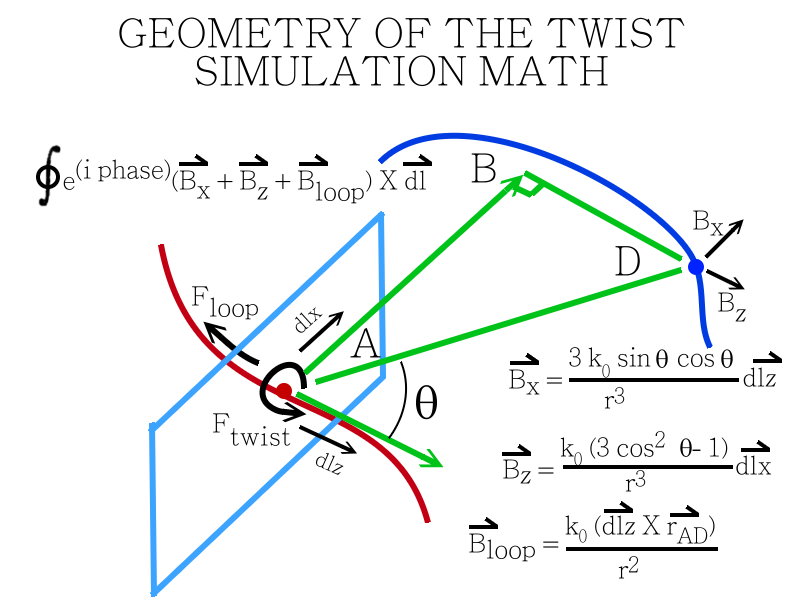
Here is a drawing of the forces on the twist path that the simulator attempts to model.

Here is a drawing of the forces on the twist path that the simulator attempts to model.

I created a picture that hopefully shows the geometry of the simulation math described in the previous post (see in particular the PPS update).  This picture attempts to show a generator twist path about point A in red, with the two force sources F(loop) and F(twist), which are delta 1/r^2 and 1/r^3 flux field generators respectively.  The destination point D path is shown in blue.  The parametric integral must be computed for every source point on each destination point–this will give a potential field.  When the entire set of curves lies on an equipotential path, one of many possible stable solutions has been found (it’s already easy to establish that any topologically unique closed loop solution will not degenerate because the 1/r^3 force will repel twist paths from crossing each other).  There probably is a good LaGrange method for finding stable solutions, but for now I will work iteratively and see if convergence for various linked or knotted loops can be achieved.


Agemoz

Simulation Construction of Twist Theory

December 2, 2014

Back after dealing with some unrelated stuff.  I had started work on a new simulator that would test the Twist Theory idea, and in so doing ran into the realization that the mathematical premise could not be based on any sort of electrostatic field.  To back up a bit, the problem I’m trying to solve is a geometrical basis for quantization of an EM field.  Yeah, old problem, long since dealt with in QFT–but the nice advantage of being an amateur physicist is you can explore alternative ideas, as long as you don’t try to convince anyone else.  That’s where crackpots go bad, and I just want to try some fun ideas and see where they go, not win a Nobel.  I’ll let the university types do the serious work.

OK, back to the problem–can an EM field create a quantized particle?  No.  No messing with a linear system like Maxwell’s equations will yield stable solitons even when constrained by special relativity.  Some rule has to be added, and I looked at the old wave in a loop (de Broglie’s idea) and modified it to be a single EM twist of infinitesimal width in the loop.  This still isn’t enough, it is necessary that there be a background state for a twist where a partial twist is metastable, it either reverts to the background state, or in the case of a loop, continues the twist to the background state.  In this system–now only integer numbers of twists are possible in the EM field and stable particles can exist in this field.  In addition, special relativity allows the twist to be stable in Minkowski space, so linear twists propagating at the speed of light are also stable but cannot stop, a good candidate for photons.

If you have some experience with EM fields, you’ll spot a number of issues which I, as a good working crackpot, have chosen to gloss over.  First, a precise description of a twist involves a field discontinuity along the twist.  I’ve discussed this at length in previous posts, but this remains a major issue for this scheme.  Second, stable particles are going to have a physical dimension that is too big for most physicists to accept.  A single loop, a candidate for the electron/positron particle, has a Compton radius way out of range with current attempts to determine electron size.  I’ve chosen to put this problem aside by saying that the loop asymptotically approaches an oval, or even a line of infinitesimal width as it is accelerated.  Tests that measure the size of an electron generally accelerate it (or bounce-off angle impact particles) to close to light speed.  Note that an infinitely small electron of standard theory has a problem that suggests that a loop of Compton size might be a better answer–Heisenberg’s uncertainty theorem says that the minimum measurable size of the electron is constrained by its momentum, and doing the math gets you to the Compton radius and no smaller.  (Note that the Standard Model gets around this by talking about “naked electrons” surrounded by the constant formation of particle-antiparticle pairs.  The naked electron is tiny but cannot exist without a shell of virtual particles.  You could argue the twist model is the same thing except that only the shell exists, because in this model there is a way for the shell to be stable).

Anyway, if you put aside these objections, then the question becomes why would a continuous field with twists have a stable loop state?  If the loop elements have forces acting to keep the loop twist from dissipating, the loop will be stable.  Let’s zoom in on the twist loop (ignoring the linear twist of photons for now).  I think of the EM twist as a sea of freely rotating balls that have a white side and a black side, thus making them orientable in a background state.  There has to be an imaginary dimension (perhaps the bulk 5th dimension of some current theories).  Twist rotation is in a plane that must include this imaginary dimension.  A twist loop then will have two rotations, one about the loop circumference, and the twist itself, which will rotate about the axis that is tangent to the loop.  The latter can easily be shown to induce a B field that varies as 1/r^3 (formula for far field of a current ring, which in this case follows the width of the twist).  The former case can be computed as the integral of dl/r^2 where dl is a delta chunk of the loop path.  This path has an approximately constant r^2, so the integral will also vary as r^2.  The solution to the sum of 1/r^2 – 1/r^3 yields a soliton in R3, a stable state.  Doing the math yields a Compton radius.  Yes, you are right, another objection to this idea is that quantum theory has a factor of 2, once again I need to put that aside for now.

So, it turns out (see many previous posts on this) that there are many good reasons to use this as a basis for electrons and positrons, two of the best are how special relativity and the speed of light can be geometrically derived from this construct, and also that the various spin states are all there, they emerge from this twist model.  Another great result is how quantum entanglement and resolution of the causality paradox can come from this model–the group wave construction of particles assumes that wave phase and hence interference is instantaneous–non-causal–but moving a particle requires changing the phase of the wave group components, it is sufficient to limit the rate of change of phase to get both relativistic causality and quantum instantaneous interference or coherence without resorting to multiple dimensions or histories.  So lots of good reasons, in my mind, to put aside some of the objections to this approach and see what else can be derived.

What is especially nice about the 1/r^2 – 1/r^3 situation is that many loop combinations are not only quantized but topologically stable, because the 1/r^3 force causes twist sections to repel each other.  Thus links and knots are clearly possible and stable.  This has motivated me to attempt a simulation of the field forces and see if I can get quantitative measurements of loops other than the single ring.  There will be an infinite number of these, and I’m betting the resulting mass measurements will correlate to mass ratios in the particle zoo.  The simulation work is underway and I will post results hopefully soon.

Agemoz

PS: an update, I realized I hadn’t finished the train of thought I started this post with–the discovery that electrostatic forces cannot be used in this model.  The original attempts to construct particle models, back in the early 1900s, such as variations of the DeBroglie wave model of particles, needed forces to confine the particle material.  Attempts using electrostatic and magnetic fields were common back then, but even for photons the problem with electrostatic fields was the knowledge that you can’t bend or confine an EM wave with either electric or magnetic fields.  With the discovery and success of quantum mechanics and then QFT, geometrical solutions fell out of favor–“shut up and calculate”, but I always felt like that line of inquiry closed off too soon, hence my development of the twist theory.  It adds a couple of constraints to Maxwell’s equations (twist field discontinuities and orientability to a background state) to make stable solitons possible in an EM field.

Unfortunately, trying to model twist field particles in a sim has always been hampered by what I call the renormalization problem–at what point do you cut off the evaluation of the field 1/r^n strength to prevent infinities that make evaluation unworkable.  I’ve tried many variations of this sim in the past and always ran into this intractable problem–the definition of the renormalization limit point overpowered the computed behavior of the system.

My breakthrough was realizing that that problem occurs only with electrostatic fields and not magnetic fields, and finding the previously mentioned balancing magnetic forces in the twist loop.  The magnetic fields, like electrostatic fields,  also have an inverse r strength, causing infinities–but it applies force according to the cross-product of the direction of the loop.  This means that no renormalization cutoff point (an arbitrary point where you just decide not to apply the force to the system if it is too close to the source) is needed.  Instead, this force merely constrains the maximum curvature of the twist.  As long as it is less that the 1/r^n of the resulting force, infinities wont happen, and the curve simulation forces will work to enforce that.  At last, I can set up the sim without that hokey arbitrary force cutoff mechanism.

And–this should prove that conceptually there is no clean particle model system (without a renormalization hack) that can be built from an electrostatic field.  A corollary might be–not sure, still thinking about this–that magnetic fields are fundamental and electrostatic fields are a consequence of magnetic fields, not a fundamental entity in its own right.  The interchangability of B and E fields in special relativity frames of reference calls that idea into question, though, so I have to think more about that one!  But anyway, this was a big breakthrough in creating a sim that has some hope of actually representing twist field behavior in particles.

Agemoz

PPS:  Update–getting closer.  I’ve worked out the equations, hopefully correctly, and am in the process of setting them up in Mathematica.  If you want to make your own working sim, the two forces sum to a flux field which can be parametrically integrated around whatever twist paths you create.  Then the goal becomes to try to find equipotential curves for the flux field.  The two forces are first the result of the axial twist, which generates a plane angle theta offset value Bx = 3 k0 sin theta cos theta/r^3, and Bz = k0 ( 3 cos^2 theta -1)/r^3.  The second flux field results from the closed loop as k0 dl/r^2).  These will both get a phase factor, and must be rotated to normalize the plane angle theta (some complicated geometry here, hope I don’t screw it up and create some bogus conclusions).  The resulting sum must be integrated as a cross product of the resulting B vector and the direction of travel around the proposed twist path for every point.