Posts Tagged ‘relativity’

General Relativity and the 3D Hypersurface Activation Layer

February 13, 2025

Dr. Hossenfelder states that our universe includes all of 4D spacetime (what she calls the “Block Universe”), rather than just the 3D hypersurface we exist in and can observe. She uses the observer dependent event timing of special relativity and the overall spacetime curvature math of general relativity to make her case, and this view appears to be shared by physicists in general, including Dr. Thorne, the science adviser for the movie Interstellar. I disagree, and in previous posts I’ve detailed my claims and the evidence backing the Activation Layer concept (that is, that we exist in a single curved 3D slice, or hypersurface, within 4D spacetime that moves in the time direction). To be able to substantiate my claim, I must look at how special and general relativity would exist in within this Activation layer without requiring connections to other hypersurfaces or anything else in 4D spacetime.

In my previous post, “Special Relativity and the 3D Hypersurface Activation Layer” (https://wordpress.com/post/agemozphysics.com/1989), I show how special relativity is an observation effect that results because the observer’s frame of reference affects event simultaneity only for that observer–his frame of reference does not affect any event behavior that other observers see (unless they are observing that first observer). In that post I show how the wavelike construction of elementary particles results in the observation effects seen in special relativity, and how nothing outside of our 3D Activation Layer hypersurface existence is needed to explain special relativity.

General relativity is different in that all observers will see spacetime curvature, it affects all objects and fields within our universe. In this post, I will show how general relativity can exist solely within our hypersurface.

General relativity does not need anything outside of our Activation Layer hypersurface (although it is clear that the hypersurface must curve according to Einstein’s stress-energy tensor equation). You can see this if you look at how stress-energy tensors are defined as 4 dimensional entities, such as a t,x,y,z functional matrix. All contributions to the stress-energy tensor at a given point must either be local or propagate causally through the Activation Layer. This tensor then sets up spacetime curvature via a 4 dimensional metric, that when multiplied by a translation or rotation operator defines how that translation or rotation occurs within that curved spacetime–but within the Activation Layer hypersurface. We can then use LaGrangian equations of motion or other tools to find the path (e.g, a planetary orbit) taken in our potentially curved hypersurface.

Note, I’m only going to talk about what general relativity requires within standard 4D spacetime–hypothetical extradimensional theories will create exceptions, and yes, spacetime curvature can be affected by masses in other hypersurfaces–but general relativity does not require those. It can wholly exist and operate within our existence as a 3D hypersurface moving in the time dimension within 4D spacetime. If we could show the existence of stress-energy tensors that required sums over multiple times (multiple hypersurface x,y,z points) that didn’t just propagate their effect through our Activation Layer, then the Block Universe concept would have to be true, but my research shows no such entity has been proven to exist. To reiterate–nothing from outside our hypersurface existence is required for general relativity to hold.

Dr. Hossenfelder believes that our past is left behind in an accessible set of successive hypersurfaces, sort of like the tesseract we see in the movie Interstellar, and should be accessible. I claim that the mass and resulting curvature induced by such an enormous object as the tesseract makes such a conclusion impossible. Within the limits of what we have observed in the cosmos, no such masses exist outside of our Activation Layer hypersurface. These copies of the past are not necessary for any aspect of either special or general relativity, thus, the Activation Layer is necessary and is also sufficient for our existence.

Agemoz
Activation Layer Deep Dive, Continued: Does Time Variation of Special Relativity Contradict the Activation Layer Hypothesis?

February 21, 2023

I have postulated that existence as we know it is confined to a 3D slice, a hypersurface isotropic in time, of 4D spacetime I call the activation layer. I’ve discussed in previous posts that this activation layer is why observers only are aware of one instance of time at any given point in time, and that interactions are confined to the activation layer. I’ve previously posted that this shows why we don’t get visits from the future and will not be able to observe or interact with our past selves–the activation layer is the only one of an infinite number of hypersurfaces in spacetime where observation and interactions occur. There is no existence in non-activated hypersurfaces, even if you use a wormhole to travel to them.

In previous posts (https://agemozphysics.com/2023/02/08/space-time-activation-layer/ and https://agemozphysics.com/2023/02/14/gravity-and-the-activation-layer/), I show how the timewise motion of the activation layer concept leads to why we experience the acceleration factor g of gravity. An object in the activation layer literally moves forward in spacetime, so if the spacetime region is curved, it experiences a force identical to the straight-line path of an orbiting planet in a curved spacetime. Einstein’s equivalence principle where inertial behavior cannot be distinguished from object motion in a gravitational field, therefore becomes an identity, and gravitational force becomes an illusion.

However, hypotheses such as the activation layer can sound good but fail as a representation of truth if something is found that leads to contradictions. In the last month or so I’ve been looking for both contradictions or ways to prove the hypothesis.

I always thought Neil Bohr’s “not even wrong” quote meant that he thought an idea was stupid because of a lack of knowledge or a faulty conclusion, but recently I learned that this is not the case. He meant that the idea was such that it could not be proved (or disproved) and thus was worthless to the progress of science. What I’m trying to do with with these posts is to address whether there is truth here and whether there are consequences (not “not even wrong”).

One really big elephant in the room for the activation layer hypothesis–cliche for an obvious objection–is that even in flat spacetime, clocks can progress at different rates for different observers (with different frame of reference velocities)–the obvious example being the twins paradox. Historically, the documented reason Einstein worked on general relativity was to extend the laws of special relativity to the curved spacetime of gravitational fields. The activation layer concept depends on the use of a time-wise isotropic hypersurface that always moves forward in time. How do we get different clock observations if time progresses identically everywhere in the activation layer?

Here is why I don’t think that is a showstopper: the activation layer forward time motion is the engine that powers the motion of every clock everywhere in the layer, but the rate of aging–the speed at which a clock ticks or the age of an observer–can vary depending on the observer’s frame of reference and the curvature of the activation layer in his local neighborhood. In other words, the word time is used to represent two different things. Declaring that time cannot be identical for every observer in the universe is ignoring the difference between the forward progress of hypersurfaces in 4D spacetime and the property of aging (clock ticking rate) for a given observer or entity within a hypersurface.

Here is an example of how to distinguish the two meanings of time. Mathematically, g is an acceleration factor dependent on the speed of the activation layer surface in time (the isotropic hypersurface time) and the curvature of the surface. You have to multiply it by a local observer’s time^2 (the observer’s aging rate, dependent on the locally applied laws of special relativity) to get the total effect of gravity on that observer’s awareness of time passing.

I will continue my deep dive into the activation layer with more posts to come. Next will be a discussion about why the activation layer hypothesis leads to one of the two postulates of special relativity, the speed limit set as the speed of light.

Agemoz

Space-Time Activation Layer

February 8, 2023

In my last post, I described the well-known idea that a wormhole connecting past and present via the folding of spacetime is believed to allow travel to (or direct observation of) a past point in time for an observer. I predicted that the outcome will be disappointing, because while it should be possible to travel to a past point in time, I argue that there will be nothing there.

As I discussed, this is because R3 + T spacetime cannot be a complete description of our world–we are also constrained by something I called the activation layer. This activation layer is a three-dimensional slice of our four dimensional spacetime and our interactions and observations are confined within this slice. This activation layer is a necessary constraint for an observer to only see at one point in time (rather than seeing an event at all points in time simultaneously).

I found it odd that you can find physics papers and texts on every conceivable subject except this one. To me, this is an obvious constraint on our ability to observe our existence that is sitting right in front of our noses, yet as far as I can see, no one studies it! I have a pile of physics texts, such as the MTW Gravitation text, and I see no hint of this constraint even under some other name. Perhaps you all see something obvious here I’m missing.

So, let’s take a brief tour of the properties this thing, the activation layer, must have. There’s some easy observations we can make–low hanging fruit, to use a cliche.

It has to be a three dimensional surface that cuts 4D spacetime in half–the past (negative time), now (0 time, a 3D “plane”) and the future (positive time). The zero time “plane” is the only point in time we can observe or interact. Note that I’m specifically not referring to an observer’s lightcone, which is the set of possible spacetime points he eventually could interact with given the passage of time.

Is it flat–an Euclidean slice through spacetime? Of course not, otherwise the curved spacetime of general relativity is going to cause major-league observational contradictions as observers see constantly varying time points throughout space. The very nature of the activation layer means that observation of objects will pop in and out of existence in curved spacetime (the same reason why time travel to a past time will show nothing there).

Is the activation layer the same for every observer or is it a property that varies from observer to observer? Once again, if it varies between observers, then you can set up situations where some observers will see something that other observers will not. Conservation laws say it has to be common to every observer, even every entity, in the universe.

Does the activation layer move? Well, this is a bit semantic, since we observe that time passes, that objects move, and so on–kind of a recursive question about the activation layer that mathematicians love. However, I will just reply that since we observe clocks progress, not regress, everywhere in space, and there are no exceptions we can see–I am going to define every point in the activation layer at time 0 moves forward along the time dimension, even if this dimension curves or varies in direction and velocity depending on where you are and how you are moving in space. What it means for a layer to “move” along a time dimension is a really complicated concept to grasp.

Does the activation layer possess energy or is it affected by force? Now we are starting to get at the heart of how our universe works with this question. Another way to ask it is simply–Why is it there? It’s clear that the stress-energy tensor has to affect its curvature, so concentrations of any forces in a region are going to also affect the layer. However, forces will only affect it indirectly, by curving the spacetime it lies in. Asking whether it possesses an energy or mass is a really interesting question, I’m going to continue to study that idea. I suspect the answer will be no, otherwise there should be cases where the activation layer would exert gravitational force that should be observable, for example, around a black hole or in large scale cosmology.

Lastly, for now, how does this affect our quantum theories? From what I know, all quantum interactions, including entangled particles, must lie within the activation layer of spacetime. You cannot have entangled particles at the same physical point but one is in the past and one is in the future. Wave interference is clearly confined to within the activation layer, but we see quantum field theory suggesting past/future wave and elementary particle interactions. The activation layer is going to have significant implications that I am just beginning to think about.

Could the activation layer give us clues how to connect relativity and quantum theory? Could it give us insight into why gravity does what it does? I don’t know at this point. It certainly seems like the activation layer, right in front of our noses, needs to be studied. I’ll continue down this path for a while.

Agemoz

Central Force Charge Infinities

March 26, 2021

In the last post, I stated that if an electron were truly an infinitely small point, and electrostatic fields obeyed the central force relation where force decreases with the square of distance, we should see electrons able to achieve very high velocities. There is an analogy with gravitationally driven masses that slingshot around other masses and gain sufficient momentum to exit the solar system. For example, the P orbital (second excitation state of electrons in an atom) has a probability distribution that intersects with the nucleus, so close encounters should cause large central force acceleration such that the electron would be ejected from the atom at high velocity. We never see this happen for stable atoms, so I concluded that one or more of our assumptions has to be wrong. Either the electron is not a point, or electrostatic fields do not follow the 1/r^2 decrease in strength away from a charge source.

I think enough experiments have been done to show that the bare electron has to be a point as far as we are able to measure. I think trying to find a solution that depends on a significant electron radius is a lost cause.

However, I have posted many times working out ideas how the electrostatic field has to be exerted via sinusoidal waves. We already see wave behavior from quantum particle experiments, so I ran several simulations that showed how charged particles are displaced, either as attraction or repulsion, via quantum interference–waves summing to form interference patterns defining particle location probability bands. This led to the hypothesis that charge forces are a consequence of quantum interference, and that the electromagnetic field consists of waves.

Recently I’ve been questioning why quantum field theory has to use renormalization to cancel out infinities caused by the central force behavior of electrostatic fields. This (and the gravitational mass analogy positing spontaneous expulsion of electrons from atoms) has led me to think that modelling the field as a 1/r^2 central force field is incorrect. I conclude that the electrostatic field near a point charge has to be represented by a probability amplitude, not of 1/r (which would yield a probability distribution of 1/r^2), but must also include its wavelike nature. This means that the probability amplitude would be a sync function: Sin[r]/r, giving a probability distribution of Sin^2[r]/r^2. Now we should not need to renormalize, and we also would no longer have the possibility of electron expulsion from an atom. We still retain quantum properties such as the wavelike interference behavior of particles, but will no longer have infinities caused by a pure central force field.

Agemoz

Electrons and Charge Central Force Equation

March 21, 2021

The Standard Model describes probability distributions for particle motion and interactions, but does not tell us why we have the particle masses and charge forces we can experimentally observe. I’ve found two concepts that can be tacked on to the model–the proof that particles that experience the properties of special relativity have to be composed entirely of waves (see the paper referenced below) and that E=hv implies that particle wave components can be modelled as twists in a unitary vector field in R3+I+T (agemoz.wordpress.com/2021/01/23/unifying-the-em-interactions/). I am very certain of the former, and think the latter is the most likely of all alternatives I can think of.

Since then, I have tried to synthesize hypotheses that would result. Previous posts show how I understand the difference between virtual particle and real (on-mass shell, e.g., conserves momentum at any point in time) particles as partial/returning twists and complete quantized twists respectively. I wrote how real photons have quantized twists with angular momentum through the axis of travel, thus providing the polarization degree of freedom.

Electrons are much more difficult because experiment shows they are infinitely small point particles. So many people have proposed variations of the DeBroglie standing wave in a circle using EM fields–but these cannot explain why experiment collisions show the point particle radius is smaller than any measurable constant. I am certain that EM fields cannot work for many reasons (discussed in previous posts) but even a loop in the unitary twist vector field doesn’t explain the unmeasurably small radius of the electron. In order to define the difference between photons, and to explain photon capture by an electron, whether free or bound to an atom, I saw years ago that a twist loop would be a great explanation (photons try to go through the loop center field region, but at the moment of collision creates a momentary standing wave reflection that cancels itself out, causing a transfer of angular momentum to the electron). But this can’t work if the electron is a point particle. I thought of a new reason to dispute the zero electron radius assumption.

Admittedly, the bare electron doesn’t exist in the real world as a point–it is surrounded by a cloud of particle/anti-particle creation/annihilation operators. The problem remains, however–the central force nature of the EM field forces quantum field theory to renormalize out infinite forces arbitrarily close to the electron inside the cloud.

Renormalization is necessary because of the central force nature, the strength of the field varying as 1/r^2, of the EM field–the charge of the electron produces this field which then impedes the motion of the electron to some extent. This field strength asymptotically goes to infinity as you approach the electron, that is, as r goes to zero. If the electron is truly point sized, we have to compute the effect of the field arbitrarily near the electron, and the only way to get non-infinite results reflecting reality is to arbitrarily cancel out the field infinite forces near it.

There’s a really interesting way to look at the central force equation near point particles, and it comes from the behavior of gravitational masses. Gravitational particles can experience infinite central force behavior, or more accurately, forces far beyond the energies present in the local region of the system. Look at the particle jets emitted from spinning black holes–the masses present in the jets are accelerated to incomprehensible velocities. We see the same thing when a spacecraft swings close enough to a planet to give it enormous kinetic energy, sufficient to rocket it out of the solar system like the Voyager spacecrafts.

It suddenly hit me–we do not see this happen with electrons! Even the most powerful collisions at CERN never shows this asymptotic slingshot behavior–the interaction momentums are always conserved. I think we will find answers to the nature of electrons by comparing the two systems. The potential energy near a gravitational mass can become enormous as the radius of the mass gets smaller, but this doesn’t happen for particles! Why not? One thing is for sure–the fact that we see no jets or massively accelerated particles in electron interactions means that the existence of an infinitely small point electron in a central force EM field, the central assumption of quantum field theory renormalization, cannot be an accurate description of reality.

Agemoz

Quantum Interference as a Cause For Charge Force

October 26, 2020

In the previous post, I posited that the difference between radiation pressure and charge force, both of which are mediated by photons, is due to different properties of photons. Radiation pressure is due to the ability of massless photons transferring angular momentum from a source such as atomic electron state changes to a destination (which also could be an atomic electron that changes state). Charge force cannot be the result of a momentum exchange, otherwise energy would not be conserved–charge forces exert continuously in all directions simultaneously. Nor could you have attractive forces, since momentum transfer is observably always positive, not negative. To address the fact that we know charge forces are mediated by photons, but cannot be transferring energy, I had posited that quantum interference (which redirects particle paths without expending energy) is responsible for charge force. This scheme does allow for negative momentum transfer necessary for charge attraction. However, I now see that this approach cannot work, at least in the way I have proposed.

A problem with this idea is that quantum interference requires identical frequency waves from two sources, or from the same source but via different paths. I can readily model charge attraction via quantum interference in my simulator (see many previous posts on attraction force simulations). However, this approach gets into trouble for two reasons–one is that charge is constant, but waves from a source particle can Doppler shift if the source is moving relative to the destination. If charge forces are due to quantum interference, the wave and the destination particle will have to have the same frequency when they meet, and Doppler shifting of a moving source particle means they won’t have the same frequency and won’t interfere.

The bigger problem with this approach comes from trying to explain the central force behaviour of charge. I had assumed that charge force, which decreases as the square of the distance from the source, was a result of the granular distribution of photons from the source. Any given neighborhood volume at a radius r from a source is going to occupy a percentage of the total surface area at that radius r. If there is a fixed emission of photons from the source, there will be a fixed distribution of photons within a surface area that varies as r^2, hence the central force dropoff of charge force (a generalization results than any system with quantized particles will observe central force behaviour). If the charge force is mediated by quantized photons, this works–but that cannot be, because then you have energy transfer that would dissipate the source mass. But if quantum interference of waves is the cause of charge force, then you don’t have particle quantization needed to get the central force 1/r^2 dropoff in charge field strength.

This is a variation of the quantum wave vs. particle dilemma. Photons act like waves or particles depending on the circumstances. However, neither particles (quantized photons) nor waves (quantum interference) explain charge forces. It appears to be some combination of both. Further work is needed before a satisfactory answer is found.

Agemoz

Linear Momentum Doesn’t Exist

August 19, 2020

That should be a controversial title and garner an immediate rejection from every physicist (I have lots of practice with that). However, it appears to be true as a model for our real world! Let me see if I can explain why I think this way.

I have been working on a simulator which models reality using a unitary vector rotation field with instantaneous quantum interference waves (not an EM field, a failed approach tried by many researchers in the past and even recently–reference DeBroglie, Compton, etc). Because this field has a background state, rotations are quantized, and these rotations generate waves mathematically identical to quantum interference components. By default, rotations propagate in R3 on a linear path and are modelled as photons, but two or more rotations can generate interference patterns that can form closed loops. These closed loops are modelled to be stable or unstable elementary particles. For more information on the details of these conclusions, you can reference previous posts on this website.

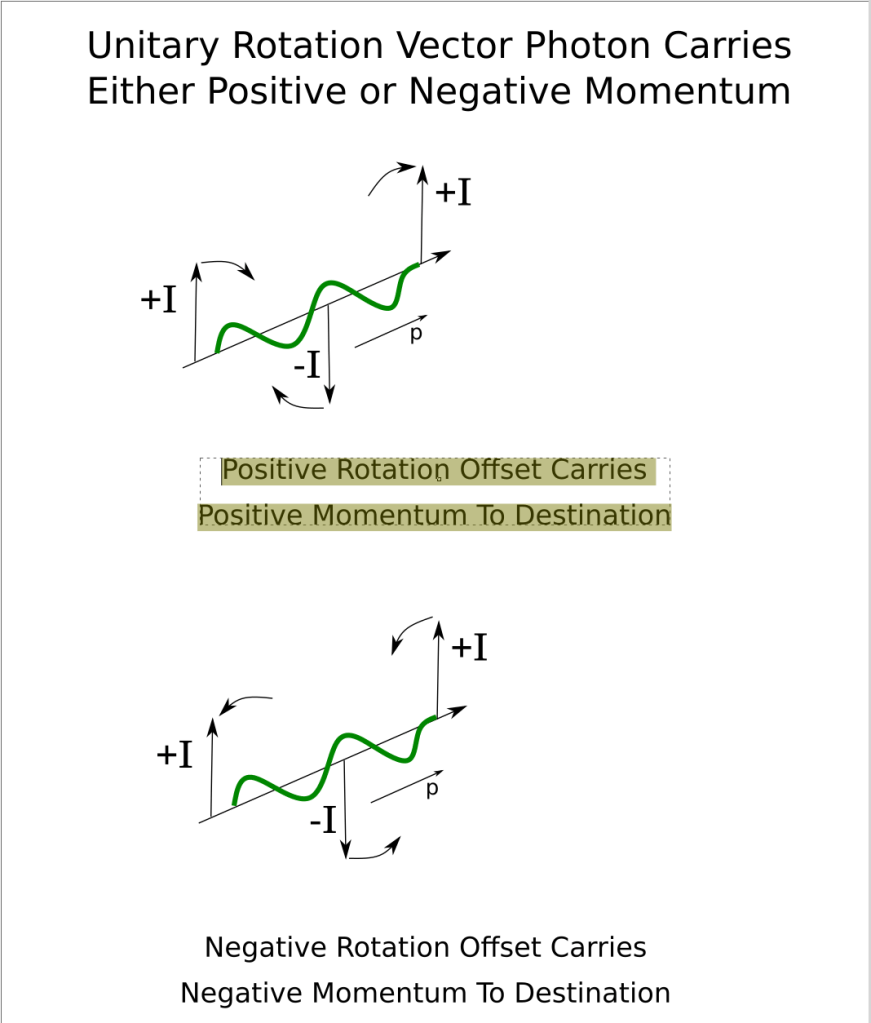
Two of the most important derivations from this work are the emergence of the constant speed of light from any wave based model of reality (see this paper: group_wave_constant_speed) , and the prediction for negative momentum carrying photons labelled antiphotons, which have yet to be discovered. Linearly propagating field rotations acting as photons (or antiphotons) carry momentum at speed c from source to destination, but being intrinsically massless, do not have any momentum of their own.

It is well known that photons emerge from atoms when bound electrons change state, that is, fall to a lower energy state. Alternatively, the atom can capture an incoming photon by raising the energy level of a bound electron. In the unitary rotation vector field theory, the electron emits a photon as a full field rotation with a specific angular momentum. At first glance, I concluded that the linear momentum of the electron gets converted to angular momentum to a linearly propagating rotation–a photon. When the photon is absorbed, the photon’s angular momentum gets converted to linear momentum in the target particle.

However, I ran into problems trying to incorporate this exchange in my simulation. Essentially, a photon interacting with a target electron (linear momentum exchange) or vice versa, was getting too much energy and not matching reality. I finally figured out what was wrong–the concept of linear momentum gets in the way of reality. There can be no such thing as linear momentum! It is an illusion caused by a particle that consists of closed loop field rotations, that is, it has angular momentum confined inside a finite region.

What actually happens when a particle is observed to have linear momentum is that the particle rotations are waves, and increasing the relative velocity of the particle does not add linear momentum. Instead, it causes the particle component composite waves to Doppler shift (note that in all cases in this post, I refer to classical Doppler shifting, not relativistic). When this Doppler shifted wave strikes some other object, the object receives an energy proportionate to the Doppler shifting, which is directly proportionate to the relative velocity of the particle. The Doppler shifting of the angular momentum of the particle is sufficient to explain the momentum change of the target particle, so the standard physics principle of linear momentum cannot actually exist.

The fundamental discovery here is this: The transfer of momentum from photon to electron or vice versa is entirely a transfer of angular momentum that can get Doppler shifted into higher or lower frequencies and hence higher or lower levels of angular momentum (and hence kinetic energy). Our reality, at least in this model of the universe, does not provide for the existence of linear momentum of objects!

Agemoz

Defining a Unitary Rotation System Interaction

November 17, 2019

The new quantum interference interpretation described in previous posts provides a great connection between Newtonian physics, special relativity, and quantum mechanics.  I wrote a paper on it (group_wave_constant_speed), and then began working out a mathematical model that uses the main premise of the interpretation (particles form from a sum of instantaneous phase waves).  I’m taking some time from that work to post this progress report–a list of assumptions and structures I am assuming in this model, along with an effort to justify them.

The first question that has to be answered is whether the precursor waves (the instantaneous phase group wave described in the paper) can be modeled as single valued or can be superposed on each other in a linear combination.  Since I’m trying to construct a model representing the real world, I chose the E=hv relation to help answer this question.  This equation specifies that a given frequency can only have one energy for a quanta of that frequency, so that constrains the precursor field to just a single degree of freedom.  That strongly implies that a geometrical/mathematical model of a quanta must be a single unitary twist in some vector field.  In order to anchor this twist to a single rotation, there must be a lowest energy background state for the rotation, with a cost applied to any deviation from the background state.  This locks in the rotation to a single state.  If we allow the rotation vector to have a magnitude, we have too many degrees of freedom for E=hv to hold, so that means several things–first, that the rotation vector space is unitary, and secondly single valued–you cannot put two waves on top of each other in this field.  This has the additional effect that the field is blocking–you cannot pass information through a limiting neighborhood of a field without altering the vector orientation in that neighborhood.

The background vector state cannot exist in R3 without inducing a detectable dimensional preference in R3 (see Michelson experiment and similar), so I hypothesize a fourth imaginary dimension for it.  I realize that this violates the KISS (keep it simple) premise of science, but I believe it is required and so I assume a unitary four-vector field in R3 + I.  For the time being, time T will be independent of R3 + I but later I will bring in the necessary adjustments for special and general relativity.

With these assumptions in place, we are ready to define the mathematical basis for the precursor field, and make some more assumptions about how particles could interact.

It should be straightforward to define each element of this single-valued rotation field as a unitary three-vector, e.g., x = [xy_rot, xz_rot, and xi_rot] where ||x|| = 1.  Since this is a unitary vector field, no magnitude exists and a fourth vector element is not needed.

Let’s now consider two basic twist types in this vector field and determine a construct for how they will interact.  The first twist type is a linearly propagating twist, a quanta, of one complete cycle from the background state and back again.  The second twist type is a twist loop with one complete cycle (previous posts on this site describe how quantum interference will work to confine such a loop).  Can we propose a model interaction of these two types?  You can see why I propose a single-valued field–multiply-value fields cannot constrain the interaction, and in fact I believe that such a field would cause the two twists to fail to interact at all.  The blocking behavior of the single-valued field is necessary for interaction.

Now, both particles will have a fundamental wave frequency (see the paper for a more specific treatment), so let’s set up an interaction where the linearly propagating twist approaches a stationary twist loop.  We will use conservation of momentum to help constrain what happens.  The momentum of both particles is proportional to the fundamental wave frequency (E=hv, again), so if the linear particle is absorbed by the twist loop, the twist loop will emerge from the interaction with the same momentum as the propagating linear twist.

One promising way to make this momentum transfer work in our R3 + I vector field is to allow momentum transfer only when both particles have parallel vector alignment.  Then in that delta time, a delta momentum (which is inversely proportionate to the linear particle’s wavelength because the orthogonal rotation rate of the linear particle will vary as its frequency) will be exchanged.  Integrating over the time of the linear propagating particle, momentum will be conserved.  Note that only when the linear particle goes through the loop there will be a unique parallel vector alignment.  Nearby particles may have partial rotation absorption, however any virtual particle interaction such as this having an incomplete quantized rotation will fall back to the background state without having transferred a net momentum to the twist loop.

We have shown how the momentum exchange will produce a transfer inversely proportionate to the incoming particle’s momentum, but now we need to de-construct how the motion of the twist loop particle is affected  by this momentum change.  As this post is already too long, let’s start a new post for that…

Agemoz

Physics Paper is Done!

May 3, 2019

I have spent the last two years working hard on a journal paper based on some of the work I’ve discussed on this site.  I learned a lot in the process, for example, the importance of substantiating every claim I made, and making sure the more speculative stuff stays out of the paper.  Take a look if you like!  You may need to download and use a PDF viewer–some of the math equations don’t show correctly in the wordpress viewer.


Here’s the abstract:

The Dirac equation successfully predicts the evolution of probability amplitudes even for relativistic particle interactions, but it is a causal equation and thus cannot predict non-causal quantum interference effects such as quantum entanglement resolution. An extension of the Dirac equation will require a valid quantum interpretation that derives both quantum interference behavior and the special relativity postulate of constant speed in any frame of reference. None of the current quantum interpretations provide the means to derive the special relativity postulate. Therefore, in this study, I assume a quantum interpretation based on a non-causal form of group wave particles.  The study shows that observation of these group wave particles have a constant speed in all frames of reference and thus the quantum interpretation is a valid basis for both special relativity and the Dirac equation. The result of this study is a first step toward building an extension to the Dirac equation that predicts the non-causal interference effects of quantum mechanics.

edit: replaced wrong (older) version of pdf paper

Agemoz

Special Relativity and Unitary Twist Theory

January 30, 2017

I’ve been working diligently on the details of how the quantizing behavior of a unitary twist vector field would form loops and other topological structures underlying a particle zoo. It has been a long time since I’ve talked about its implications for special relativity and the possibilities for deriving gravity, but it was actually the discovery of how the theory geometrically derives the time and space dilation factor that convinced me to push forward in spite of overwhelming hurdles to convincing others about the unitary twist theory approach.

In fact, I wrote to several physicists and journals because to me the special relativity connection was as close as I could come to a proof that the idea was right. But here I discovered just how hard it is to sway the scientific community, and this became my first lesson in becoming a “real” scientist. Speculative new theories occupy a tiny corner in the practical lives of scientists, I think–the reality is much reading and writing, much step-by-step incremental work, and journals are extremely resistant to accept articles that might cause embarrassment such as the cold-fusion fiasco.

Back in my formative days for physics, sci.physics was the junk physics newsgroup and sci.physics.research was the real deal, a moderated newsgroup where you could ask questions and get a number of high level academic and research scientists to respond. Dr. John Baez of UC Riverside was probably one of the more famous participants–he should be for his book “Gauge Fields, Knots and Gravity”, which is one of the more accessible texts on some of the knowledge and thinking leading to thinking about gravity. But on this newsgroup he was the creator of the Crackpot Index, and this more than anything else corrected my happy over-enthusiasm for new speculative thinking. It should be required reading for anyone considering a path in the sciences such as theoretical physics. Physicists 101, if you will–it will introduce you hard and fast to just how difficult it will be to be notable or make a contribution in this field.

I’m not 100% convinced, as I’ve discussed in previous posts, that there isn’t a place for speculative thinking such as mine, but this is where I discovered that a deep humility and skepticism toward any new thinking is required. You *must* assume that speculation is almost certainly never going to get anywhere with journal reviewers or academic people. Nobody is going to take precious time out of their own schedule to investigate poorly thought-out ideas or even good ideas that don’t meet an extremely high standard.

So, I even presented my idea to Dr. Baez, and being the kind and tolerant man he is, he actually took the time review what I was thinking at that time–has to be 20 years ago now! Of all the work I have done, none has been as conclusive to me as the connection to special relativity–but it did not sway him. I was sure that there had to be something to it, but he only said the nature of special relativity is far reaching and he was not surprised that I found some interesting properties of closed loops in a Lorentzian context–but it didn’t prove anything to him. Oh, you can imagine how discouraged I was! I wrote an article for Physical Review Letters, but they were far nastier, and as you can imagine, that’s when my science education really began.

But I want to now to present the special relativity connection to unitary twist theory. It still feels strongly compelling to me and has, even if the theory is forever confined to the dustbin of bad ideas in history, strongly developed my instinct of what a Lorentzian geometry means to our existence.

The geometry connection of unitary twist field theory to special relativity is simple–any closed loop representation of a particle in a Lorentzian systen (ie, a geometry that observes time dilation according to the Lorentz transforms) will geometrically derive the dilation factor beta sqrt(1 – v^2/c^2). All you have to do to make this work is to assume that the loop represention of a particle consists of a twist that is propagating around the loop at speed c, and the “clock” of this particle is regulated by the time it takes to go around the loop. While this generalizes to any topological closed system of loops, knots, and links (you can see why Dr. Baez’s book interested me), let’s just examine the simple ring case. A stationary observer looking at this particle moving at some speed v will not see a ring, but rather a spiral path such that the length of a complete cycle of the spiral will unroll to a right triangle. The hypotenuse of the triangle by the Pythagorean theorem will be proportionate to the square root of v^2 + c^2, and a little simple math will show that the time to complete the cycle will dilate by the beta value defined above.

When I suddenly realized that this would *also* be true in the frame of reference of the particle observing the particles of the original observer, a light came on and I began to work out a bunch of other special relativity connections to the geometry of the unitary twist theory. I was able to prove that the dilation was the same regardless of the spatial orientation of the ring, and that it didn’t matter the shape or topology of the ring. I saw why linear twists (photons) would act differently and that rest mass would emerge from closed loops but not from linear twists. I went even as far as deriving why there has to be a speed of light limit in loops, and was able to derive the Heisenberg uncertainty for location and momentum. I even saw a way that the loop geometry would express a gravitational effect due to acceleration effects on the loop–there will be a slight resistance due to loop deformation as it is accelerated that should translate to inertia.

You can imagine my thinking that I had found a lodestone, a rich vein of ideas of how things might work! But as I tried to share my excitement, I very quickly learned what a dirty word speculation is. Eventually, I gave up trying to win a Nobel (don’t we all eventually do that, and perhaps that’s really the point when we grow up!). Now I just chug away, and if it gives somebody else some good ideas, then science has been done. That’s good enough for me now.

Agemoz