Posts Tagged ‘science’

Unifying the EM Interactions

January 23, 2021

I can get a good sense of what real physicists care about in physics forums such as the old s.p.r. (sci.physics.research) newsgroup or the current https://www.physicsforums.com/#physics.9 website. Quantum gravity/cosmology and neutrino issues seem to dominate. On the engineering side, practical application of quantum entanglement such as quantum computers generates a lot of discussion. I personally don’t feel that pursuing quantum gravity makes sense until we know a lot more about quantum theory–it’s kind of like building an airplane out of black boxes–we don’t know enough. I’d rather try to work out more at the quantum level before bringing in gravity.

As a consequence, I spend time on creating ideas for mathematical structures for quantum field theory. There are so many basic questions here, and the one that really grabs my attention: how are the various EM interactions related, and can I come up with a unifying model that obeys the interaction characteristics? There are four basic types of EM interactions (many others are variations and are not listed here):

EM transaction typecausal?momentum?
radiation pressureyesyes
charge forceyesno
electron self resistanceyesno
quantum interference/entanglementnono

According to quantum field theory, these four interactions are all related to each other by quantized exchanges mediated by photons. The mathematical infrastructure is well established and no physicist bothers with studying why we get the different properties for each. The causal and momentum characteristics are explained as a variation of the wave versus particle perspective–radiation pressure results from true photon particle exchanges, whereas charge force uses virtual photons–interactions off the mass shell that only require energy conservation (net zero momentum) over an arbitrary delta time. On the other hand, quantum interference effects has the math infrastructure but no attempt to interpret that structure as virtual photons or anything else has been established.

So, here we have it–the math works, and no investigation into the why is done. The why is considered an interpretation and is regarded as a philosophical question not deserving of any serious study or grant money and research time. However, I look at those four transactions and wonder what makes them different–are virtual photons really related to true photons, and if so, how?

Here is what I came up with. You don’t have to agree that what I did represents reality, but my thinking process led me down this path. I am attempting to create a model that unifies these EM transactions and formulates a specific geometrical explanation for why virtual photons are different than quantized photons.

To start, I bring in the E=hv relation for quantized photons. This clearly indicates one degree of freedom–frequency, so an EM field (which has both frequency and magnitude, the magnitude dissipates over distance) cannot be used to model a single photon without constraining it somehow. Physics references often show light waves as oscillating E and B fields, but this recursive definition cannot be correct at the quantum level. Whatever field we choose to construct a quantized photon must only allow a frequency component, so this is why I propose an underlying unitary rotation vector field. EM field solutions to electron interactions require renormalization because of its central force behavior, but no such problem exists for this unitary rotation field. This unitary field cannot dissipate to zero–it’s just a rotation field, so zero magnitude makes no sense.

EM fields and particles must then be derivable from this precursor field, see prior posts on this website. Next, there must be a way to ensure a single unit of frequency cycles, because E=hv does not allow a photon with, for example, 1.5 times the energy of a single cycle photon. So… I conceptualized that this means there must be a lowest energy background state for this vector field. A single vector rotation (twist) that starts and stops on the background state. Finally, since there is good experimental evidence that there is no preferred direction in our universe dimension set R3, I proposed that there must be a rotation direction background state I that is normal to our three dimensions.

In this construction, photons form rotation waves in both the R3 and I (imaginary) directions (transforms constrained to SU(4)). Momentum transfer happens when a full rotation occurs from the background state direction all the way around back to the background state direction–this rotation carries momentum. Virtual particles are partial rotations away from the background I state that in a delta time fall back to this background state without having made a complete rotation, never expending a momentum transfer and thus conserving net zero energy. For example, electron self-field resistance, represented in the Standard Model with two types of virtual photon interactions, now becomes a result of electrons moving into a region of partial rotations that counters and slows down the bare electron’s LaGrangian solution to its path in time. I think it’s an elegant solution that gets rid of the renormalization issue in current Standard Model formulations because it eliminates the central force infinity of EM fields. I’ll work on the math for this in a later post (and perhaps a paper).

So far, this model doesn’t seem excessively speculative except for the creation of the I rotation background state, but even that appears to be required (I can’t think of any alternative way) to establish the quantization specified in E=hv. The math for this precursor field exactly matches a limiting case of the quantum oscillator model that sometimes is used to compute quantum mechanics. The unitary twist vector field model now creates a clear picture of the different EM transaction types, specifically how momentum and off-mass-shell behavior works. The model doesn’t have to represent reality–it just needs to map one-to-one to whatever reality actually does. If it does, it becomes a computable representation of reality that can be used to define higher level structures and interactions such as our particle zoo.

Let’s stop here for now and bring in details for the next post.

Agemoz

Time As A Dimension

January 7, 2021

COMMENTARY ON THE RESULTS FROM THE PREVIOUS POST: I realized that confirmation of the mathematical validity of the theory (a group wave composition of wave components will always appear to move at constant speed regardless of the observer’s frame of reference velocity) has much more impact than I first thought. When Einstein discovered the constant speed of light as derived from Maxwell’s equations, he interpreted that to mean that space and time are interchangeable depending on an observer’s frame of reference. From that came the realization that time could be treated as a dimension, and from there on, physics has accepted that as foundational. Dirac’s prediction of antiparticles, and the subsequent experimental verification of antiparticle existence via oppositely curving positrons led Feynman and others to postulate that antiparticles experience time in the reverse direction. Since then, many have attempted to use dimensional time to explain quantum decoherence, unification with gravity, and so on.

The thing I really don’t like about this is that Dirac’s equation results from the incorporation of Lorentz invariance (special relativity) into Schroedinger’s equation, and as such it builds in time-symmetric solutions. So, when Feynman ran into difficulty figuring out how the self energy of an electron in its own field would work, he pulls out the rabbit in the hat–retarded and advanced potentials–that was built in to the Dirac equation. What did they expect–build in negative time, get an answer that includes negative time solutions. I may be naive about what happened but I think Feynman’s famous skepticism took a vacation here. The Dirac equation needs another constraint added to it to make it match reality–the laws of thermodynamics that enforces forward time passage. There must be a negative energy solution to the Dirac equation that does not require a negative time interpretation.

As a result of this thought process, my big problem as an amateur physicist is that I think interpreting time as dimensional is a mistake. I think there is better evidence that time is a property of particles in their own frame of reference. Aside from quantum uncertainty that exists for both space and time, we have no evidence of visitors, particles, or waves, or anything else from the future. If a particle is moving relative to an observer, the apparent time passage that the particle experiences can look different, but isn’t actually different in his own frame of reference. And there’s no question that when a particle is accelerated, time as a property of the particle does slow down relative to a static observer.

The big glaring elephant in the room is the fact that to observe an antiparticle curve in the opposite direction, it has to be moving forward in time, continuously coincident in time with all non-antiparticles. If an antiparticle really were moving backwards in time, it would only exist as a momentary blip in the spacetime plane of normal particle existence. The fact that the constant speed of light has the alternate explanation described in my paper reinforces the idea that interpreting time as a dimension could be a mistake.

Unfortunately, there isn’t a single physicist out there that will go against established theory about time as a dimension, there has been too much published research for them to arbitrarily believe my hypothesis that they all got something wrong. To make matters worse, there is the well deserved disdain for those who claim established physics is wrong–if I were to persist, I would fall into the crackpot trap. I cannot do that. All I can do is say I have my doubts, and that I can show another way this could work that doesn’t require time to be a dimension.

So, what does that mean? Nothing more than that I can continue on uncovering what I can with what I know. But my accepting this result as reality means I will travel alone on this journey, no serious researcher will go with me.

Agemoz

Why Speed of Light is Constant, and What It Tells Us about Quantum Decoherence

December 26, 2020

UPDATE: improved the listed Mathematica code by setting up a Fourier delta function sum to make the constant velocity easier to see, adding better comments, and showing a better view of the functions using different frames of reference.

2ND UPDATE: Fixed missing velocity vr term in Mathematica formula. 3RD UPDATE… arggh, that update wasnt right.. fixed now with matching units. The result where different vr (frame of reference velocity) values result in constant v0 speed is correct. And–one last update to the Mathematica code that adds a negative reference frame velocity–this shows the robustness of the theory, it still maintains constant observed velocity v0 in spite of different observer velocities vr. I updated the pictures to show this new result.

The theory of special relativity is built on the assumption that the speed of light (in a vacuum) is constant. I wrote a proof of a theory why reality has this constant speed:

This derivation shows that in classical physics, any entity composed entirely of waves in spacetime will always appear to be moving at a fixed speed regardless of the observer’s frame of reference relative velocity. If we accept this statement as applying to reality, it should be a logical deduction that as all particles and fields in our reality obey special relativity, they must all be composed entirely of waves in spacetime. If any component internal to a particle is not constructed of waves, it will not Doppler shift, and its velocity will sum with the velocity of the observer’s frame of reference, causing it to disassociate from the rest of the particle.

Why do I mention this now in the midst of my ongoing work on the nature of quantum decoherence (see previous post, where I determine that decoherence cannot be mediated by a spacetime field between entangled particles)? The Standard Model cannot help us resolve what actually happens, but this paper shows there must be a wave basis for all particles. If we also use the accepted knowledge that quantum decoherence is a quantum wave effect (quantum states are represented mathematically as wave functions), we obtain a step forward on the path to resolution.

The paper specifies that a classical physics Fourier sum of waves will always produce an observed constant speed regardless of the observer’s frame speed. Since this conclusion is new (not part of established physics for reality) it is worth understanding why this works in depth, which is why I wrote a mathematical proof. It’s possible to set up a simple geometric simulation using classical Doppler shifting. I set up a very basic Mathematica animation that demonstrates the principle proven in the paper for different frames of reference velocities. You can run it with the simple code I show here:

UPDATE: improved code that ensures that apparent constant speed is observed in one animation, otherwise it’s possible different animations could possibly run at different speeds). Fixed incorrect unit matching in equations.

(* create a Fourier component in spacetime, moving at velocity v0. 
 Offset it in the y direction for visibility. v0 and vr point in 
the positive x  direction. While the ability to use a time-varying 
particle is provided, this  illustration assumes a delta function 
in space only (easier to see the constant speed result) *)
 comp[x_, t_, k_, f_] := Sin[2 Pi (k x - f t)] 
(* Here is a Fourier composition wave that forms a delta function *) 
 ftd[x_, t_, k_, f_] :=  
comp[x, t, k, f] +  
comp[x, t, 2 k, 2 f] + 
comp[x, t, 3 k, 3 f] + 
comp[x, t, 4 k, 4 f] +    
comp[x, t, 5 k, 5 f] 
(* doppler shift the ftd Fourier composite delta function in 
space  depending on the observer's frame of reference speed.  Also,
move x by the frame of reference speed vr. The theory (basis for
wave based particles having a constant speed comes from these
two factors cancelling out, leaving only the original v0. *)
 dsftd[vr_, v0_, x_, t_, k_, f_] := ftd[x-vr, t, v0/(v0 - vr) k, f]
 (* Now plot several frames of reference speed to demonstrate the 
 constant speed of the delta function for each vr (velocity of 
reference frame).  Note an arbitrary constant y is added to the
plots to allow visibility of combined plots. *)
 plotdsftd[vr_, v0_, t_, k_, f_, y_, c_] := 
  Plot[dsftd[vr, v0, x, t, k, f] + y, {x, 0, Pi}, 
  PlotPoints -> 200,    PlotStyle -> RGBColor[c], PlotRange -> {-4, 30}]
 (* to emulate the observer frame of reference, move the emitter 
(and the emitted wave) by some frame of reference speed vr set 
from the emitters point of view, the velocity of the wave causes 
a constant phase shift over time. Doppler shift the spatial 
frequency of waves by 1/vr.  In addition, move the observer's 
frame of reference (x offset) by  vr times t.  You may have 
to slow the animations down.   Now observe that  all velocities 
are the same regardless of the observer's frame of reference speed. *) 
 plotdsftd[0, 0.5, 0, 1, 1, 0, {1, 0, 0}]
 ar = .4
(* Show wave sums, each of four different frames of reference 
velocity.  Observer will see the delta function move at a 
constant speed regardless of the frame of reference velocity *)
 Animate[Show[plotdsftd[0, 1, t, 1, 1, 0, {0, 0, 0}], 
   plotdsftd[-0.3, 1, t, 1, 1, 6, {1, 0, 0}], 
   plotdsftd[-0.5, 1, t, 1, 1, 12, {.5, 0.5, 0}], 
   plotdsftd[-0.8, 1, t, 1, 1, 18, {0, .6, 0}],
   plotdsftd[0.2, 1, t, 1, 1, 24, {0, .6, 1}]], {t, 0, 10, .03}, 
  AnimationRate -> ar]

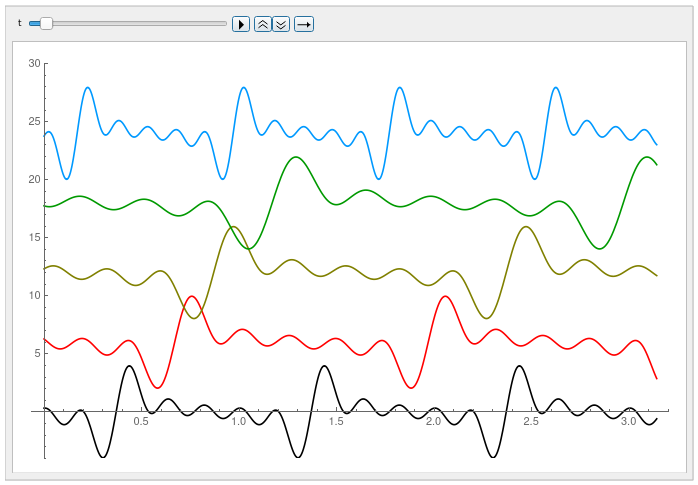
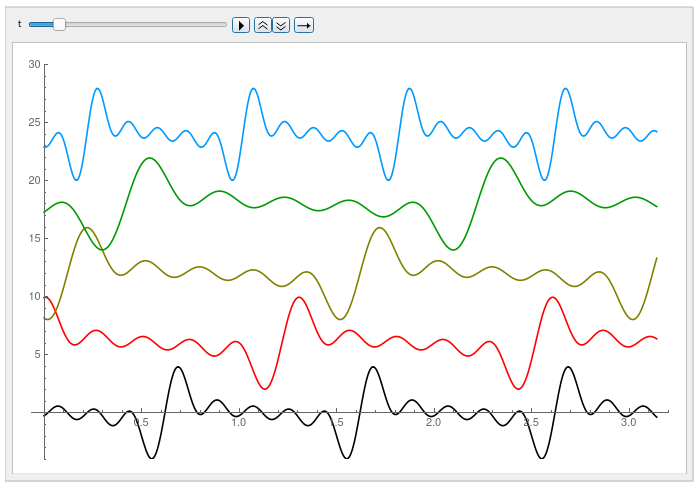
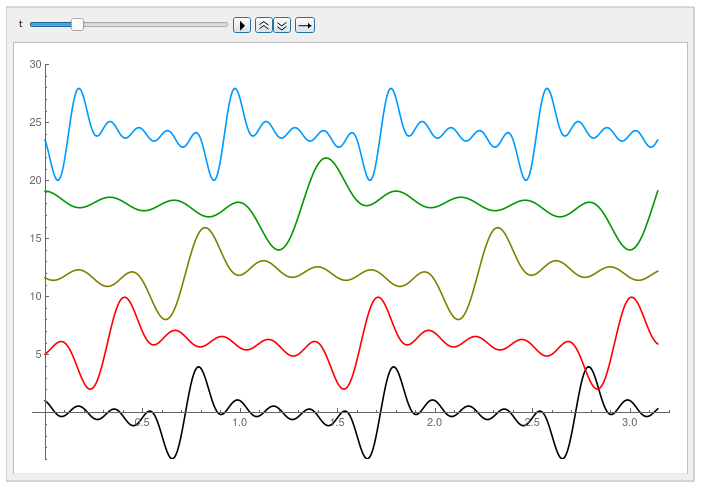
Here are pictures:

Motion of a Fourier wave construction as observed in different frame of reference velocities (-0.2, 0.8, 0.5, 0.2, and 1.0) This view is at time t=0
This view is at time t=7
This view is at time t=14
This view is at time t=23

The examples are all running with different observer’s frame of reference velocities (black=1.0,red= 0.8, brown=0.5, green=0.2, blue=-0.2), yet all are moving at the same velocity. This is a nice demonstration of what I proved in the paper–that objects constructed of waves always appear to move at the same velocity regardless of the observer’s frame of reference velocity.

This is why I strongly believe that reality has the constant speed of light that underlies the principles of special relativity. Note that once you have a constant speed, it is easy to show geometrically that this results in time and spatial dilation by the beta factor used in special relativity–many have done this, and I refer you to papers on Arxiv and other places. Currently, the Standard Model does not postulate a cause for the constant speed, it is one of two assumed postulates that are the foundation for the theory of special relativity. By finding an underlying cause for this postulate, I think we now have a valuable tool for making progress understanding why quantum mechanics, in particular, quantum decoherence and quantum interference, exists. Since all particles can only have wave components, a variety of approaches become available for study, which I will do in following posts.

Agemoz

Is the Quantum Entanglement Connection a Field?

December 16, 2020

In the last post, I postulated that coherence between two entangled particles cannot be a field, and went on to conclude that distance would then have to be an emergent property–that is, the decoherence correlation between entangled force particles does not act over distance but through an unseen “sideband” dimension.

The rules (math) for entangled particles are applied as if entangled particles are a single entity spread over distance, so positing that it doesn’t occur via a connection field is an enormously radical line of thought. I need to be really certain I believe there is no way a field could be responsible for decoherence correlation, so I spent a lot of time thinking of any possible way to prove it or test it. I have a thought experiment (which should be practical to do, construction should be similar to building a quantum computer) which shows you one reason I think this way:

Suppose we construct an entangled particle emitter such that the particles are routed in opposite directions from each other through, for example, a fiber optic cable channel for photons or a fine single atom wire for spin-up/down electrons. We put quantum state detectors several miles away on each end. We set the emitter to periodically emit entangled particles, and check both for loss of coherence due to overlapping coherence connection fields and for correlation between consecutive pairs. Either one would violate quantum mechanics. We know that each pair particle must correlate exactly–a spin up on one entangled particle means the other will always be spin down, so seeing coherency lost would imply presence of a connection field.

UPDATE: eeek, can’t use a fiber optic cable for entangled photons–interaction with atoms in the cable would destroy coherence. Even the electron case with a wire will have the same problem. The channel for particles will have to be a vacuum…

But what about between pairs? If we set up emission rates such that there are, say, thousands of entangled particles in flight at the same time, there will be thousands of connection paths overlapping each other. Since no part of this configuration allows for detection of states until they reach the detector, quantum mechanics says there will be no correlation between pairs. If the connection is a field, this configuration means that coherence has to hold for all pairs in spite of superposition of thousands of connection fields. Since the entanglement states for pairs must be random, a connection field would affect sequences of pairs and we should be able to detect a correlation between pairs. If a connection field is what maintains coherence, we should see both lost coherence cases, and correlation between pairs should start to occur. Entanglement connection fields means that quantum mechanics will be violated even though no detection of particles has occurred.

The tinted boxes represent the connection fields between entangled particles. The overlap region represents altered field values where coherence has to fail (is lost).

Am I certain? Let’s look at a couple ways we could have entanglement connection fields and yet not violate quantum mechanics.

It is possible that by the time the inner (later emitted) particles reach the detectors, coherence will be restored, but that won’t work. All you have to do is insert detectors in between the existing detectors and the emitter at a time just after the pipeline of particles is filled–at a location where many overlapping fields exist, and those detectors will see that coherence is lost and that there will be correlations between pairs.

Another possibility is that the connection fields don’t superpose, but instead repel each other and form smaller channels (strings) so all can fit independently within the particle channel. While possible, this looks like a pretty absurd proposition to me. I’ll keep thinking about this and see if I change my mind. The field behavior in the spin-up/down entangled electron case travelling via a single atom wire would be very complex and improbable in my mind.

As outrageous is my claim that distance is an emergent property and quantum decoherence occurs via an unseen dimension independent of distance, I think there is good evidence for it, or some permutation of it here. Something about decoherence is hidden from us. It cannot occur over distance with fields and the laws of physics we have now.

Agemoz

Quantum Decoherence and the Central Force Law, Part II

December 14, 2020

Continuing my TL:NR post from yesterday, where I evaluated what questions are worth asking about Quantum Decoherence. I stated that I was less interested in the question of how can quantum decoherence be non-causal, and much more interested in the apparently infinite range of quantum coherence. Experiments have shown no limit yet for the separation distance of entangled particles, verifying that the coherent state is maintained for kilometers.

I’m not that interested in non-causality because to me that is the default way the universe works–the appearance of a speed limit (the speed of light) is emergent. We are so used to the speed of light for everything–everything we observe obeys that limit–that we don’t think how oddball that is. In previous posts, I have hypothesized and proven that particles will always observe a speed limit if they are constructed solely of wave components, see this paper:

Non-causality is not as interesting to me because I see that only the motion of a subset of possible universe components (particles, fields based on boson exchanges) have to observe causality. Thorough experimental testing of quantum decoherence timing has made it abundantly clear that some element of particle interaction is non-causal. Jon Bell showed that there cannot be a causal explanation for particle interactions, at least in a local neighborhood of the interaction–he thus showed that no hidden (causal) structure can explain what we observe.

The real mystery to me isn’t non-causality–it’s that coherence can be maintained over an arbitrary distance. I am not seeing any possible default mode (like infinite speed) that can explain this. It is here that I spend a lot of time thinking how this could work. This is a question that is very valuable, very interesting, because the only answers I see require substantial rethinking of how spacetime works.

As I mentioned in the previous post, maintaining coherence requires some type of connection between two entangled states over distance. Trying to enumerate the list of possibilities requires careful semantic evaluation of this statement: we cannot assume, for example, that there are two particles, because entangled particles mathematically compute as a single entity. However, that doesn’t destroy the terminology of the question–whether one system or two particles, or two group waves, or any other entity definition we choose–entangled particles have a connection spread over a significant distance. There is no default mode that allows such a thing to occur, so I attempt to form a complete enumeration of possible elaborations of what the connection is:

a: some type of field between the two entangled particles in our current dimension

b: a sideband path in another dimension

c: default mode of spacetime has space (distance) as an emergent, non-default property. This idea is similar to the emergent property of the speed of light

d: decoherence actually occurs at the emitter for both particles, but appears as if decoherence happens at detection–in other words, contrary to experimental conclusions, the experiment outcome is pre-determined.

e: tachyons–for example, a wave going backwards in time from a future detector to a current-time source

Is this really complete? Probably not, I continue to try to think out of the box for other possibilities. Nevertheless, I have pretty carefully evaluated each of the above, and I think everyone interested in quantum decoherence has spent time investigating one or more of these possibilities.

I rejected option e: tachyons almost immediately–it violates Huygen’s principle since the light cones involved are spherical shells, not laser like rays, and cannot (third law of thermodynamics) arbitrarily focus back on the source emitter. It’s a misunderstanding of Minkowski space geometry to try this as a solution.

Many, many people have tried to come up with a predetermined solution (option d:), I don’t think I need to convince anyone reading this that that doesn’t work. Timed gates used in the Aspect experiment have shown that resolution of the two entangled states doesn’t happen until at the point of detection.

Declaring that the connection is maintained via a field (option a:), or component particles/virtual particles, has been extensively researched. Many experiments have been performed where the connection spatial interval has been blocked during time of flight have failed to destroy coherence. In addition, the connection is maintained over significant distance and even in the presence of many pairs of entangled particles, each of which would have to have its own connection field that doesn’t interfere with other overlapping fields. This field cannot, in theory, ever drop in magnitude to the point where coherence fails. As a result of these thoughts, I have reached the conclusion that there is no field representing the quantum entangled particle connection.

Assuming I have enumerated all possible scenarios (not necessarily a good assumption), that leaves the b: option, the sideband dimension solution or the c: option, the emergent space property. If there is a rolled up or otherwise compactified dimension (option b), this means that all of space, at least as far as the entangled particles are concerned, are locally connected. I realized this is actually another way of saying that space (and potentially spacetime) emerges in this universe–it is an emergent property of our existence, just like the speed of light is emergent from an infinite speed universe. Options b and c are the same, and in my opinion it is this option that describes the quantum entanglement connection.

What results from this conclusion? Is it testable?

More to come.

Agemoz