Posts Tagged ‘special-relativity’

Gravity and Activation Layer Deep Dive

February 18, 2023

In my last post, I postulated that gravity arises from any curved spacetime that has an activation layer that constantly moves forward in time.

In MTW Gravitation, this activation layer would be called a hypersurface that is isotropic in time (a fancy way of saying that the surface is formed such that the time value is constant at all points in space), one of an infinite set of curved 3D surfaces through 4D spacetime. What I add to the concept is that existence as we think of it consists of objects and observers in only one (current time) hypersurface called the activation layer. I think the concept of gravity emerging from a moving hypersurface is a great idea, but as always in science, the devil is in the details. Let’s dive in a bit to see if the activation layer hypersurface has anything new worth investigating.

First, I want to make it clear that my activation layer thinking has to lie strictly within the math of general relativity. I am only proposing a constraint to what it means to exist in spacetime, but I am not proposing any changes to how general relativity computes world lines for objects or observers. The activation layer concept attempts to explain why we only can observe one point in time at a time–something that has to be added to 4D spacetime models of our existence. One interesting consequence of this addition is how gravitational potentials would then arise solely from the timewise motion of the hypersurface activation layer through its enclosing 4D spacetime.

To further clarify, I am proposing that time travel like what was shown in the Interstellar movie won’t work as expected–that any given time point, the only hypersurface that has anything in it is the “current time” hypersurface–the activation layer. Time travel is possible to other hypersurfaces via some mechanism like wormholes, but there will not be activated objects, particles or fields there. There is only one activated hypersurface–the one we are currently in.

This is where my activation layer idea starts, and as I postulated in the previous post, the timewise motion of the hypersurface through successive hypersurfaces in 4D spacetime will trace out worldlines that act as if there was a gravitational force (the Einstein equivalence principle of gravitational forces being indistinguishable from inertial acceleration forces). With this activation layer methodology, I am saying that the equivalence principle is not really an equivalence but rather an identity–they are the same. There is no actual gravitational force, just like there’s no real centripetal force being applied to an orbiting object.

However, for the application layer concept to work, there must be a difference between the current time hypersurface and all other hypersurfaces in 4D spacetime. This is what I am studying and researching. I’m especially interested in how this thinking might be used to determine the gravitational constant from the rate of time passing and spacetime curvature–in other words, the stress-energy tensor G = 8 Pi T.

One thing for sure, and what got me started on this whole thing, the 4D tesseract portrayed in Instellar has to be just completely wrong. Wrong even when accounting for Hollwood dramatization. Wrong even just from an observation point of view, never mind the problem of applying forces from one hypersurface (the activation layer) to another. And where did the photons come from that allows Cooper to see the tesseract? And how is Cooper’s 2D retinal sensors going to select which hypersurface it sees? And how is Cooper’s finger going to selectively apply forces to a watch that apparently exists in all hypersurfaces? The premise that gravitational forces cut across timelines to affect a ticking watch makes no sense–world lines are a reflection of how a hypersurface travels through curved spacetime. I see gravity as a pseudo-force like centripetal force, it’s an illusion.

Update: It has been several years since I read his book (“The Science of Interstellar”), so, because of my current issues with the movie science, I did a re-read of how Dr. Thorne worked out the details. I had forgotten how conscientously he and the movie people tried to get the science right. I feel a renewed push to come to a deeper understanding of where we differ in our thinking, especially in how gravitational waves can travel back in time.

The interesting thing about all this is if the equivalence principle is actually an identity principle, and gravity is just a pseudo force, maybe that will shed new insight on how to unify the math of gravity (general relativity) with quantum theory.

I actually wrote Dr. Thorne about these issues, and to give him credit, he did write back! All he said was… “Read my book.” 🙂

Agemoz

Gravity and the Activation Layer

February 14, 2023

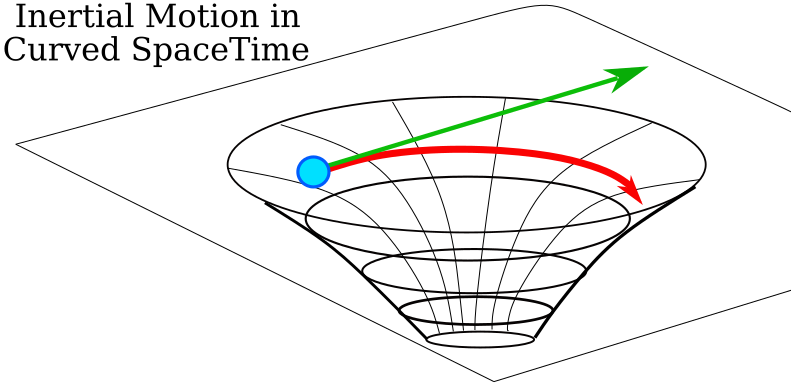
General relativity shows how curved spacetime affects the motion of objects in the neighborhood of a large mass such as a planet or a star. Planetary orbits are described as the path of a planet moving in a straight line on a curved surface.

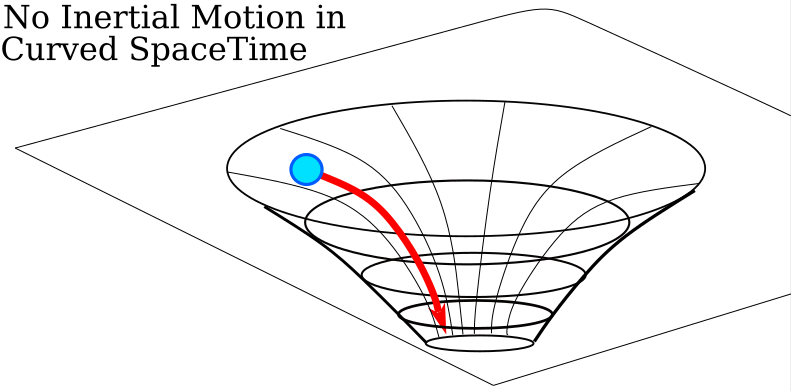
I have had no problem comprehending how curved spacetime would cause a moving object to move in a circular orbit without the application of an arbitrary force, but I’ve always had trouble understanding why a stationary object would move under the influence of gravity. It is not taking a straight line path anywhere regardless of the spacetime curvature it lies in. Why do we experience gravitational force if we are not on an inertial path? The answer I’ve been given is in that case, the object falls down the gravitational well–to which I respond, that’s no answer, you are using gravity to explain gravity! A more rigorous answer will show a path that seeks the lowest energy using something like a Lagrangian equation solution. But I still ask, why would potential energy be higher the further you move away from the gravitational well? It’s still using gravity to explain gravity.

In the last few posts, I have postulated the existence of an Activation Layer, a 3 dimensional slice of 4 dimensional spacetime. This activation layer shows why we only observe objects and interactions at one point in time at any point in time. I worked out some basic principles and properties of this activation layer, and then demonstrated the resulting futility of doing time travel. I showed that the activation layer would have to curve along with spacetime near large masses such as a planet or star, and that the activation layer has to continuously move forward in the time dimension, even if that dimension has been curved due to nearby masses.

I found that the activation layer provides an elegant solution to the gravity problem I describe above. I suddenly realized that even if an object is perfectly still, it will still be residing in the activation layer, which is constantly moving forward along the time dimension. There’s the path we needed! Look at the diagram to see how the activation layer will always tilt toward the gravitational well no matter where the object is. Since the activation layer is always moving forward in time, the tilt of this motion will always take the path of the object forward toward the gravitational well. Even with no initial motion in 3D space, the object will experience a force in that direction. (It’s important not to get confused by the apparent time direction of the activation layer out of the gravitational well–this is an artifact of drawing a 4D image on a 2D surface).

What’s so neat about this is how the activation layer concept shows why gravitational forces emerge from nothing more than curved space time plus the basic axiom that the activation layer always moves forward along the time dimension, even if that time dimension is curved.

Agemoz

Space-Time Activation Layer

February 8, 2023

In my last post, I described the well-known idea that a wormhole connecting past and present via the folding of spacetime is believed to allow travel to (or direct observation of) a past point in time for an observer. I predicted that the outcome will be disappointing, because while it should be possible to travel to a past point in time, I argue that there will be nothing there.

As I discussed, this is because R3 + T spacetime cannot be a complete description of our world–we are also constrained by something I called the activation layer. This activation layer is a three-dimensional slice of our four dimensional spacetime and our interactions and observations are confined within this slice. This activation layer is a necessary constraint for an observer to only see at one point in time (rather than seeing an event at all points in time simultaneously).

I found it odd that you can find physics papers and texts on every conceivable subject except this one. To me, this is an obvious constraint on our ability to observe our existence that is sitting right in front of our noses, yet as far as I can see, no one studies it! I have a pile of physics texts, such as the MTW Gravitation text, and I see no hint of this constraint even under some other name. Perhaps you all see something obvious here I’m missing.

So, let’s take a brief tour of the properties this thing, the activation layer, must have. There’s some easy observations we can make–low hanging fruit, to use a cliche.

It has to be a three dimensional surface that cuts 4D spacetime in half–the past (negative time), now (0 time, a 3D “plane”) and the future (positive time). The zero time “plane” is the only point in time we can observe or interact. Note that I’m specifically not referring to an observer’s lightcone, which is the set of possible spacetime points he eventually could interact with given the passage of time.

Is it flat–an Euclidean slice through spacetime? Of course not, otherwise the curved spacetime of general relativity is going to cause major-league observational contradictions as observers see constantly varying time points throughout space. The very nature of the activation layer means that observation of objects will pop in and out of existence in curved spacetime (the same reason why time travel to a past time will show nothing there).

Is the activation layer the same for every observer or is it a property that varies from observer to observer? Once again, if it varies between observers, then you can set up situations where some observers will see something that other observers will not. Conservation laws say it has to be common to every observer, even every entity, in the universe.

Does the activation layer move? Well, this is a bit semantic, since we observe that time passes, that objects move, and so on–kind of a recursive question about the activation layer that mathematicians love. However, I will just reply that since we observe clocks progress, not regress, everywhere in space, and there are no exceptions we can see–I am going to define every point in the activation layer at time 0 moves forward along the time dimension, even if this dimension curves or varies in direction and velocity depending on where you are and how you are moving in space. What it means for a layer to “move” along a time dimension is a really complicated concept to grasp.

Does the activation layer possess energy or is it affected by force? Now we are starting to get at the heart of how our universe works with this question. Another way to ask it is simply–Why is it there? It’s clear that the stress-energy tensor has to affect its curvature, so concentrations of any forces in a region are going to also affect the layer. However, forces will only affect it indirectly, by curving the spacetime it lies in. Asking whether it possesses an energy or mass is a really interesting question, I’m going to continue to study that idea. I suspect the answer will be no, otherwise there should be cases where the activation layer would exert gravitational force that should be observable, for example, around a black hole or in large scale cosmology.

Lastly, for now, how does this affect our quantum theories? From what I know, all quantum interactions, including entangled particles, must lie within the activation layer of spacetime. You cannot have entangled particles at the same physical point but one is in the past and one is in the future. Wave interference is clearly confined to within the activation layer, but we see quantum field theory suggesting past/future wave and elementary particle interactions. The activation layer is going to have significant implications that I am just beginning to think about.

Could the activation layer give us clues how to connect relativity and quantum theory? Could it give us insight into why gravity does what it does? I don’t know at this point. It certainly seems like the activation layer, right in front of our noses, needs to be studied. I’ll continue down this path for a while.

Agemoz