I did some research to understand the apparent difference between real and virtual photons. This has to be understood since radiation pressure and charge repulsion are models of each, respectively, and are fundamentally different from each other. Radiation pressure is quantized by E=hv and charge repulsion is not–a great example of the particle vs. wave dichotomy. My effort to find a basis for the particle zoo entities has to model this correctly. I have been trying to force-fit the unitary twist vector field into a particle zoo model, but ran into the issue of how to model charge and radiation pressure, or more precisely, the particle vs. wave behavior in real or virtual particles.
I had suspected that I was running into a definition problem: the difference has to do with the mistake of trying to describe real and virtual particles classically. At this tiny scale, defining a point can only be done with probability distributions–a more concrete definition doesn’t work because the actual entity doesn’t exist that way. QFT has various means of computing expected interactions in spite of that, but those of us insisting on a more detailed underlying structure are going to find ourselves without an infrastructure to derive results (and rolled eyes from the researches who understand this). I think I get the picture. The two types of interaction are different, but attempting to model the difference must take into account that geometric definitions such as the unitary twist vector field can’t model the entities very well if at all–the best we can do is the diffuse equations of probability distributions. I got hung up on trying to explain charge and virtual photons and the apparent point size of electrons via the unitary twist vector field, but now I see I really can’t do that.
Unfortunately, probability distributions have yet to show us why we have the particle masses and charge forces of reality. It will require a different approach than what I am doing to get there, though–a unitary rotation vector field might be a starting point, but I’m going to have to rethink the model. The only two clues I have found, other than what we already know from the Standard Model and quantum field theory, is that everything must consist of some type of wave (see this paper):
I can get a good sense of what real physicists care about in physics forums such as the old s.p.r. (sci.physics.research) newsgroup or the current https://www.physicsforums.com/#physics.9 website. Quantum gravity/cosmology and neutrino issues seem to dominate. On the engineering side, practical application of quantum entanglement such as quantum computers generates a lot of discussion. I personally don’t feel that pursuing quantum gravity makes sense until we know a lot more about quantum theory–it’s kind of like building an airplane out of black boxes–we don’t know enough. I’d rather try to work out more at the quantum level before bringing in gravity.
As a consequence, I spend time on creating ideas for mathematical structures for quantum field theory. There are so many basic questions here, and the one that really grabs my attention: how are the various EM interactions related, and can I come up with a unifying model that obeys the interaction characteristics? There are four basic types of EM interactions (many others are variations and are not listed here):
EM transaction type
causal?
momentum?
radiation pressure
yes
yes
charge force
yes
no
electron self resistance
yes
no
quantum interference/entanglement
no
no
According to quantum field theory, these four interactions are all related to each other by quantized exchanges mediated by photons. The mathematical infrastructure is well established and no physicist bothers with studying why we get the different properties for each. The causal and momentum characteristics are explained as a variation of the wave versus particle perspective–radiation pressure results from true photon particle exchanges, whereas charge force uses virtual photons–interactions off the mass shell that only require energy conservation (net zero momentum) over an arbitrary delta time. On the other hand, quantum interference effects has the math infrastructure but no attempt to interpret that structure as virtual photons or anything else has been established.
So, here we have it–the math works, and no investigation into the why is done. The why is considered an interpretation and is regarded as a philosophical question not deserving of any serious study or grant money and research time. However, I look at those four transactions and wonder what makes them different–are virtual photons really related to true photons, and if so, how?
Here is what I came up with. You don’t have to agree that what I did represents reality, but my thinking process led me down this path. I am attempting to create a model that unifies these EM transactions and formulates a specific geometrical explanation for why virtual photons are different than quantized photons.
To start, I bring in the E=hv relation for quantized photons. This clearly indicates one degree of freedom–frequency, so an EM field (which has both frequency and magnitude, the magnitude dissipates over distance) cannot be used to model a single photon without constraining it somehow. Physics references often show light waves as oscillating E and B fields, but this recursive definition cannot be correct at the quantum level. Whatever field we choose to construct a quantized photon must only allow a frequency component, so this is why I propose an underlying unitary rotation vector field. EM field solutions to electron interactions require renormalization because of its central force behavior, but no such problem exists for this unitary rotation field. This unitary field cannot dissipate to zero–it’s just a rotation field, so zero magnitude makes no sense.
EM fields and particles must then be derivable from this precursor field, see prior posts on this website. Next, there must be a way to ensure a single unit of frequency cycles, because E=hv does not allow a photon with, for example, 1.5 times the energy of a single cycle photon. So… I conceptualized that this means there must be a lowest energy background state for this vector field. A single vector rotation (twist) that starts and stops on the background state. Finally, since there is good experimental evidence that there is no preferred direction in our universe dimension set R3, I proposed that there must be a rotation direction background state I that is normal to our three dimensions.
In this construction, photons form rotation waves in both the R3 and I (imaginary) directions (transforms constrained to SU(4)). Momentum transfer happens when a full rotation occurs from the background state direction all the way around back to the background state direction–this rotation carries momentum. Virtual particles are partial rotations away from the background I state that in a delta time fall back to this background state without having made a complete rotation, never expending a momentum transfer and thus conserving net zero energy. For example, electron self-field resistance, represented in the Standard Model with two types of virtual photon interactions, now becomes a result of electrons moving into a region of partial rotations that counters and slows down the bare electron’s LaGrangian solution to its path in time. I think it’s an elegant solution that gets rid of the renormalization issue in current Standard Model formulations because it eliminates the central force infinity of EM fields. I’ll work on the math for this in a later post (and perhaps a paper).
So far, this model doesn’t seem excessively speculative except for the creation of the I rotation background state, but even that appears to be required (I can’t think of any alternative way) to establish the quantization specified in E=hv. The math for this precursor field exactly matches a limiting case of the quantum oscillator model that sometimes is used to compute quantum mechanics. The unitary twist vector field model now creates a clear picture of the different EM transaction types, specifically how momentum and off-mass-shell behavior works. The model doesn’t have to represent reality–it just needs to map one-to-one to whatever reality actually does. If it does, it becomes a computable representation of reality that can be used to define higher level structures and interactions such as our particle zoo.
Let’s stop here for now and bring in details for the next post.
COMMENTARY ON THE RESULTS FROM THE PREVIOUS POST: I realized that confirmation of the mathematical validity of the theory (a group wave composition of wave components will always appear to move at constant speed regardless of the observer’s frame of reference velocity) has much more impact than I first thought. When Einstein discovered the constant speed of light as derived from Maxwell’s equations, he interpreted that to mean that space and time are interchangeable depending on an observer’s frame of reference. From that came the realization that time could be treated as a dimension, and from there on, physics has accepted that as foundational. Dirac’s prediction of antiparticles, and the subsequent experimental verification of antiparticle existence via oppositely curving positrons led Feynman and others to postulate that antiparticles experience time in the reverse direction. Since then, many have attempted to use dimensional time to explain quantum decoherence, unification with gravity, and so on.
The thing I really don’t like about this is that Dirac’s equation results from the incorporation of Lorentz invariance (special relativity) into Schroedinger’s equation, and as such it builds in time-symmetric solutions. So, when Feynman ran into difficulty figuring out how the self energy of an electron in its own field would work, he pulls out the rabbit in the hat–retarded and advanced potentials–that was built in to the Dirac equation. What did they expect–build in negative time, get an answer that includes negative time solutions. I may be naive about what happened but I think Feynman’s famous skepticism took a vacation here. The Dirac equation needs another constraint added to it to make it match reality–the laws of thermodynamics that enforces forward time passage. There must be a negative energy solution to the Dirac equation that does not require a negative time interpretation.
As a result of this thought process, my big problem as an amateur physicist is that I think interpreting time as dimensional is a mistake. I think there is better evidence that time is a property of particles in their own frame of reference. Aside from quantum uncertainty that exists for both space and time, we have no evidence of visitors, particles, or waves, or anything else from the future. If a particle is moving relative to an observer, the apparent time passage that the particle experiences can look different, but isn’t actually different in his own frame of reference. And there’s no question that when a particle is accelerated, time as a property of the particle does slow down relative to a static observer.
The big glaring elephant in the room is the fact that to observe an antiparticle curve in the opposite direction, it has to be moving forward in time, continuously coincident in time with all non-antiparticles. If an antiparticle really were moving backwards in time, it would only exist as a momentary blip in the spacetime plane of normal particle existence. The fact that the constant speed of light has the alternate explanation described in my paper reinforces the idea that interpreting time as a dimension could be a mistake.
Unfortunately, there isn’t a single physicist out there that will go against established theory about time as a dimension, there has been too much published research for them to arbitrarily believe my hypothesis that they all got something wrong. To make matters worse, there is the well deserved disdain for those who claim established physics is wrong–if I were to persist, I would fall into the crackpot trap. I cannot do that. All I can do is say I have my doubts, and that I can show another way this could work that doesn’t require time to be a dimension.
So, what does that mean? Nothing more than that I can continue on uncovering what I can with what I know. But my accepting this result as reality means I will travel alone on this journey, no serious researcher will go with me.
UPDATE: improved the listed Mathematica code by setting up a Fourier delta function sum to make the constant velocity easier to see, adding better comments, and showing a better view of the functions using different frames of reference.
2ND UPDATE: Fixed missing velocity vr term in Mathematica formula. 3RD UPDATE… arggh, that update wasnt right.. fixed now with matching units. The result where different vr (frame of reference velocity) values result in constant v0 speed is correct. And–one last update to the Mathematica code that adds a negative reference frame velocity–this shows the robustness of the theory, it still maintains constant observed velocity v0 in spite of different observer velocities vr. I updated the pictures to show this new result.
The theory of special relativity is built on the assumption that the speed of light (in a vacuum) is constant. I wrote a proof of a theory why reality has this constant speed:
This derivation shows that in classical physics, any entity composed entirely of waves in spacetime will always appear to be moving at a fixed speed regardless of the observer’s frame of reference relative velocity. If we accept this statement as applying to reality, it should be a logical deduction that as all particles and fields in our reality obey special relativity, they must all be composed entirely of waves in spacetime. If any component internal to a particle is not constructed of waves, it will not Doppler shift, and its velocity will sum with the velocity of the observer’s frame of reference, causing it to disassociate from the rest of the particle.
Why do I mention this now in the midst of my ongoing work on the nature of quantum decoherence (see previous post, where I determine that decoherence cannot be mediated by a spacetime field between entangled particles)? The Standard Model cannot help us resolve what actually happens, but this paper shows there must be a wave basis for all particles. If we also use the accepted knowledge that quantum decoherence is a quantum wave effect (quantum states are represented mathematically as wave functions), we obtain a step forward on the path to resolution.
The paper specifies that a classical physics Fourier sum of waves will always produce an observed constant speed regardless of the observer’s frame speed. Since this conclusion is new (not part of established physics for reality) it is worth understanding why this works in depth, which is why I wrote a mathematical proof. It’s possible to set up a simple geometric simulation using classical Doppler shifting. I set up a very basic Mathematica animation that demonstrates the principle proven in the paper for different frames of reference velocities. You can run it with the simple code I show here:
UPDATE: improved code that ensures that apparent constant speed is observed in one animation, otherwise it’s possible different animations could possibly run at different speeds). Fixed incorrect unit matching in equations.
(* create a Fourier component in spacetime, moving at velocity v0.
 Offset it in the y direction for visibility. v0 and vr point in
the positive x  direction. While the ability to use a time-varying
particle is provided, this  illustration assumes a delta function
in space only (easier to see the constant speed result) *)
 comp[x_, t_, k_, f_] := Sin[2 Pi (k x - f t)]
(* Here is a Fourier composition wave that forms a delta function *)
 ftd[x_, t_, k_, f_] :=
comp[x, t, k, f] +
comp[x, t, 2 k, 2 f] +
comp[x, t, 3 k, 3 f] +
comp[x, t, 4 k, 4 f] +
comp[x, t, 5 k, 5 f]
(* doppler shift the ftd Fourier composite delta function in
space  depending on the observer's frame of reference speed.  Also,
move x by the frame of reference speed vr. The theory (basis for
wave based particles having a constant speed comes from these
two factors cancelling out, leaving only the original v0. *)
 dsftd[vr_, v0_, x_, t_, k_, f_] := ftd[x-vr, t, v0/(v0 - vr) k, f]
 (* Now plot several frames of reference speed to demonstrate the
 constant speed of the delta function for each vr (velocity of
reference frame).  Note an arbitrary constant y is added to the
plots to allow visibility of combined plots. *)
 plotdsftd[vr_, v0_, t_, k_, f_, y_, c_] :=
  Plot[dsftd[vr, v0, x, t, k, f] + y, {x, 0, Pi},
  PlotPoints -> 200,    PlotStyle -> RGBColor[c], PlotRange -> {-4, 30}]
 (* to emulate the observer frame of reference, move the emitter
(and the emitted wave) by some frame of reference speed vr set
from the emitters point of view, the velocity of the wave causes
a constant phase shift over time. Doppler shift the spatial
frequency of waves by 1/vr.  In addition, move the observer's
frame of reference (x offset) by  vr times t.  You may have
to slow the animations down.   Now observe that  all velocities
are the same regardless of the observer's frame of reference speed. *)
 plotdsftd[0, 0.5, 0, 1, 1, 0, {1, 0, 0}]
 ar = .4
(* Show wave sums, each of four different frames of reference
velocity.  Observer will see the delta function move at a
constant speed regardless of the frame of reference velocity *)
 Animate[Show[plotdsftd[0, 1, t, 1, 1, 0, {0, 0, 0}],
   plotdsftd[-0.3, 1, t, 1, 1, 6, {1, 0, 0}],
   plotdsftd[-0.5, 1, t, 1, 1, 12, {.5, 0.5, 0}],
   plotdsftd[-0.8, 1, t, 1, 1, 18, {0, .6, 0}],
   plotdsftd[0.2, 1, t, 1, 1, 24, {0, .6, 1}]], {t, 0, 10, .03},
  AnimationRate -> ar]
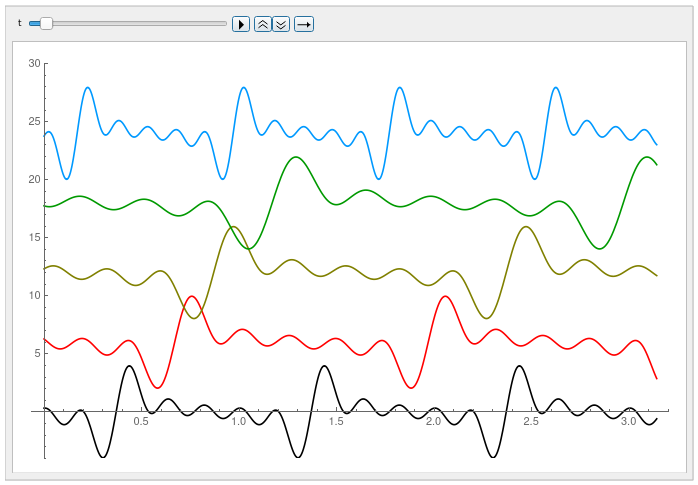
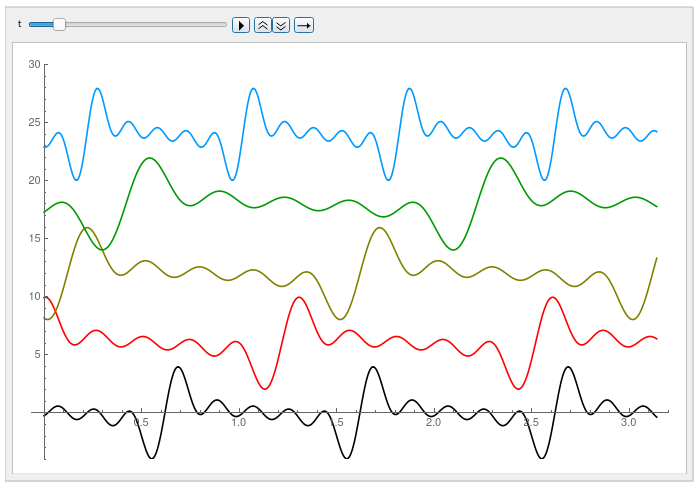
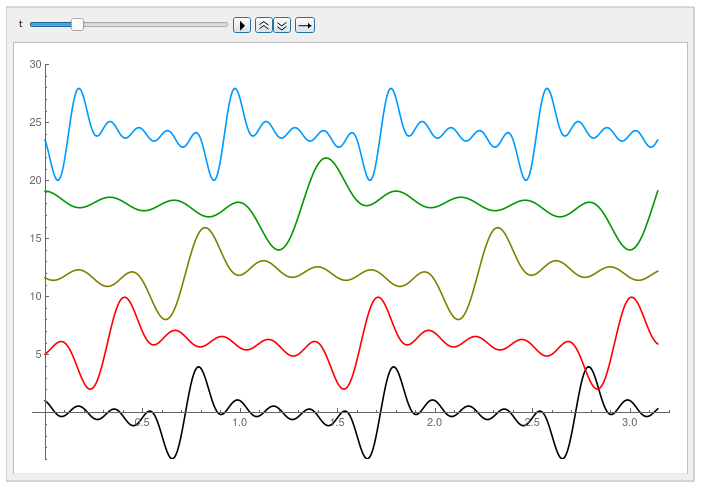
Here are pictures:
Motion of a Fourier wave construction as observed in different frame of reference velocities (-0.2, 0.8, 0.5, 0.2, and 1.0) This view is at time t=0This view is at time t=7This view is at time t=14This view is at time t=23
The examples are all running with different observer’s frame of reference velocities (black=1.0,red= 0.8, brown=0.5, green=0.2, blue=-0.2), yet all are moving at the same velocity. This is a nice demonstration of what I proved in the paper–that objects constructed of waves always appear to move at the same velocity regardless of the observer’s frame of reference velocity.
This is why I strongly believe that reality has the constant speed of light that underlies the principles of special relativity. Note that once you have a constant speed, it is easy to show geometrically that this results in time and spatial dilation by the beta factor used in special relativity–many have done this, and I refer you to papers on Arxiv and other places. Currently, the Standard Model does not postulate a cause for the constant speed, it is one of two assumed postulates that are the foundation for the theory of special relativity. By finding an underlying cause for this postulate, I think we now have a valuable tool for making progress understanding why quantum mechanics, in particular, quantum decoherence and quantum interference, exists. Since all particles can only have wave components, a variety of approaches become available for study, which I will do in following posts.
In the previous post, I described an asymmetry between two types of photon interactions–the fact that radiation pressure and electron level changes in atoms are repulsive only, but charged interactions can be attractive or repulsive. I hope you will take a moment to read it–it really is an interesting question. Quantum field theory addresses this issue mathematically, but does not answer why this asymmetry exists.
I will summarize that post as follows: Charge forces can be either attractive or repulsive, but radiation pressure is only observed to be repulsive, away from the emitter. The unitary rotation vector field theory (for which I’ve been writing a simulator) posits that there should be attractive radiation pressure via a new particle, antiphotons. I discussed in that post several other justifications for antiphotons that do not rely on believing in the validity of the unitary rotation vector field approach. These justifications essentially state that charge attraction requires that negative momentum be transported from source to destination via particles or field entities that have no momentum of their own.
The unitary rotation vector field describes specifically how this works, using the premise that electron/photon interactions are exchanges of angular momentum, either negative or positive.
However, there is no experimental evidence for antiphotons other than electrostatic attraction, so I became concerned that this is not the real reason for the force directional asymmetry. This post continues that line of thought with an examination of what the unitary rotation vector field idea says about the two types of photon mediated forces. While the theory does allow for negative momentum carrying particles called antiphotons, further investigation hints that this is not the cause for the force asymmetry. Rather, the two photon interaction forces are fundamentally different–one results from photon angular momentum exchange and the other is caused by quantum interference.
Both forces (charge and radiation pressure/electron level transitions) are said to result from photon exchanges and/or photon creation/annihilator operators. Radiation pressure and atomic electron level shifting clearly result from quantized photon packets and are observed to exchange only positive momentum (i.e., are repulsive forces). Energy is conserved as quantized exchanges in these cases.
Charge is different. There is no momentum or energy exchange. Imagine a single positron surrounded by a vast quantity of electrons in all possible directions. Computing the electrostatic force on each electron includes a full charge attraction contribution from the positron (along with a vast quantity of repulsive contributions from all the other electrons). This thought experiment seems to show that there cannot be energy flow in charged interactions, since there would have to be photon exchanges from the positron to each electron simultaneously, an energy flow that easily could vastly exceed the rest mass energy of the positron.
So what is really going on in charged interactions? One possible answer comes from the unitary rotation vector field theory–it is quantum interference between the source and the destination particles. This theory posits that particles form in a single-valued, unitary magnitude rotation field with a background state in a direction orthogonal to R3, the I dimension. Particles are group wave constructs composed of one or more “poles”, quantized single twist rotations from +I and back again. As a group wave, the particle is defined as a peak amplitude magnitude region and its location can be affected by waves from other sources without an expenditure of energy (for example, the relocation caused by quantum interference in the two-slit experiment). The simplest such particle is the one pole photon, a linearly propagating twist; two pole systems can form closed loops, because the waves from each pole form interference patterns (quantum interference) that reposition the pole location. A single pole photon has been demonstrated (see many previous posts) to momentarily shift–via quantum interference–the location of an intercepting two pole closed loop (an “electron”). I hope you will go back several posts and look at my simulation results that beautifully demonstrate this group wave position shifting behavior:
In this theory, an answer to the asymmetry of charge force bidirectionality versus observed unidirectional radiation pressure or atomic electron level change emerges. Simulations show that the twist is a stable state that forms R3 waves around it. Radiation pressure energy transfer (exchange of angular momentum) exerts repulsive forces only when a closed loop set of twists intercept a single pole photon. But charge interactions don’t work this way–instead, the spherical wave surrounding the twist photon form an interference pattern just like that of the two pole closed loop. Like other quantum interference scenarios, no energy exchange happens, instead the interference pattern forces the destination particle to exist in a nearby position either toward or away from the source emitter. Both attraction and repulsion are possible depending on the relative phase of the waves to the destination.
Further work here is needed to ensure that charge is relativistically invariant in this model.
So, to summarize what the unitary rotation vector field is telling us–radiation pressure and electron level changes are caused directly by angular momentum exchanges, and the photon is created or destroyed in the process. Charge forces are caused by quantum interference between the source and destination particles and no momentum is exchanged! The two types of forces are both the result of photon characteristics, the former due to the angular momentum of the photon, the latter due to the quantum interference wave pattern radiating from the photon. The unitary rotation vector field shows that antiphotons should be possible, but are not necessary to explain the directional asymmetry of charge and radiation pressure forces.
One of the interesting asymmetries in physics involve photons and charged forces. Photons have been observed to carry positive momentum from an atom to a detector (for example, another atom with electrons that can be knocked free, forming an electric current that can be measured). We can also measure the radiation pressure of photons, always exerting force away from the source. Finally, we can observe photon interactions in the form of electromagnetic forces between particles.
Charged forces are attributed to photons, both real and virtual, and are measured to be either attractive or repulsive. By symmetry, I would expect photons could also carry negative momentum, observable in antimatter atoms emitting antiphotons or as negative radiation pressure toward the source emitter.
We see negative momentum via charge attraction forces, but we don’t see attractive radiation pressure. Hence, I thought it logical to assume the existence of negative momentum photons–antiphotons.
I actually arrived at this conclusion from a different path–the photon model in the unitary rotation vector field theory has neither mass or momentum of its own but can carry either positive or negative momentum from a source to a destination. For this reason, I predicted the existence of antiphotons, but shortly thereafter realized that even if you don’t believe the unitary rotation vector field theory, antiphotons should exist by symmetry.
That was a daring statement to make–and it makes me nervous, because we’ve done enough high-energy particle collisions with antiparticles that I would have suspected we would have seen evidence of antiphotons. Both the asymmetry of the photon mediating charged interactions and the promising studies of the unitary rotation vector field suggest that antiphotons should be common in antiparticle interactions. In addition, the lack of antimatter in the universe strongly suggests an asymmetry in how gravity and radiation pressure affect formation of stars. Stars cannot exist without a balance of radiation pressure and gravity–if radiation pressure is negative, it will not form a stable state with gravity to form stars.
So, lots of good evidence that antiphotons should exist–so why don’t we see them? Either they are really hard to distinguish from photons, or are really hard to generate, or they don’t exist. I’ve put a lot of thought into this, and realized that studying charge forces using the unitary rotation vector field might suggest the correct answer.
According to quantum field theory, electric and magnetic forces are mediated by photons. Looking at the LaGrange equations of motion for electron/photon interactions, you can get both positive and negative momentum solutions for the photon wave equation, and in the standard model, attractive forces are interpreted to be photons interacting with an EM field via constructor/annihilator operators. In addition, virtual photons can exist for bounded spacetime neighborhoods that don’t conserve momentum.
The crucial question here is–why the asymmetry? Why couldn’t you interpret this in a symmetric way simply by saying the negative LaGrange solutions are simply photons carrying negative momentum–antiphotons? As mentioned previously, there’s many good reasons to think antiphotons should exist. But we don’t! Why not? We have negative momentum charge (attractive forces), but no observed negative radiation pressure, even though both are mediated by photons. We see no antimatter stars in astronomy, strongly suggesting that such stars do have negative radiation pressure, yet we see no evidence of an antimatter protostar cloud collapsing rather than assuming a stable state in the form of a star.
One answer is that antiphotons are hard to detect. An experiment to observe an anti-atom emit an antiphoton is going to be difficult to set up. You would have to have a detector that could tell the difference between an antiphoton and a photon. As I suggested in a previous post, this might be a positron brehmstrallung experiment that measures the tiny radiation pressure from antiphotons generated by positrons travelling through a magnetic field. Maybe the reason has simply been that no one has looked for an antiphoton, after all, we’ve been taught for so long that photons are their own antiparticle, there is no such thing.
Although I thought the derivation of antiphotons from the unitary rotation vector field was clever, I really have doubts. I think we would have seen antiphotons in high energy collisions creating a negative momentum collision track. There’s good reason to believe that antiphotons should exist, yet there has to be a reason why we don’t see negative momentum carrying photons, but do see negative carrying charge forces.
For this to make sense, the answer may be much more controversial: that photon mediated charge forces and photon radiation pressure forces involve photon particles that are different in some way. If photons cannot carry negative momentum, we are forced to conclude that charge forces are not mediated by the same particles as radiation particles–a theory that goes against the well tested Standard Model. Alternatively, we could decide the issue has to do with the difference between photons and virtual photons (or similarly, quantized photons versus the quantized EM field), but it is very clear to me that neither case can explain the observed asymmetry in photon mediated interactions.
I think insight into the question of antiphoton existence and the charge force asymmetry question can be found by looking at the way the unitary rotation vector field addresses these photon interactions. Since this post is already long, I’ll present my observations in my next post.
A while ago, I discovered a showstopper–a contradiction between two parts of the theory I’ve been working on that proposes an underlying unitary rotation field for the particle zoo. The theory is based, in part, on two discoveries: that any Fourier construction of particles (a sum of waves that results in a group wave delta function) will appear to move at constant speed regardless of observer frame of reference, thus providing a basis for special relativity, and secondly, that quantized energy states can emerge from an R3+I unitary rotation field. Lots of work has resulted from this basic model of existence, including the quantized formation of stable solitons.
However, the showstopper problem needed to be resolved, and I think I have done so, although I’ve not proven it yet. The problem is this: how can a sum of waves exist in a unitary single valued vector field? There is no magnitude component in such a field, so the only way to “sum” a Fourier composition of waves is to sum the rotations at any given point. This doesn’t really work when you try to classically doppler shift the resulting field, there’s no wave components present in the resulting field and the special relativity behavior can’t emerge. I’ve looked at abandoning the doppler shift approach, but there are only a few other ways that special relativity could emerge and so far they all seem unworkable as an underlying field for particles.
Coming back to the original premise, I can resolve the paradox if doppler shifting can occur on a single wave cycle (rather than requiring a sum of waves). I believe that this should be true for this reason–when generating a Fourier sum of a delta function, normally waves of infinite span are used. However, in the limiting case, all parts of the sum cancel out except in the region of the delta function, so the constant speed derivation is just as valid if you only use the sum of waves in the immediate region of the delta function. A single cycle of oscillation will still doppler shift, and the apparent constant velocity of the resulting delta function is valid whether the infinite waves are summed or the region bounded (single cycle) waves are summed. If there is only a single cycle wave present, its shape and velocity are still defined by the math of the original theorem with a different set of limits (described in this paper: group_wave_constant_speed) and now the contradiction is resolved.
There’s more work to do, I think it would be pretty easy to blow holes in this framework as it is. Nevertheless, it’s the first time I’ve been able to work out a promising answer to the showstopper contradiction.
The unitary rotation field in R3+I dimensions is part of a quantum interpretation that obeys special relativity. Recently I was able to show that the field can produce both linear and closed loop soliton solutions that do not produce discontinuities in the field. This is a big step forward in the hypothesis that this field is a good representation of how things work at the quantum/subatomic scale. Note that this field is NOT the EM field, which under quantum field theory reduces to a system of quantized and virtual particles.
This unitary rotation vector field is derived from the E=hv quantization principle discovered by Einstein more than a century ago. This principle only allows one frequency dependent degree of freedom, so I determined that only a field of unitary twists of vectors could produce this principle. (I didn’t rule out that other field types could also produce the principle, but it’s very clear that any vector field that assigns magnitude to the vectors could not work–too many degrees of freedom to constrain to the E=hv property). This has two corollaries: first, no part of the field has zero magnitude or any magnitude other than unity, and, the field is blocking–you cannot linearly sum two such fields such that a field entity could pass through another entity without altering it.
Why did I determine that the rotation has to be in R3+I, that is, in four dimensions (ignoring time for now)? Because of the discontinuity problem. If the field were just defined as R3, you cannot have a quantized twist required to meet E=hv. No matter how you set up the rotation vectors around a twist of vectors along an axis, there must be a field discontinuity somewhere, and field discontinuities are very bad for any reality based physical model. That makes the field non-differentiable and produces conservation of energy problems (among many other problems) at the discontinuity.
However, all of quantum mechanics works on probability distributions that work in R3+I, so that is good evidence that adding a fourth dimension I for rotation direction is justified. It doesn’t mean there is a spatial displacement component in I–unlike the R3 spatial dimensions, I is just a non-R3 direction. And the I dimension does at least one other extremely important thing–it provides a default background state for all vectors. In order for photons and particles to have quantized twists, a background starting and stopping vector rotation is necessary. The unitary field thus normally would have a lowest energy state in this background state.
Aha, you say–that can’t work, the vacuum is presumably in this lowest energy state, and yet we know that creation operators in quantum mechanics will spontaneously produce particle/anti-particle pairs in a vacuum. You would be correct, I have some ideas, but no answers at this point for that objection. Nevertheless, I recently was able to take another step forward with this hypothesis. As I mentioned, it is critical to come up with a field that does not produce discontinuities when vector twists form particles. Unlike R3, the R3+I field has both linear and closed loop twist solutions that are continuous throughout.
This was very hard for me to show because four dimensional solutions are tough to visualize and geometrically solve. I’m not a mathematician (whom would undoubtably find this simple to prove), so I used the Flatland two dimensional geometry analogy to help determine that there are continuous solutions for vector twists in four dimensions. There are solutions for the linear twist (e.g., photons) and closed loop particles. There are also solutions for linked closed loops (e.g., quarks, which only exist in sets of two or more).
I will follow up next post with a graphical description of the derivation process (this post is already approaching the TL;DR point).
Now, this is a very critical step indeed–there is no way this theory would fly, I think, if field discontinuities exist. However, I’m not done yet–now the critical question is to show that the solitons won’t dissipate in the unitary rotation field. If there are no discontinuities, then the solitons in a field are topologically equivalent to the vacuum field (all vectors in the +I background state). What keeps particles stable in this field? As dicussed in previous posts, my hypothesis has been to use the displacement properties of quantum interference–now that the discontinuity problem is resolved, a more thorough treatment of the quantum interference effects on the unitary rotation field approach is now necessary.
Regardless of how you think about my hypotheses that unitary rotation vector fields could represent subatomic particle reality, surely you can see how interesting this investigation of the R3+I unitary rotation field has become!
None of the current well known quantum interpretations are satisfactory–they all have shortcomings that cause logical contradictions to known experimental data. I think all would agree that the Everett many worlds interpretation has an element of absurdity to it (doesn’t mean it’s wrong, just seems improbable), and the Copenhagen interpretation where decoherence occurs somewhere near a detector has significant logical problems (see the EPR paradox to start). Physicists seem to like best the modified Bohm interpretation that works around Bell’s inequality, but it adds a wave term (the guiding pilot wave) to equations describing time evolution of particle position and motion. This redirects the particle to form an interference pattern on a target–but in so doing, since the particle has momentum, it exerts a force for which we have no experimental evidence.
So, I thought long and hard and came up with a new quantum interpretation that seems to overcome these problems, and as far as I can tell, seems logically consistent. Better yet, particles that conform to the assumptions of this interpretation must meet the constraints of special relativity.
I thought this interpretation flows logically out of the thought process of how quantum interference works. We know that quantum entangled particles will always resolve to opposite states instantaneously across any distance, appearing to disobey causality (when a detector resolves one of the particles, that sets the state of the other particle instantaneously even if they are far apart–see various Aspect experiment variations). But, neither particle can exceed the speed of light, nor can any communication between the particles exceed the speed of light.
Now that gives a powerful hint of what this implies–that if the momentum aspect of the particle cannot exceed the speed of light, something else must exceed it. I realized that if the particle was represented by some construct of waves, the waves could form a rogue-wave–a soliton or delta function where the group could not exceed the speed of light, but component wave phases would not have such a limit–a change in phase would be reflected across the entire length of the wave instantaneously. The rate of change in time of this phase is limited, so that makes the particle as a whole causal–but the instantaneous effect of this phase change would cause an instantaneous effect on quantum interference over the entire distance of the wave. And–a quantum interference effect would relocate the particle by virtue of the delta function sum of interfering waves, without the expenditure of energy (the problem with the Bohm interpretation).
This got much, much more interesting as I started working on the math for such a particle–I almost accidentally discovered that such particles would always look like it was moving at the same speed, regardless of how fast an observer was moving! Instantly, I realized that this quantum interpretation would derive the primary postulate of special relativity–and leads to some pretty astonishing conclusions. This happens because unlike a solid baseball, a group wave will classically Doppler shift according to the observer’s relative velocity. If the entire wave Doppler shifts simultaneously, which will be true with this quantum instantaneous phase wave interpretation, the relative velocity of the observer’s frame of reference is exactly cancelled out by the corresponding Doppler shift of the particle’s wave components.
To me, this was an incredibly important finding–it says that any particle formed from instantaneous phase waves will act according to special relativity. And–if a particle obeys special relativity, it must Doppler shift–and thus must be composed only of various types of wave. There cannot be any internal structure in an electron, for example, that doesn’t Doppler shift and thus it must be composed solely of wave components. Now, admittedly, that’s a pretty big box of components–they don’t have to be planar waves, but could be oscillating vectors, helical waves, compression waves, you name it. All it has to do is Doppler shift and special relativity will fall out.
Amazing! Or so I thought. I proposed this to many different experts in this field, and all of them pooh-poohed it. I submitted to 5 journals–all rejected. I guess I’m totally on my own, which is rather a shame–I think there’s some really good new stuff here.
Agemoz
PS: here’s the mathematical derivation, feel free to comment:
I last posted on my discovery that any classical group wave will obey the observed constant speed property, a prerequisite (one of the two assumed postulates) for special relativity. That is, if you throw a baseball, its speed will be some value v_p. If you are standing on a train moving in the same direction at speed v_e, an observer on the ground will see the baseball move at speed v_p + v_e. But, if you throw an object that is a linear sum of waves, such as a delta function group wave, it doesn’t matter what v_e (the relative speed of the thrower) is, the observer on the ground will always see it move at speed v_p.
The math and concept seemed bullet-proof, so I spent a couple of years writing a paper and trying to get it published. I stayed away from any speculation and just wrote a proof that says classical group waves must appear to move at some constant speed v_p regardless of an observer’s frame of reference velocity v_e. I made sure there was nothing in there that would make a reviewer immediately toss the paper. I worked on getting the format and grammar acceptable for scientific publishing, had several reviewers check it for errors and conceptual problems. They claimed it was good to go so then I submitted to several journals. No luck–a bunch of rejections later and I finally gave up. However, no editor wrote to disprove my math or the conceptual thinking, not sure they ever looked at that–it was always the paper doesn’t meet the quality standards of the journal or some such reason (if any). In spite of my best skeptical analysis, I cannot find fault with the derivation, and I still think there’s some science here, so I decided to forget the publishing effort and just continue seeing what I could discover on my own.
Unlike many of the ideas I post here, which are guesses how things work and are borderline science fiction, I thought this work was a small breakthrough, it says several important things. First, if this is true (represents reality), it shows why special relativity exists in our universe. All the research I have done shows that no one has determined why we assume the constant speed of light postulate holds and thus why we have special relativity behavior. Second, it shows that every particle and exchange particle must consist entirely of some kind of a wave summation, otherwise it would violate special relativity–thus giving an important clue how to mathematically define subatomic particles. And third, it shows that any quantum particle composed of waves must phase shift the waves at a causal rate–but there can be no time-dependent component to the phase-shift along the length of the wave. In other words, the entire wave component shifts non-causally, albeit at a causal rate. This is important because now the Aspect experiment makes sense–if entangled particles are emitted in opposite directions, the particles stay coherent–perhaps as a orthogonally complex double helix going to oppositely placed detectors. They oscillate their states, back and forth, until one detector captures and absorbs the momentarily real portion of the double helix, instantaneously leaving the orthogonal (imaginary at that moment) helix intact for discovery by the other detector at a later time.
This work provides a novel set of tools for looking at various quantum particle interactions. I’m going to discuss some of what I’ve discovered on this website. I am trying to be clear what is provable (stuff in that paper) or science fiction (these posts, for the most part, are guesses how things work and aren’t really provable at this point). I will try to make a good case for my science fiction, that is, why I find my ideas attractive possibilities.
One example is the famous two-slit experiment. When a single particle hits a barrier with two openings in it, it interferes with itself and only will land at certain target locations on the other side of the barrier. Paradoxically, if you close one of the openings, now the particle will land on any target location. I have considered the question: why does the second opening cause an alteration to the particle’s path?
The second Bohm interpretation (the leading contender of valid quantum interpretations) suggests that the particle is preordained to go through one or the other slit, but is guided to an interference controlled destination by the particle’s extended wave property going through two slits. In this Bohm interpretation, when determining the time/space evolution of the particle wave function, a complex exponential (representing the wave from the second opening) is added to the particle wave function to mathematically guide the particle to the interference pattern target. Two spherical waves will combine to produce various interference patterns–see the figure:
The big problem with this interpretation is that work is done to move a particle. If the particle was ordained to go through one opening to a target that is blocked when the second opening is opened, but instead goes to a nearby interference defined location, the Bohm interpretation says that the waves going through the second slit is somehow expending energy via some force being applied to the particle. There is no evidence for such a force in nature.
There are no forces needed when using the group wave interpretation approach described in my paper. The particle is merely defined by where the wave components sum to produce a localized group wave delta function or similar construct. Interfering waves simply change the possible places where the “particle” will appear, and in fact the concept of particle region is set by how a detector absorbs the group wave. In the region of the barrier, the concept of a particle becomes very ambiguous, but no waves are absorbed by the barrier . Instead, they all pass through the openings, so a Fourier composition must reform the particle somewhere after the barrier that will eventually hit the target detector region. No funny or weird alterations to the wave function are needed.
There are many more ideas like this that follow from assuming a group wave interpretation–one of the most important being that group wave particles will appear to be moving at constant speed regardless of the observer’s frame of reference–a foundation for special relativity. Do you agree why the group wave concept is a cleaner approach than the Bohm interpretation? I don’t think this is science fiction, but I couldn’t get any journal editors to see things the way I am…. 😦
Agemoz
PS: I use wave and wave functions interchangeably in this post–the concepts shown here are valid for both physical waves and probability distributions.
I'm an amateur physicist. I've studied physics and philosophy for a very long time, and have investigated some of the unanswered questions in physics with an intent of finding some possible explanations or theories on how they might work. Two of the most interesting questions for me are whether there is a geometrical basis for quantization and special relativity, and why there is a particle zoo (that is, is there an underlying structure that results in the particle zoo). I'm well aware of the danger of crackpot theories (usually characterized by just enough knowledge to get things wrong or silly), but allow myself to pursue ideas anyway as long as I'm clear about their speculative nature. I don't pretend that I have any significant discoveries to report, but thoroughly enjoy pursuing various ideas about how the universe works. To faciliate this study, I've created a lattice simulator that allows me to test a variety of ideas.
Archives
Unitary Twist Field Theory
A long description and justification for the thinking that has led to the Unitary Twist Field Theory. Note, IANAP (I am not a Physicist). This is long and describes the historical evolution of the Unitary Rotation Vector Field. The latest work has changed several parts, I am in the process of updating this.
Summary: A unitary rotation vector field is investigated as an underlying field that gives rise to the particles and fields of the Standard Model. The underlying field is single-valued, waves cannot pass through other waves. This is the means by which quantum interference redirects particle paths. The simulation work has revealed a new principle:
Quantum interference is responsible for redirecting particles along wave interference peaks–and also for creating those particles.
Long description: This effort to work out the details of this unitary twist field is based on the underlying assumption that our existence can emerge from nothing, and posits a reductionist approach to explaining the particle zoo. The theory basically says that there is a continuous rotation field in R3 + I that can produce stable solitons. Here is a list of the steps I have taken to arrive at this theory:
a: If existence does not require an intellect to form, the existence must arise from nothing, both space and time.
b: If existence does require an intellect (e.g, God) then further investigation isn’t really necessary because the rules for existence are set in a place we do not have access to.
c: One way to determine if the creating intellect exists would be to determine if the existence could not come into being without at least two rules, and such rules would have to come into existence from a creator. Saying that existence formed with one and only one rule is equivalent to saying that existence could arise from nothing and God is not required.
d: Finding God seems to be pretty much unanswerable without clear direct communication from God, whereas coming up with a way that existence could form from nothing seems to be an alternative possible approach for a human mind to answer the question about the existence of God.
e: Such an approach could start with the limits of current human knowledge, the known existence of the particle zoo. If a reductionist approach could be taken as to why the particles exist, we may be a step closer to saying that an intellect is not needed to create this existence. Conversely, if we can show with reasonable probability that it’s impossible to form particles from some continuous field, that’s an argument in favor of the necessity of an intellect in creating our existence.
f: I am assuming that a continuous field that can create stable particles is a reductionary step–that is, a step in the direction of finding a single rule defining this existence.
g: Now I start applying known physics to this field to determine what it must look like. I am assuming that this field is opaque, that is, there aren’t any parallel overlapping fields. This is clear because multiple rules are necessary to form two fields.
h: I assume that this field has elements that can only rotate. No displacement or magnitude can be applied to any field element. This assumption comes from the E = hv relation for particles, which basically says that particles are described only by frequency, there is no field degree of freedom equivalent to field magnitude.
i: when objects move, the field elements pass rotations via three types of momentum to adjacent elements. In this theory, no field element ever “moves”, instead particles move because field rotations pass as momentum from one field element to the next.
j: In order for E = hv to work, there has to be a means of ensuring that no partial or multiple count of rotations can exist. This is a form of field quantization, and I have proposed a background lowest energy state. In such a system, field rotations called twists start and stop at the background state rotation angle.
k: To ensure that R3 does not have an observable resonance (which would be experimentally discernable) that would undermine gauge theory symmetries, this background states points to an imaginary dimension. It is not possible to have the background state point to a basis vector in R3.
l: If the field has a crossproduct momentum transfer as well as the more standard linear translation of angular momentum of field rotation elements, this becomes a necessary and sufficient condition for forming stable linear particles of arbitrary frequency. UPDATE: simulation work shows that quantum interference is responsible for particle formation.
m: the crossproduct rule for momentum displacement allow a particle to start a single twist, and allows the particle to end the twist after one full rotation.
n: The crossproduct rule also allows the formation of twists that move along a curve. This is possible due to the vector combination of the crossproduct that is normal to the current element rotation orientation and speed. UPDATE: simulation work shows that quantum interference is responsible for path curvature.
o: If twists can curve, there are some twists that will form stable closed loops. There are many possible stable curve solutions, which I am proposing is the basis for the particle zoo.
p: A single free linear twist models a photon of some energy and length defined by the frequency of twist rotation.
q: Since the twist moves from +I background state to an R3 direction and continuing to rotate through to the +I direction, polarization of this twist arises as a linear combination of the two R3 vectors normal to the direction of twist travel. UPDATE: new simulation data suggests that quantum interference and momentum provide a basis for polarization, this will be revised.
r: The crossproduct momentum translation is necessary to allow a twist to start and to stop, otherwise field symmetry would propagate in both directions simultaneously at every point in the twist, and stable particles could not form (they would dissipate). In other words, the quantization of the field is ensured with the background state, and the ability to start and stop a twist arises from the crossproduct momentum translation. Thus it can be stated that to form stable particles from a field, it is necessary that a field capable of forming stable particles must have a handedness that can only come from a crossproduct momentum property. UPDATE: simulation results show this and following sections needs to be revised.
s: This handedness thus must be ingrained in any field solution that produces stable particles. This handedness of the field will show up in some cases as a chirality violation.
t: In order for the twist propagation to be stable, the only possible momentum transfer via crossproduct relation is at the speed of light, where the leading and trailing edge of the twist cannot be affected or connected to neighboring element rotations.
u: Any closed loop rotation sequence thus will be limited to the speed of light. If one were to unravel the cylindrical spiral path this loop takes in Minkowski space, a single quantized twist will form a right triangle where the hypotenuse is the speed of light times the time of one rotation of the twist, one side is the particle travel distance, and the other side of the triangle is the radius of the loop. This right triangle enforces a relation between the loop travel speed and the speed of light. This relation computes to the beta factor of special relativity and is the means by which special relativity geometrically arises from the twist theory.
v: A corollary to u: above is that time dilation for every particle results from the constrained stretching of the spiral helix in Minkowski space as the particle increases speed proportionate to the speed of light. In other words, each particle’s relativistic clock is implied by the time to complete a single twist. Observing from different frames of reference will alter the apparent time to complete a twist and thus affect the relative passage of time between particle and observer.
w: A single closed loop models the electron of one type of spin. The twist direction relative to direction of travel defines a spin-up or spin-down electron, whereas the loop curvature relative to the handedness of the field defines the particle vs the antiparticle version of the electron. Note that a linear twist does not have these degrees of freedom, so there is no antiparticle to the linear twist photon.
x: Quarks are posited to be linked twist loops, the up quarks have a single link going through its center and the down quark has two. The strong force results when linked twist loops are pulled apart such that twist momentums approach each other with an asymptotic direction conflict. The passage of a twist through the center of a loop affects the rotation of the loop by increasing the crossproduct momentum of the loop. Note that since electrons are modeled by a loop with no central twist going through it, electrons (and positrons) cannot combine with quarks.
z: This modeling of quarks seems to correlate to the masses of the up and down quarks–the twist going through the center of a up quark loop acts with a central force that causes the loop radius to reduce by half. The doubling of the resultant normal (to direction of twist travel) acceleration results in a loop that is 1/4 the size of the electron loop model. Similarly, a down quark has two twists going through its center, doubling again the normal acceleration of twist travel and causing that loop to be 1/8 in size. The rest masses of the electron, up quark and down quark correlate to this geometric analysis of particle loops. Electrons have a .511MeV mass, up quarks are 2.3MeV, and down quarks are 4.8MeV. Admittedly this may all be numerology, but I was surprised to find this mass correlation to loop length.
y: A possible model for the weak force results because there is a small chance for linked twist loops to tunnel through each other. If the rotation of one twist loop matches the rotation of a linked loop right at the point where linked loops are being pulled apart, the loops can separate. This is proposed as particle decay and would model the randomizing effect of the weak force.
Glossary
3D + T: the three spatial and 1 time-wise dimensions of our existence. Equations usually are set up for solutions in this space.
Causal: Causality: The property where a particle or field changes according to special relativity, that is, changes cannot propagate faster than the speed of light.
Dirac Equation: Relativistic equations using operators that effectively describes electron behavior in an atom and relativistic interactions of particles
Electron, Positron: charged fundamental quantum particles with spin (no known substructure with a fixed rest mass)
EM: EM Field: Electromagnetic Field.
Entangled Particles: A property of a system of particles where resolving a state of one of the particles instantly (non-causally) affects the remaining particles
Frame of Reference: Used in Special Relativity, refers to the observer's position relative to a system being observed. Special Relativity describes how a system (for example, a set of particles) will appear to the observer that is dependent on how fast and in what direction the observer is moving in relation to the system.
General Relativity: Einstein's theory describing the stress-energy tensor, which details the equivalence of acceleration and gravity and describes how dimensions distort and forces apply when objects are accelerated, especially as speeds approach the speed of light. For example, it describes how a particle's mass increases as it is accelerated.
Interference: Quantum interference: The property at small (quantum) scale where the probability of a particle state or location varies according to wave superposition, the trait of waves interfering with each other
Lorentz Transform: equations that describe how dimensions of time and space distort in different frames of reference (special relativity)
QFT: Quantum Field Theory: theory of how fields, such as the electromagnetic field, are quantized.
Quantum, Quanta: property where fields or particles have a property that can only have a particular value from a set (the set of real or complex numbers, for example)
Quantum Mechanics: the equations that describe the wave-like behavior of particles in various systems, such as a particle in a box.
Photon: quantum of light. Only one possible value of energy, depending on frequency.
Planck's Constant: The lower bound for simultaneous measurement of two orthogonal properties such as a particle's position and momentum.
Relativistic: Usually refers to particles or interactions of particles with velocities that approach the speed of light
Rest mass: Since any particle with mass will have that mass increase as it is accelerated, rest mass is defined as an intrinsic property of a particle that is not moving
Schroedinger Equation: Wave Equation: second order differential equation that describes the probability distribution of (for example) an electron around an atom
Special Relativity: Einstein's theory that describes how dimensions (space and time) interconnect and vary according to an observer's frame of reference. It specifies causality of all particles or field components, and that the speed of light is the same constant in every frame of reference.
Twist: Field Twist: Author's idea of how photons and electrons (twist rings) substructure could be described
Uncertainty relation: Heisenberg uncertainty principle: the lower bound (planck's constant) for resolving two orthogonal properties of a system.
Unitary: in transforms, the property that preserves magnitude (such transforms can cause rotation or displacement, but cannot change the size or shape of objects). In vector spaces (such as fields), unitarity implies that all vectors have a constant magnitude, only direction varies.


 Agemoz's Physics Blog