Posts Tagged ‘special relativity’

Paper Synopsys–A new Quantum Interpretation

May 5, 2019

I posted here for the first time in almost two years that I wrote a physics paper and posted the attachment (see previous post).  After doing all the work on the paper and going through the publishing process I kind of decided that was enough of that.  It’s exhausting work and I gained a new appreciation of the work PhD candidates go through.  No, the paper didn’t get published after four tries, mostly “not in the scope of the journal”–but I did learn a lot about being thorough and detailed.  I like to think I’m a little less of a crackpot for going through the process.

I decided to go back to posting about my research work here, which is a lot more fun and allowed me more time for research, reading Arxiv articles, and running sims.  The cool thing about the research described in my paper was the creation of new computational tools for simulating particle interactions using a new quantum interpretation–so I have lots of ideas where to go from here.

I will try not to post too often, and try to limit speculation–in other words, build your trust that this is a site worth going to and not waste your time.  Comments are always welcome although I can be pretty slow in responding.

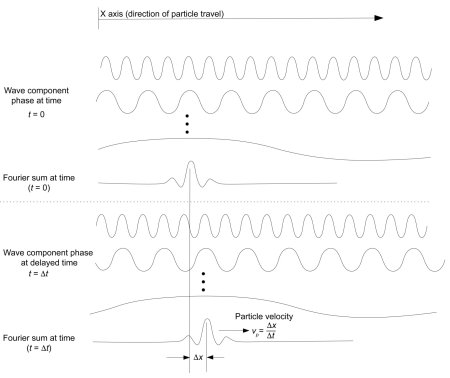
Since everyone loves reading a paper (not), let me summarize what I did in that paper.  I hypothesized that a new quantum interpretation is needed for extending the Dirac equation to predict quantum interference effects.  This interpretation is based on the group wave principle–that particles are formed when a Fourier composition of waves sum to an analytic function such as a delta function.  Each wave component has instantaneous phase–that is, changing the phase of a wave component takes effect instantaneously across the wave (see the figure).  Causal limits on the particle result from a limitation on the rate of change of any wave phase.  The paper provides a mathematical proof that such a Fourier sum will always appear to be moving at a constant speed regardless of the frame-of-reference velocity of the observer, thus deriving a basic postulate of special relativity and validating the quantum interpretation over our current set of interpretations.

Fig2

FIG. 2. Instantaneous change in phase across waves on x-axis for each value of time t

This interpretation leads to a bunch of derivations I want to explore.  I describe a simple example in the paper for entangled particle decoherence.  Another of my favorites is how the interpretation explains “particle or wave” in the dual slit experiment.  Using this approach, it’s very easy to see that the group wave particle is intact until it nears the barrier with two slits.  At that point the definition of where the particle is becomes very ambiguous–but math will show the particle group wave re-appears after it clears the barrier.  I’ll show some sims once I get them completed with pictures (or tell you that I was unsuccessful.  I’m probably still a crackpot, but I try to be an honest one!)

Agemoz

Physics Paper is Done!

May 3, 2019

I have spent the last two years working hard on a journal paper based on some of the work I’ve discussed on this site.  I learned a lot in the process, for example, the importance of substantiating every claim I made, and making sure the more speculative stuff stays out of the paper.  Take a look if you like!  You may need to download and use a PDF viewer–some of the math equations don’t show correctly in the wordpress viewer.


Here’s the abstract:

The Dirac equation successfully predicts the evolution of probability amplitudes even for relativistic particle interactions, but it is a causal equation and thus cannot predict non-causal quantum interference effects such as quantum entanglement resolution. An extension of the Dirac equation will require a valid quantum interpretation that derives both quantum interference behavior and the special relativity postulate of constant speed in any frame of reference. None of the current quantum interpretations provide the means to derive the special relativity postulate. Therefore, in this study, I assume a quantum interpretation based on a non-causal form of group wave particles.  The study shows that observation of these group wave particles have a constant speed in all frames of reference and thus the quantum interpretation is a valid basis for both special relativity and the Dirac equation. The result of this study is a first step toward building an extension to the Dirac equation that predicts the non-causal interference effects of quantum mechanics.

edit: replaced wrong (older) version of pdf paper

Agemoz

Summary of Findings So Far

February 5, 2018

I took the time to update the sidebar describing a summary of the unitary twist field theory I’ve been working on.  I also paid to have those horrid ads removed from my site–seems like they have multiplied at an obnoxious rate on WordPress lately.

One problem with blogs describing research is the linear sequence of posts makes it really hard to unravel the whole picture of what I am doing, so I created this summary (scroll down the right-hand entries past the “About Me” to the Unitary Twist Field Theory) .  Obviously it leaves out a huge amount, but should give you a big picture view of this thing and my justification for pursuing it in one easy-to-get place.

The latest:  I discovered that the effort to work out the quark interactions in the theory yielded a pretty exact correlation to the observed masses of the electron, up quark and down quark.  In this theory, quarks and the strong force mediated by gluons is modeled by twist loops that have one or more linked twist loops going through the center.  This twist loop link could be called a pole, and while the twist rotation path is orthogonal to the plane of the twist loop, the twist rotation is parallel and thus will affect the crossproduct momentum that defines the loop curvature.  Electrons are a single loop with no poles, and thus cannot link with up or down quarks.  Up quarks are posited to have one pole, and down quarks have two.  A proton, for example, links two one-pole up quarks to a single two-pole down quark.

The twist loop for an up quark has one pole, a twist loop path going through the center of it.  This pole acts with the effect of a central force relation similar (but definitely is not identical to an electromagnetic force) to a charged particle rotating around a fixed charge source–think an atom nucleus with one electron orbiting around it.  The resulting normal acceleration results from effectively half the radius of the electron loop model, and thus has four times the rotation frequency and thus 4 times the mass of an electron.  The down quark, with two poles, doubles the acceleration yet again, thus giving 8 times the mass of an electron.

It will be no surprise to any of you that this correlates to the known rest masses of the electron, up quark, and down quark:  .511MeV, 2.3MeV, and 4.8MeV.

I can hear you screaming to the rafters–enough with the crackpot numerology!  All right, I hear you–but I liked seeing this correlation anyway, no matter what you all think!

Agemoz

Details of the Linear Twist Sim

January 9, 2018

(Updates 1 and 2 below)

It’s been an amazing week working on the unitary twist field sim.  Most of the kinks in the sim coding are fixed, and what I’m finding in the sim results I think are astonishing.  Here’s what I’m finding:

a. There is now little doubt in my mind that there is a class of precursor fields based on a rotation (unitary) vector field that produces stable linearly propagating twist particles.  I’ve attempted a geometric proof, and within the limits of the assumptions I am making, the particles appear to have to be able to exist in this type of field and are stable, and so far the sim results are confirming this.

b.  An unexpected result from the sim–the particles have to move as a single rotation at the limiting speed of the sim.  This is exciting because photons cannot exist unless they move at the speed of light, and this sim shows linear twists match this behavior.  As I concluded in my last post, I realized that special relativity has to have a part to play here and in the sim it shows up as only one possible speed for the linear twist.

c.  You cannot form a stable linear twist unless you do one full rotation as defined by the local background state.  Any other partial twist dissipates (or has to be absorbed by something, e.g, virtual particles).  There is an asymmetry in the leading and trailing edge angular momentum of any linear twist–the only way to resolve this is if both ends have the same change of momentum (leading edge incurs a momentum in the next cell, the trailing edge cancels out that momentum).  This property prohibits a twist from being stable unless it completes a rotation, in which case the same change in momentum happens on both the leading and trailing edge.

d.  It is looking probable (but not proven yet) that you can curve the twist path depending on the change of rotation vectors in the path of the linear twist.  As mentioned in one my prior posts, a closed loop will create a changing tilt of rotation vectors internal and external to the loop, thus (in theory) sustaining the closed loop.  This is a big difference between this precursor field and attempts to create stable particles out of an EM field.  You cannot change the path of a photon with some EM field.  However, for the unitary twist field, I’ve already shown that this should be possible geometrically (see back a few posts), but now I need to confirm it with a sim.

UPDATE 1:  here is a picture–probably the most unimpressive picture ever produced by a GPU graphics card!  Nevertheless, there’s a lot of computing that was done to generate it, and clearly shows both propagation and preservation of the emitted twist.  The junk to the upper left is left over from the initial conditions that emitted the twist, I’ll fix the startup code shortly, but I thought you’d like to see the early results that I thought were exciting…

UPDATE 2:  Better pictures coming.  Just like with real photons, I can make these particles any length, modeling the continuous range of frequencies available.  What is shown above is a fairly short “photon”, but I now have pictures of much lower frequency, hence longer, photon wave rotations.  I am still getting perfect reproduction of the photon model as it travels, thus solidifying the conclusion that this field yields stable solitons.  Next up–geometrically I can see that I should be able to get two parallel photons to lase–that is, phase lock.  I’ll start the sim with two out-of-phase photons near each other and see if they lock.  Stay tuned!

end of UPDATE 1 and 2

My biggest concern with thinking I have found something interesting as opposed to “not even wrong” or trivial is that I would have expected at least a few thousand real physicists would have already found this field behavior, perhaps fleshed this out a lot more than I have, and found it wanting as a theory underlying the formation of real-world particles.  This thing is simple enough that I just cannot believe that a lot of people haven’t already been here. I also still have a ton of unanswered questions (for example, issues with the background state concept, whether the +/-I state is necessary, and so on).

So–other than having a lot of fun exploring this, I don’t see anything yet that means I should write a paper or something.  I’ll keep plowing away.  As an uncredentialed amateur, I know it’s more likely I’ll win the lottery than being taken seriously by a professional researcher, and I’m fine with that.

One thing that’s going to be really fun is setting up a sim of a major collision of some sort–I hope I don’t induce a cybernetic singularity and wipe out the universe…. 🙂

Agemoz

Sim Works for Linear Twists

January 1, 2018

Happy New Year with hope for peace and prosperity for all!

I now have the sim working for one class of particles, the linear twist.  I fixed various problems in the code and now am getting reasonable pictures for both the ring and the linear twist.  Something is still not right on the ring, but the linear twist is definitely stable with one class of test parameters.  This is an important finding because my previous work seemed to be unable to create a model of a photon (linear twist), so I had focused on the ring case.  However, last night (New Year’s Eve, what a great way to start the New Year!) I realized the problem was my assumptions on how to set up the linear twist initial conditions.

Discrete photons are always depicted as a spiral rotation of orthogonal field vectors in a quantized lump.  I could not make my sim do this, both ends of the lump would not dissipate correctly no matter how I set up the initial conditions and test parameters–the clump always eventually disappeared.  I suddenly realized this picture of a photon is not correct–you have to go to the frame of reference of the photon motion to see what’s really going on.  The correct picture in the photon’s frame of reference is not a clump nor a spiral, but simply a column of vectors all in phase from start to finish (emission and absorption).  It’s the moving frame of reference at light speed that makes the photon ends appear to start and stop in transit.  The sim easily simulates the column case indefinitely.  It also should correctly simulate the ring case for the same reason–and in this case since the frame of reference goes around the ring, the spiral nature of the twist becomes apparent in the sim.  It should also create an effective momentum (wants to move in a straight line) to counteract the natural tendency to shrink into non-existence, but I don’t have the correct test parameters that that is happening yet.

One thing that should please some of you–all of you?  🙂   The background state so far is not necessary to produce these results!  That concept was necessary to produce a quantized lump for the linear photon, but as I noted, that’s not how photons work in their frame of reference.  That simplifies the theory–and the sim computation.  And, most importantly as I suggested in the previous post, seems to validate the concept of assuming that a precursor rotation (twist) vector field can form particles.

Agemoz

First Unitary Twist Field Sim Output–It’s a Three Ring Circus! (Update)

December 24, 2017

UPDATE:  errors in the sim calculations are distorting the expected output–it’s too early to make any conclusions yet.  Corrected results coming soon–the CUDA calculations work in 3D blocks over the image, including overlap borders.  As you might expect, the 4D computation gets complex when accounting for the overlap elements.  I had the blocks overlapping incorrectly, which left holes in the computation that caused the soliton image to be substantially distorted.  I still see strong indications that there will be stable solitons in the results, but need to correct a variety of issues in the sim before drawing any conclusions.  Stay tuned…

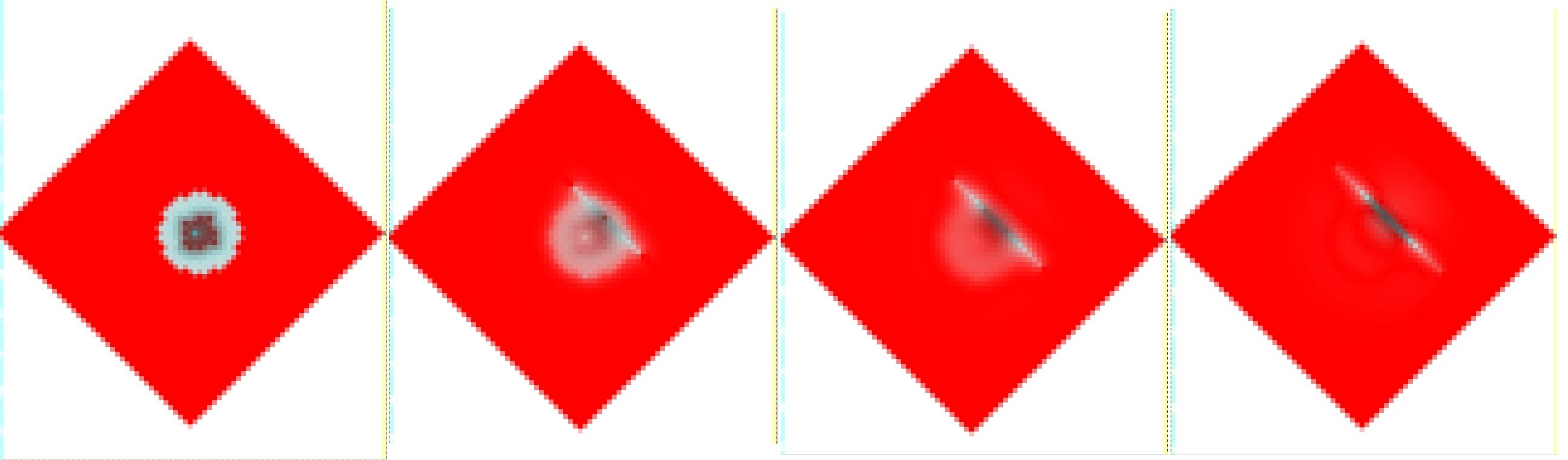
The first results from the Unitary Twist Field Theory are in, and they are showing a three ring circus! Here are the sim output pictures. The exciting news is that the field does produce a stable particle configuration that is very independent of the initial boundary conditions and strength of the background state and the neighborhood connection force–the same particle emerges from a wide variety of startup configurations. Convergence appears visible after about 20 iterations, and remains stable and unchanging after 200000 steps. So–no question that this non-linear field produces stable solitons, thus validating my hypothesis that there ought to be some field that can produce the particle zoo. Will this particular field survive investigation into relativistic behavior, quantum mechanics and produce the diversity of particles we see in the real world? I created this theory based on the E=hv constraint that implies a magnitude-free field and a background state, a rotation vector field that includes the +/-I direction, and many other things discussed in previous posts, so I think this field is a really good guess. However, it wouldn’t surprise me at all that I don’t have this right and that changes to the hypothetical field will be necessary.  As usual, as in any new line of research work, it’s quite possible I’m doing something stupid or this is the result of some artifact of how I am doing the simulation–it doesn’t look like it to me, but that’s always something to watch out for.  However, here I am seeing good evidence I have validated this line of inquiry–looking for a non-linear precursor field that produces the particles and force-exchange particles of the Standard Model.

It’s very hard to visualize even with the 4D to 2D projected slices I show here. I color coded the +I (background state) dimension as red, -I direction as black, and combined all three real dimensions to blue-green. Note there is no magnitude in a unitary twist field (mathematicians probably would prefer I call this a R3+I rotation unitary vector field), so intensity here simply indicates the angular proximity to the basis vector (Rx, Ry, Rz, or +/-I). For now, you’ll have to imagine these images all stacked on top of each other, but I’ll see if I can get clever with Mathematica to process the output in a 3D plot.

Studying these pictures shows a composite structure of two parallel R3 rings and an orthogonal interlocking -I ring, and something I can’t quite identify, kind of a bridge in the center between the two rings, from these images. These pictures are the 200000 step outputs.  You can ignore the image circles cursors in some of the screen capture shots, I should have removed those!

More investigation results to come, stay tuned!

Agemoz

Special Relativity and Unitary Twist Field Theory–Addendum

February 2, 2017

If you read my last post on the special relativity connection to this unitary twist field idea, you would be forgiven for thinking I’m still stuck in classical physics thinking, a common complaint for beginning physics students. But the importance of this revelation is more than that because it applies to *any* curve in R3–in particular, it shows that the composite paths of QFT (path integral paradigm) will behave this way as long as they are closed loops, and so will wave functions such as found in Schrodinger’s wave equation. In the latter case, even a electron model as a cloud will geometrically derive the Lorentz transforms. I believe that what this simple discovery does show is that anything that obeys special relativity must be a closed loop, even the supposedly point particle electron. Add in the quantized mass/charge of every single electron, and now you have the closed loop field twists to a background state of the unitary field twist theory that attempts to show how the particle zoo could emerge.

Agemoz

Special Relativity and Unitary Twist Theory

January 30, 2017

I’ve been working diligently on the details of how the quantizing behavior of a unitary twist vector field would form loops and other topological structures underlying a particle zoo. It has been a long time since I’ve talked about its implications for special relativity and the possibilities for deriving gravity, but it was actually the discovery of how the theory geometrically derives the time and space dilation factor that convinced me to push forward in spite of overwhelming hurdles to convincing others about the unitary twist theory approach.

In fact, I wrote to several physicists and journals because to me the special relativity connection was as close as I could come to a proof that the idea was right. But here I discovered just how hard it is to sway the scientific community, and this became my first lesson in becoming a “real” scientist. Speculative new theories occupy a tiny corner in the practical lives of scientists, I think–the reality is much reading and writing, much step-by-step incremental work, and journals are extremely resistant to accept articles that might cause embarrassment such as the cold-fusion fiasco.

Back in my formative days for physics, sci.physics was the junk physics newsgroup and sci.physics.research was the real deal, a moderated newsgroup where you could ask questions and get a number of high level academic and research scientists to respond. Dr. John Baez of UC Riverside was probably one of the more famous participants–he should be for his book “Gauge Fields, Knots and Gravity”, which is one of the more accessible texts on some of the knowledge and thinking leading to thinking about gravity. But on this newsgroup he was the creator of the Crackpot Index, and this more than anything else corrected my happy over-enthusiasm for new speculative thinking. It should be required reading for anyone considering a path in the sciences such as theoretical physics. Physicists 101, if you will–it will introduce you hard and fast to just how difficult it will be to be notable or make a contribution in this field.

I’m not 100% convinced, as I’ve discussed in previous posts, that there isn’t a place for speculative thinking such as mine, but this is where I discovered that a deep humility and skepticism toward any new thinking is required. You *must* assume that speculation is almost certainly never going to get anywhere with journal reviewers or academic people. Nobody is going to take precious time out of their own schedule to investigate poorly thought-out ideas or even good ideas that don’t meet an extremely high standard.

So, I even presented my idea to Dr. Baez, and being the kind and tolerant man he is, he actually took the time review what I was thinking at that time–has to be 20 years ago now! Of all the work I have done, none has been as conclusive to me as the connection to special relativity–but it did not sway him. I was sure that there had to be something to it, but he only said the nature of special relativity is far reaching and he was not surprised that I found some interesting properties of closed loops in a Lorentzian context–but it didn’t prove anything to him. Oh, you can imagine how discouraged I was! I wrote an article for Physical Review Letters, but they were far nastier, and as you can imagine, that’s when my science education really began.

But I want to now to present the special relativity connection to unitary twist theory. It still feels strongly compelling to me and has, even if the theory is forever confined to the dustbin of bad ideas in history, strongly developed my instinct of what a Lorentzian geometry means to our existence.

The geometry connection of unitary twist field theory to special relativity is simple–any closed loop representation of a particle in a Lorentzian systen (ie, a geometry that observes time dilation according to the Lorentz transforms) will geometrically derive the dilation factor beta sqrt(1 – v^2/c^2). All you have to do to make this work is to assume that the loop represention of a particle consists of a twist that is propagating around the loop at speed c, and the “clock” of this particle is regulated by the time it takes to go around the loop. While this generalizes to any topological closed system of loops, knots, and links (you can see why Dr. Baez’s book interested me), let’s just examine the simple ring case. A stationary observer looking at this particle moving at some speed v will not see a ring, but rather a spiral path such that the length of a complete cycle of the spiral will unroll to a right triangle. The hypotenuse of the triangle by the Pythagorean theorem will be proportionate to the square root of v^2 + c^2, and a little simple math will show that the time to complete the cycle will dilate by the beta value defined above.

When I suddenly realized that this would *also* be true in the frame of reference of the particle observing the particles of the original observer, a light came on and I began to work out a bunch of other special relativity connections to the geometry of the unitary twist theory. I was able to prove that the dilation was the same regardless of the spatial orientation of the ring, and that it didn’t matter the shape or topology of the ring. I saw why linear twists (photons) would act differently and that rest mass would emerge from closed loops but not from linear twists. I went even as far as deriving why there has to be a speed of light limit in loops, and was able to derive the Heisenberg uncertainty for location and momentum. I even saw a way that the loop geometry would express a gravitational effect due to acceleration effects on the loop–there will be a slight resistance due to loop deformation as it is accelerated that should translate to inertia.

You can imagine my thinking that I had found a lodestone, a rich vein of ideas of how things might work! But as I tried to share my excitement, I very quickly learned what a dirty word speculation is. Eventually, I gave up trying to win a Nobel (don’t we all eventually do that, and perhaps that’s really the point when we grow up!). Now I just chug away, and if it gives somebody else some good ideas, then science has been done. That’s good enough for me now.

Agemoz
The Arrow of Time and Misuse of Statistics

June 5, 2016

As an amateur physicist I try to avoid disputing established science, but one place I believe science has it wrong is the dimensionality of time.  If you read this blog at all, you’ll see I am trying to create a self-consistent world-view that conforms with peer-reviewed science.  My world-view attempts to add analysis and conclusions on some of the unanswered questions about our universe such as why are there so many elementary particles or how can quantum entanglement work.  I try never to dispute established science and to accept that my world-view is a belief system, not fact that must be forced on others–that is the mark of a crackpot that has just enough knowledge to waste other peoples’ time.

However, one place I break my rules of good behavior is this concept that time is one-dimensional.  For a long time, I’ve recoiled at the notion that the observer’s timeline could physically intersect a particular local spacetime neighborhood of an object event  multiple times.  I discussed this in a previous post, but now I want to discuss this disagreement from another angle–the claim for an existence of an Arrow of Time.

The Arrow of Time is a concept that describes the apparent one way nature of the evolution of a system of objects.  We see a dropped wine glass shatter on the floor,  but we never see a shattered wine glass re-assemble itself and rise up back onto a table.  We record a memory of events in the past, but never see an imprint of the future on our brain memory cells.  This directional evolution of systems is a question mark given that the math unambiguously allows evolution in either direction.  To put it in LaGrange equation of motion terms, the minimum energy path of an object such as a particle or a field element is one dimensional and there are two possible ways to traverse it.  The fundamental question is–why is one way chosen and not the other?

The standard answer is to invoke statistics in the form of the Laws of Thermodynamics, and I have always felt that was not the right answer.  Here is why I have trouble with that–statistics are mathematical derivations for the probability something will happen, and cannot provide a force that makes a particle go one way or the other on a *particular* LaGrangian minimum energy path.  It’s a misuse of statistics to use the thermodynamics laws to define what happens here.  In the case of the shattered wine glass, there are vastly more combinations of paths (and thus far higher probability) for the glass pieces to stay on the floor than there are for the glass shards to reassemble themselves–but that is not why they stay there!

The problem with the Arrow of Time interpretation comes from thinking the math gives us an extra degree of freedom that isn’t really there.  The minimum energy path can truly be traversed in either the time-forward or time-backward path, but it is an illusion to think both are possible.  Any system where information cannot be lost will be mathematically symmetric in time, creating the illusion of an actual path in time if only the observer were in the right place to observe the entirety of that path.  Einstein developed the equations of special relativity that were the epitomy of the path illusion by creating the concept of spacetime.  Does that mean the equations are wrong?  Of course not–but it exemplifies the danger of using the math to create an interpretation.  Just because the math allows it does not mean that the Arrow of Time exists–any relativistic system where information cannot be destroyed will allow the illusion of a directionality of time.

So what really is going on?  I’ll save that for a later post, but in my world-view, time is a property of the objects in the system.  There is only ONE copy of our existence, it is the one we are in right now, and visits to previous existences is simply not possible.  Our system evolves over time and previous existences no longer exist to visit.   Relativity does mean that time between events has to be carefully analyzed, but it does not imply its dimensionality.

Agemoz

Something-From-Nothing, Incompressible Fluids, and Maxwell’s Equations

May 22, 2016

I have made the claim that our universe must have emerged from nothing via the infinity times zero equation, and that we can derive the behavior of our universe from the geometry of a something-from-nothing system.  The something-from-nothing basis (which I’m going to start abbreviating as SFN) suggests an incompressible fluid, and two really cool consequences result from an incompressible fluid–Maxwell’s equations and three dimensions.

The assumption that a SFN system results in an incompressible fluid is a step of negative logic–you cannot have a compressible fluid as the basis of a SFN system because it implies density variation as a fundamental property–an extra rule on top of a nothing existence.  Then the question has to be asked, what is the origin of that rule, how did it come from nothing–and we’ve lost the deductive power of assuming a SFN system.  You can eventually create compressible fluids but you have to start assuming no density variations (incompressible fluid) and show how such a thing could emerge.

Why assume a fluid at all from a SFN?  That’s a much more complex question that I really want to flesh out later.  For now I would like to state that a fluid is just the result of the emergence of movement of elements of a field from an SFN system.  Developing that step is crucial to making a workable SFN theory, but for right now I want to show what results when you take that step.

An incompressible fluid is a really interesting concept that has no equivalent in real life.  Even an idealized steel bar with no internal atomic flexing is compressible by special relativity–apply a force to one end, and relativity dictates that the bar will compress slightly as the effect of the force propagates at the speed of light across the bar.  But an incompressible fluid violates special relativity and cannot exist as an entity with mass in real life.  However as a basis of a SFN system it turns out it can exist–and the very rules of special relativity have to emerge in the form of Maxwell’s Equations and three spatial dimensions.

You can see this when you realize that an infinite volume of an incompressible fluid cannot be pushed in the direction of an applied force.  Not because of infinite mass (mass emerges from an SFN system, but you can’t use it yet else you will engage in circular reasoning) but because an incompressible fluid won’t move without simultaneous displacement of an adjacent region.  Another way to state it is that incompressible fluids require a complete path for movement to happen.  In addition, movement of that path of fluid cannot initiate unless the limit of the size of the region containing the path approaches zero.  You can see that such a requirement eliminates movement in the direction of the force, only a transverse loop is possible.  You cannot have movement in either a one or two dimensional system–both would require movement to occur in the direction of the force in the infinitesimal limit.  You must have three dimensions*.  And, more profoundly, it is easy to see that Maxwell’s field equations are nothing more than the description of the motion of a fluid that rotates around the axis of an applied force (or vice versa).

Wait–I just said the incompressible fluid cant exist in real life, and is limited to an infinitesimal neighborhood?  Doesn’t that sound pretty useless as a basis for the universe?  No, because we use calculus all the time to integrate infinitesimal effects into a macroscale result.  Think Huygen’s principle, or better yet, Feynman path integrals, and the summing of all possible particle paths of LaGrange motion equations and QFT.  Even quantum entanglement has a geometrical explanation in this model–let me save those for a later post, this is about 10 times longer than anybody will read already!

Agemoz

*You must have at least three dimensions, but this analysis does not prove that more aren’t possible.  I’m thinking at this point that since more dimensions aren’t necessary, LaGrange type minimum energy paths eliminate their existence–although at gravitational scales we start to see evidence of spacetime curvature (more dimensions?).  There’s also arguments for more tiny scale dimensions when QFT is merged with relativity–but on an everyday macro scale of our existence, its quite clear that SFN system educes three dimensions.