The unitary rotation field in R3+I dimensions is part of a quantum interpretation that obeys special relativity. Recently I was able to show that the field can produce both linear and closed loop soliton solutions that do not produce discontinuities in the field. This is a big step forward in the hypothesis that this field is a good representation of how things work at the quantum/subatomic scale. Note that this field is NOT the EM field, which under quantum field theory reduces to a system of quantized and virtual particles.
This unitary rotation vector field is derived from the E=hv quantization principle discovered by Einstein more than a century ago. This principle only allows one frequency dependent degree of freedom, so I determined that only a field of unitary twists of vectors could produce this principle. (I didn’t rule out that other field types could also produce the principle, but it’s very clear that any vector field that assigns magnitude to the vectors could not work–too many degrees of freedom to constrain to the E=hv property). This has two corollaries: first, no part of the field has zero magnitude or any magnitude other than unity, and, the field is blocking–you cannot linearly sum two such fields such that a field entity could pass through another entity without altering it.
Why did I determine that the rotation has to be in R3+I, that is, in four dimensions (ignoring time for now)? Because of the discontinuity problem. If the field were just defined as R3, you cannot have a quantized twist required to meet E=hv. No matter how you set up the rotation vectors around a twist of vectors along an axis, there must be a field discontinuity somewhere, and field discontinuities are very bad for any reality based physical model. That makes the field non-differentiable and produces conservation of energy problems (among many other problems) at the discontinuity.
However, all of quantum mechanics works on probability distributions that work in R3+I, so that is good evidence that adding a fourth dimension I for rotation direction is justified. It doesn’t mean there is a spatial displacement component in I–unlike the R3 spatial dimensions, I is just a non-R3 direction. And the I dimension does at least one other extremely important thing–it provides a default background state for all vectors. In order for photons and particles to have quantized twists, a background starting and stopping vector rotation is necessary. The unitary field thus normally would have a lowest energy state in this background state.
Aha, you say–that can’t work, the vacuum is presumably in this lowest energy state, and yet we know that creation operators in quantum mechanics will spontaneously produce particle/anti-particle pairs in a vacuum. You would be correct, I have some ideas, but no answers at this point for that objection. Nevertheless, I recently was able to take another step forward with this hypothesis. As I mentioned, it is critical to come up with a field that does not produce discontinuities when vector twists form particles. Unlike R3, the R3+I field has both linear and closed loop twist solutions that are continuous throughout.
This was very hard for me to show because four dimensional solutions are tough to visualize and geometrically solve. I’m not a mathematician (whom would undoubtably find this simple to prove), so I used the Flatland two dimensional geometry analogy to help determine that there are continuous solutions for vector twists in four dimensions. There are solutions for the linear twist (e.g., photons) and closed loop particles. There are also solutions for linked closed loops (e.g., quarks, which only exist in sets of two or more).
I will follow up next post with a graphical description of the derivation process (this post is already approaching the TL;DR point).
Now, this is a very critical step indeed–there is no way this theory would fly, I think, if field discontinuities exist. However, I’m not done yet–now the critical question is to show that the solitons won’t dissipate in the unitary rotation field. If there are no discontinuities, then the solitons in a field are topologically equivalent to the vacuum field (all vectors in the +I background state). What keeps particles stable in this field? As dicussed in previous posts, my hypothesis has been to use the displacement properties of quantum interference–now that the discontinuity problem is resolved, a more thorough treatment of the quantum interference effects on the unitary rotation field approach is now necessary.
Regardless of how you think about my hypotheses that unitary rotation vector fields could represent subatomic particle reality, surely you can see how interesting this investigation of the R3+I unitary rotation field has become!
Agemoz
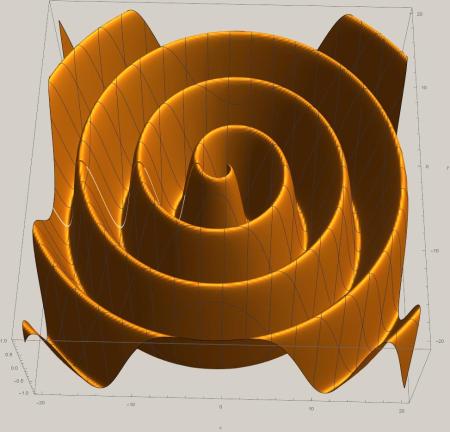
 There are no waves here, because the sum of the delta functions can never produce anything but a plane, no matter how fast they oscillate in time. I realized that now I think I know why electrons are not deBroglie circular waves with a Compton radius size–they have to be infinitely small. The waves shown in the first figure have to result from a non-causal sum of a rotating and infinitesimally spaced, oscillating pair (or more) of delta functions. Space and time for a particle emerge in a non-causal way from the orbiting pair of oscillating delta functions to produce the spiral waves shown in the first figure. Only then could you see non-causal spiral waves emerge. There’s other work I’ve done that shows that the delta functions must reflect some sort of twisting vector field in R3 + I (NOT an EM field vector, those are photons). Along the same lines, I’m sure you’ve seen the recent experimental observation of twist momentum found in photons. Can you see why I see so much exciting work emerging from the simple theorem proof I describe in the paper? Frustrating not to be able to publish it–I think I have something there, but can’t convince anybody else of it! And until someone else sees the validity of what I’ve done, there’s no science here.
 Agemoz's Physics Blog