Posts Tagged ‘theory’

Unitary Rotation Vector Field Three Pole Solutions Exactly Mimic Quark Combinations

April 25, 2020

I apologize for overposting here–I’m definitely going to be overdoing it–but I just felt like I had one more result to post (UPDATE below).

Most three pole solutions just produce the infinite wave results that are not sustainable as a real representation of particles, I just see the infinite series of wave rings.  But I thought, what if I tried to duplicate the three quark up/down configurations?  I place three poles in a triangle, and gave them all the same energy.  Nope, infinite rings.  Next, gave one of the poles half the frequency like an up quark.  Nope, still infinite rings.  Now, give it an antipole rotation: voila!  a stable particle configuration:
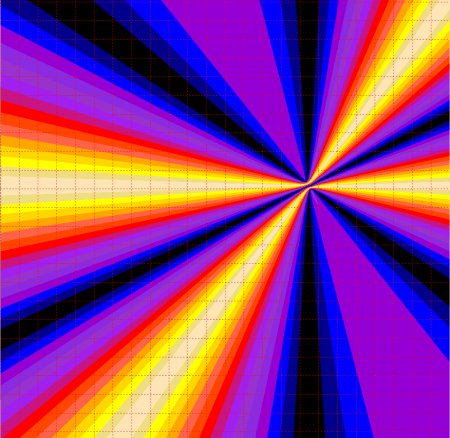
three_pole_m2_4_m2

In fact, I tried all combinations of “up” particles and “down” particles, and guess what–only two produced particles, the anti-up, down, down and the up, anti-down,anti-down configuration!  Yow–that was exciting.

However, Feynman’s ghost is here, and he says: be skeptical.  This may just have a stupidly simple reason, not a physics breakthrough.  It could just simply be the fact that 1 + 1 – 2 = 0, and -1 -1 + 2 = 0.

{update}:  quark sets have extremely complicated interactions and I now doubt that this configuration directly represents them (for example, where is the mass of the gluons).  It might give a clue of internal details of a quark set, but there has to be more to it.

Something much more significant is showing up with these sim results–the hypothesis that a testable principle exists.  It is this:

Quantum interference is responsible for redirecting particles along wave interference peaks–and also for creating those particles.

It doesn’t matter that we are talking wave functions (probability distributions) rather than actual waves, the redirection still happens.

It’s becoming very clear from these sim results that at certain wave frequencies, the effect of quantum interference must control the motion of poles because in the unitary rotation vector field, every field location is single valued (only one possible rotation at each point).  As a result, the quantum interference redirection that occurs in the two-slit experiment can also cause poles to encircle each other in a stable pattern.  I’m about to set up an experiment to directly test this principle.

More pictures to come…

Agemoz

Unitary Rotation Field Simulator: More Results

April 25, 2020

I’ll try not to post here too often, but a whole ton of results are coming back from different experiment configurations using the Unitary Rotation Vector Field simulator.  One thing that became immediately obvious is that stable solutions are not going to come from most pole configurations–the spreading waves you saw on the previous post aren’t sustainable in a universe full of particles.  I was pretty suspicious of something not right when I could make the dipole disappear entirely (see previous post).

I discovered a whole new ball game when I set up opposite pole dipoles:

dipole_1

The wave pattern disappears as the poles cancel out.  The residual rotations shown occur because I have yet to apply the effect of the I dimension (the background state referred to in previous posts about the theory I’ve been working on).  Here is a picture of two such dipoles of different frequencies:

two_dipoles_1

There are wide space dipoles representing lower energy solutions:

dual_2pi_dipole

Note that I’m just barely scratching the surface of the properties of this amazing field.  I’m only using one of the rotation modes (there are three in the R3+I field of the theory), I don’t have the background state turned on yet, I am currently only studying 2D configurations, and I have not turned on any time dependent characteristics, in particular, how such particles will move.  There’s so much to do and to document!

Agemoz

Why Static Twists Cannot Be Stable

March 11, 2012

Some really exciting results from my simulation results of the Twist hypothesis!  I have been simulating this for a while now, to recap:  The twist theory posits (among many other things) that underlying the photon elements of an electromagnetic field is a unitary twist field.  This unitary twist field is a direct (or mapped) result of the E=hv quantization of all particles.  Photons are linear twists of the unitary field, whereas massive particles are self-contained twists, such as a ring for electrons/positrons.  Quarks and other massive particles are posited to be other geometrical constructions.  If this model is studied, one very interesting result is the correct representation of the special relativity space and time Lorentz transforms, where linear twists travel at a maximum, but constant, speed in all frames of reference–but all self-contained structures such as the electron ring must obey time and spatial dilation.  The model correctly derives the beta dilation factor.

As a result of this work, I have put together a simulator to model the twist behavior in the hopes of verifying the existing corollaries to the twist theory, and also to see if more complex geometrical structures could be determined (say for quarks, although it is certain that the strong force would have to be accounted for somehow).

One of the results of the theory seemed to imply that a static linear twist should be possible, yet static photons do not exist in nature.  I’m very excited to have the simulator show its first demonstration of why this happens!  When I set up the simulator to do a static linear twist, I discovered (see previous posts) that the twist always self destructed by dissipation, and it took a lot of work to find out why.  This will be easiest to show with this diagram:

Why the static twist dissipates. Note the narrowing of the twist from the outside in.

The premise of the unitary twist theory is that E=hv particles can only be quantized geometrically in a continuous field system if particles exist in a localized background field direction have a fixed amplitude twist.  The fixed amplitude (different from an EM field that allows any magnitude) prevents the quantized entity from dissipating, and the background direction enforces quantization of the twist–partial twists (virtual particles) are not stable and fall back to the background direction, whereas full twists are topologically stable since the ends are tied down to the background direction such that the twist cannot unwind.  The frequency of the twist is determined by the twist width, shown in the diagram as omega.

Iteration of the linear twist in the simulation showed that, even though the unitary twist magnitude could not dissipate, the twist would vanish (see previous post pictures).  At first, I thought this was an artifact of the lattice form of the simulation, I represented a continuous twist with a stepwise model.  Further sims and analysis showed that the behavior was not a lattice effect (although it definitely interfered with the correct model behavior).  As this diagram shows, I was able to demonstrate that a static twist cannot exist, it is not stable.  What happens is that the twist width cannot be preserved over time because the ends experience normalizing forces to the background.  This process, demonstrated in the simulation, ultimately causes the particle to approach a delta function, at which point the simulation twist model gets a single lattice node and eliminates it.

It would be a valid statement to say that the sim does not correctly model what happens at that final stage, but there’s no question in my mind of the validity of the narrowing of the twist width.  There is only one way that the linear twist can be stable–if the light cones of each twist element are out of range of each other.  This can only happen if the twist elements are moving at speed c.

I was disappointed at first, I didn’t have a working model of the twist field.  But I didn’t see that the sim had handed me my first victory–the explanation of why there are no static photons.

Agemoz