Posts Tagged ‘twist field’

Special Relativity and Unitary Twist Theory

January 30, 2017

I’ve been working diligently on the details of how the quantizing behavior of a unitary twist vector field would form loops and other topological structures underlying a particle zoo. It has been a long time since I’ve talked about its implications for special relativity and the possibilities for deriving gravity, but it was actually the discovery of how the theory geometrically derives the time and space dilation factor that convinced me to push forward in spite of overwhelming hurdles to convincing others about the unitary twist theory approach.

In fact, I wrote to several physicists and journals because to me the special relativity connection was as close as I could come to a proof that the idea was right. But here I discovered just how hard it is to sway the scientific community, and this became my first lesson in becoming a “real” scientist. Speculative new theories occupy a tiny corner in the practical lives of scientists, I think–the reality is much reading and writing, much step-by-step incremental work, and journals are extremely resistant to accept articles that might cause embarrassment such as the cold-fusion fiasco.

Back in my formative days for physics, sci.physics was the junk physics newsgroup and sci.physics.research was the real deal, a moderated newsgroup where you could ask questions and get a number of high level academic and research scientists to respond. Dr. John Baez of UC Riverside was probably one of the more famous participants–he should be for his book “Gauge Fields, Knots and Gravity”, which is one of the more accessible texts on some of the knowledge and thinking leading to thinking about gravity. But on this newsgroup he was the creator of the Crackpot Index, and this more than anything else corrected my happy over-enthusiasm for new speculative thinking. It should be required reading for anyone considering a path in the sciences such as theoretical physics. Physicists 101, if you will–it will introduce you hard and fast to just how difficult it will be to be notable or make a contribution in this field.

I’m not 100% convinced, as I’ve discussed in previous posts, that there isn’t a place for speculative thinking such as mine, but this is where I discovered that a deep humility and skepticism toward any new thinking is required. You *must* assume that speculation is almost certainly never going to get anywhere with journal reviewers or academic people. Nobody is going to take precious time out of their own schedule to investigate poorly thought-out ideas or even good ideas that don’t meet an extremely high standard.

So, I even presented my idea to Dr. Baez, and being the kind and tolerant man he is, he actually took the time review what I was thinking at that time–has to be 20 years ago now! Of all the work I have done, none has been as conclusive to me as the connection to special relativity–but it did not sway him. I was sure that there had to be something to it, but he only said the nature of special relativity is far reaching and he was not surprised that I found some interesting properties of closed loops in a Lorentzian context–but it didn’t prove anything to him. Oh, you can imagine how discouraged I was! I wrote an article for Physical Review Letters, but they were far nastier, and as you can imagine, that’s when my science education really began.

But I want to now to present the special relativity connection to unitary twist theory. It still feels strongly compelling to me and has, even if the theory is forever confined to the dustbin of bad ideas in history, strongly developed my instinct of what a Lorentzian geometry means to our existence.

The geometry connection of unitary twist field theory to special relativity is simple–any closed loop representation of a particle in a Lorentzian systen (ie, a geometry that observes time dilation according to the Lorentz transforms) will geometrically derive the dilation factor beta sqrt(1 – v^2/c^2). All you have to do to make this work is to assume that the loop represention of a particle consists of a twist that is propagating around the loop at speed c, and the “clock” of this particle is regulated by the time it takes to go around the loop. While this generalizes to any topological closed system of loops, knots, and links (you can see why Dr. Baez’s book interested me), let’s just examine the simple ring case. A stationary observer looking at this particle moving at some speed v will not see a ring, but rather a spiral path such that the length of a complete cycle of the spiral will unroll to a right triangle. The hypotenuse of the triangle by the Pythagorean theorem will be proportionate to the square root of v^2 + c^2, and a little simple math will show that the time to complete the cycle will dilate by the beta value defined above.

When I suddenly realized that this would *also* be true in the frame of reference of the particle observing the particles of the original observer, a light came on and I began to work out a bunch of other special relativity connections to the geometry of the unitary twist theory. I was able to prove that the dilation was the same regardless of the spatial orientation of the ring, and that it didn’t matter the shape or topology of the ring. I saw why linear twists (photons) would act differently and that rest mass would emerge from closed loops but not from linear twists. I went even as far as deriving why there has to be a speed of light limit in loops, and was able to derive the Heisenberg uncertainty for location and momentum. I even saw a way that the loop geometry would express a gravitational effect due to acceleration effects on the loop–there will be a slight resistance due to loop deformation as it is accelerated that should translate to inertia.

You can imagine my thinking that I had found a lodestone, a rich vein of ideas of how things might work! But as I tried to share my excitement, I very quickly learned what a dirty word speculation is. Eventually, I gave up trying to win a Nobel (don’t we all eventually do that, and perhaps that’s really the point when we grow up!). Now I just chug away, and if it gives somebody else some good ideas, then science has been done. That’s good enough for me now.

Agemoz
Nope: Precursor Field With a Background State Has to be Discontinuous

December 15, 2016

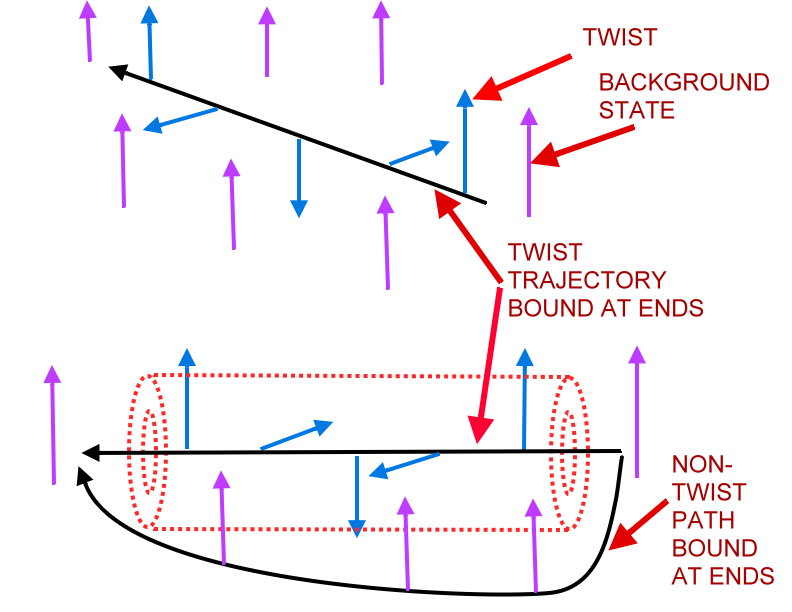
In the last post, I had come to the conclusion that the proposed R3 + I precursor field that would give rise to the particle zoo and EM and other fields could have twists and not have a discontinuity. This posed a problem, however, since quantization of a unitary twist field depends on the twist not being able to dissipate–that the discontinuity provides a “lock” that ensures particle stability over time. Further study has revealed that the extra I dimension does NOT topologically enable a continuous field that could contain twists.

The proof is simple. If the two ends of the twist are bound to the background state, but there is a field twist in between, it must be possible to create some other path connected to the endpoints that does not have a twist, since the background state must completely surround the twist path–see the diagram below. But this is impossible, because in a continuous system it must be topologically possible to move the paths close to each other such that an epsilon volume contains both paths yet has no discontinuities. Since this field is unitary and orientable (I like to use the car seat cover analogy, which is a plane of twistable balls for infinitesimal field elements), there is no “zero” magnitude possible. Somewhere in the epsilon volume there must be a region where the field orientations show a cut analogous to a contour integral cut.

It doesn’t matter how many dimensions the field has, if I’ve thought this through correctly, twists always require a discontinuity in a unitary orientable vector field.

This is a relief in most ways–otherwise this whole scheme falls apart if twists can dissipate. The only way a twist can unravel is in a collision with another twist of the opposite spin or some other similar geometrical construct.

Agemoz

twist_discontinuity_p1

Precursor Field Does Not Have to be Discontinuous

December 3, 2016

In trying to ferret out the properties of a precursor field that would give rise to the particle zoo and EM fields and so on, I had been working out just what this field would look like if it could form a loop. I have so far determined that it would have to reside in a orientable, unitary R3 + I vector field, the same dimensionality as the quantum oscillator field, and that to achieve E=hv quantization, quanta would take the form of twists in a background state pointing in the I direction. I figured out that a twist would curve in R3 if it formed a loop around a central background state region, because regardless of the loop topology in R3, it would always pass through a field orientation tilt toward the central I background region.

Up to now, the concept seemed to be workable, but I always have struggled with the field twist concept. I knew that in R3, you cannot have a field twist without a field discontinuity along the twist axis, which really caused me to doubt the veracity of the unitary twist theory. I know of no instance in the real universe where there’s a true discontinuity–even in black holes. To have our existence form from particles made of twists and field discontinuities has always seemed unlikely to the extreme–I have several times nearly abandoned this work because non-analytic fields seemed non-intuitive, non-differentiable, and non-geometrical.

However, when I tried to detail the specific mathematical possibilities for describing a curved twist in the R3 + I field, I discovered something quite surprising. Every mathematician probably knew this already–but when vector fields are described in four dimensions (R3 + I), axial twists can form in three of the four dimensions and not cause a discontinuity. The I orientation gives the field surrounding the twist an extra degree of freedom that removes the necessity for a discontinuity.

However, this does cause a different problem with the unitary twist theory. We all know that trying to form a soliton out of photons (an EM closed loop solution) is impossible because nothing can curve a photon into a ring. A big problem with trying to describe quantized photons out of EM waves is the dissipation problem, why doesn’t a quantized photon just radiate into nothing, thus losing the apparent quantization and conservation of energy? Currently, Standard Model physics doesn’t really provide an answer to that, but in unitary twist field theory work, I had determined that the discontinuities in a precursor field had acted as a lock that prevents unraveling of the particle, and thus may be necessary for particle stability. You can’t unravel a quantized twist in R3 (causing a particle loop or linear twist to disappear) because you would have to somehow resolve the discontinuity to the background state–and that definitely can’t be done in R3. But in R3 + I, there is no discontinuity required, and thus I think any twist configuration could disappear, thus potentially destroying the energy present in the particle.

So–which is it? We need R3 plus I to achieve quantization and closed loop twists–but R3 + I means we don’t have to have discontinuities–a far more realistic and likely representation of our universe via a unitary vector field, but with the disadvantage that what now enforces quantization? Are there solutions in R3 + I that still depend on a discontinuity for stability and conservation of energy?

Looks like more study and thinking is needed.

I’ll bet there’s a few scientists out there wondering if I could achieve something a lot more significant if I’d put all this time and energy into something worthwhile!

Agemoz

Precursor Field Curving Twists

November 18, 2016

I think I see the geometry of how the twists could form closed quantized loops. If there is a geometrical explanation for the particle zoo, I think this model would be a viable candidate. It has a huge advantage over all the geometric attempts I see so far, all of which have been shot down because the experimental evidence says subatomic particles have no size–collision angles suggest zero size or very tiny, yet all previous geometrical solutions have a Compton radius. This model has the ring in the R-I plane, meaning that collisions would have to hit a one dimensional line, thus appearing to have zero radius.

I have to wonder though, am I just spitting in the wind. No serious physicist would entertain primitive models like this, it’s like the old atom orbital drawings of the 60s before the quantum concept of orbital clouds really took hold. I had one physicist tell me that my geometric efforts faded out in the early 1900s as the Schrodinger view and wave functions and probability distributions really took over. Geometry lost favor as too-classical thinking.

Yet I really struggle with this. Geometry at this level implies logical thinking even if it accompanies a probabilistic theory (quantum theory). If we abandon geometry to explain the particle zoo, are we not just admitting that God created everything? Really, saying geometry cannot drive the formation of particles is like saying some intellect put them there. The reason I persist with a geometrical model is because I just don’t believe this universe was intentionally created, instead, I think it spontaneously formed from nothing. It’s very much one of the few true either-or questions–creator or spontaneous formation. If there’s a creator, I’m wasting my time since the particles are intentionally formed with a basis I cannot see–but that approach has the “what created the creator” paradox. I strongly believe that the only possible valid self-consistent solution is spontaneous creation, and that requires a logical (geometrical, in some way) explanation for the formation of particles. That is why I persist with these silly primitive efforts–with what I know, a logical derivable explanation has to be there and I’m using all my thinking efforts to try to find it.

Anyway, I think I figured out how unitary fields could produce rings from curving twists. The picture below is really tough to draw, because the arrows draw propagation direction, not twist orientation for a given point. But what I realized is that when the background state is constant, a twist will propagate linearly. However, if the background state has some rotation, trying to rotate normal to that rotation actually induces a rotation that has its maximum twist in an offset, or curved, direction. Perhaps if you imagine a field of dominoes pointing straight up, pushing one domino will cause a linear path of fallen dominoes. But if all the dominoes are slightly tilted normal to the direction of propagation, the fallen domino path will veer away from the linear path. This means that you should be able to form a twist ring if the twist line of the ring lies in the Ry-I plane, but there is a rotation in the Rx direction at the center. More complex geometries can easily form from other closed loop structures when the means for twist curvature is brought into the model.

So far, in the quest for a geometrical explanation of the particle zoo, this is what I think has to happen:
a: R3 + I
b: restoring connection to I to enable twist quantization
c: neighboring connection to propagate the twist
d: twist propagation can be altered when passing through an already tilted twist region, where this twist region is normal to the twist curvature
e: whole bunch of other issues on causality/group wave/etc etc discussed in previous posts.

I fully admit my efforts to explain the particle zoo may be primitive and too much like old 1900s classical thinking. I am thinking that twists to a background direction are the only geometrical way quantization of the particle zoo energies can be achieved. Whether that is right or wrong, I am resolute in thinking that there has to be a logical and geometrical basis for the zoo. The current searching for more particles at CERN so far doesn’t seem to have shed light on this basis, and assuming that particles just are what they are sounds like either giving up on humanity’s question for understanding or admitting they were intentionally created by something–but then what created that something? That line of thinking just can’t work. There’s just got to be a way to explain what we observe.

Agemoz
central-twist-induced-curve

String Theory vs Twist Theory in QFT

November 11, 2016

I’ve worked for some time now on a twist field theory that supposedly would provide a description of how quantized particles emerge, and have been working out the required constraints for the field. For example, it’s very clear that this precursor field cannot be some variation of an EM field like DeBroglie and others have proposed. In order for quantization to occur, I’ve determined that the field cannot have magnitude, it is a unitary R3 + I vector field with a preferred orientation to the I dimension, thus allowing geometrical quantization and special relativity behavior (see previous posts for more details). Particles arise when the twist forms a ring or other closed loop structure. I’ve been attempting to work out enough details to make possible an analytic solution and/or set up some kind of a computer model to see if the quantized particles in the model can somehow represent the particle zoo of reality. As I tried to work out how the field elements would interact with each other, I started to see a convergence of this twist field idea with quantum field theory, the field components would interact in a summation of all possible paths that can be computed using Feynman path integrals. If it were true, I think the twist field theory would add geometrical details to quantum field theory, providing a more detailed foundation for quantum physics.

Quantum field theory assumes the emergence of particles from the vacuum, provided that various conservation properties are observed. All interactions with other particles or with EM (or other) fields take place using specific exchange particles. Quantizing the field in QFT works because only specific particles can operate as exchange bosons or emerge from the background vacuum, but QFT does not provide a means to describe why the particles have the mass that we observe. QFT uses quantized particles to derive why interactions are quantized, but doesn’t answer why those particles are quantized. I worked on this twist field theory because I thought maybe I could go a step further and find out what quantizes the particles of QFT.

At this point, I’ve determined that the fundamental foundation of my theory could be described simply as saying that all of the particles in QFT are twists, some closed loop and some linear. So what? You say potay-to, I say potah-to? Particle, twist, what’s the difference? No, it’s more than that. Particles have no structure that explains why one particle acts differently than another, or why particles only exist with specific intrinsic energies. As I have described in many of my previous posts, describing the QFT component particles as geometrical loops of twists can constrain the possible loop energies and enable only certain particles to emerge. It is a model for QFT particles that I think will provide a path for deepening our understanding of quantum behavior better than just assuming various quantized particles.

I realized that my thinking so far is that the unitary twist field really is starting to look like a string theory. String theory in all its forms has been developed to try to integrate gravity into QFT, but I think that’s a mistake. We don’t know enough to do that–the gravity effect is positively miniscule. It is not a second order or even a tenth order correction to QFT. We have too many questions, intermediate “turtles” to discover, so to speak, before we can combine those two theories. As a result, the math for current string theory is kind of scattergun, with no reasonable predictions anywhere. Is it 10 dimensions, 20, 11, or what? Are strings tubes, or one dimensional? Nobody knows, there’s just no experimental data or analysis that would constrain the existing string theories out there. As a result, I don’t think existing string theory math is going to be too helpful because it is trying to find a absurdly tiny, tiny sub-perturbation on quantum field math. Let’s find out what quantizes particles before going there.

The unitary twist field theory does look a little like strings given the geometry of axial precursor field twists. The question of what quantizes the QFT particles is definitely a first order effect, and that’s why I think the unitary twist field theory is worth pursuing first before trying to bring in gravity. It’s adding quantizing geometry to particles, thus permitting root cause analysis of why we have our particle zoo and the resulting QFT behavior.

I really wish I could find a way to see if there’s any truth to this idea in my lifetime…

Agemoz

Precursor Field Continuing Work

October 28, 2016

I suspect that groundbreaking work in any field which involves the old saw of 5% inspiration, 95% sweat applies to what I’m doing with the precursor field. It may be a rather big chunk of chutzpah to call my work “groundbreaking”, but it’s definitely creative, and is definitely in the “tedious work out the details” phase. To summarize what I am describing here, I have invented an area of study which I’ve encapsulated with a concept name of the “precursor field”. As discussed in many previous posts, the one-line description of this area of study is “If a single field could bring forth the particle zoo, what would it look like”. For the last bunch of posts, I’ve been working out an acceptable list of assumptions and constraints for this field. Not very exciting, but I’m trying to be thorough and make reasonable conclusions as I work step by step on this. Ultimately I want to derive the math for this field and create a sim or analysis to verify that stable particles resembling the particle zoo will emerge.

Up to now, as discussed in many previous posts, I’ve been able to show that the precursor field cannot be derived from an EM field like DeBroglie and others have done, they failed to come up with a workable solution to enable emergence of stable quantized particles. Thus, there has to be a precursor field from which EM field behavior emerges. I’ve been able to determine that the dimensions of this precursor field has to encompass R3 + I as well as the time dimension. The field must be orientable without magnitude variation, so a thinking model of this field would be a volume of tiny weighted balls. Quantum mechanics theory, in particular, non-causal interference and entanglement, force the precursor field to Fourier decompose to waves that have infinite propagation speed, but particles other than massless bosons must form as group wave clusters. These will move causally because motion results from the rate of phase change of the group wave components, and this rate of phase change is limited (for as yet unknown reasons). The precursor field must allow emergence of quantization of energy by having two connections between field elements–a restoring force to I, and a neighborhood connection to R3. The restoring force causes quantized particles to emerge by only allowing full rotation twists of the precursor field. The neighborhood force would enable group wave confinement to a ring or other topological structures confined to a finite volume, thus causing inertial mass to emerge from a twist in the field.

I’ve left out other derived details, but that should give you a sense of the precursor field analysis I’ve been doing. Lately, I’ve come up with more conclusions. As I said at the beginning–this is kind of tedious at this point, but needs to be thought through as carefully as possible, otherwise the foundation of this attempt to find the precursor field structure could veer wildly off course. I’m reminded of doing a difficult Sudoku puzzle–one minor mistake or assumption early on in the derivation of a solution means that a lot of pointless work will follow that can only, near the end of the puzzle derivation, result in a visible trainwreck. I would really like for my efforts to actually point somewhere in the right direction, so you will see me try to be painstakingly thorough. Even then, I suspect I could be wildly wrong, but it won’t be because I rushed through and took conceptual shortcuts.

OK, let me now point out some new conclusions I’ve recently uncovered about the precursor field.

An essential question is whether the precursor field is continuous or is somehow composed of finite chunks. I realized that the field itself cannot exist in any quantized form–it must be continuous in R3 + I. Thus my previously stated model of a volume of balls is not really accurate unless you assume the balls are infinitely small. I make this conclusion because it appears clear that any field quantization would show up in some variation of a Michelson-Morley experiment, there would be evidence of an ether–and we have no such evidence. I thought maybe the field quantization could be chaotic, e.g, elements are random sized–but then I think the conservation of momentum and charge could not strictly hold throughout the universe. So, the precursor field is continuous, not quantum–thus making the argument that the universe is a computer simulation improbable.

The necessity for twists to allow quantized stable particle formation from a continuous field means that this field is not necessarily differentiable (that is, adjacent infinitesimals may have a finite, non infinitesimal difference in orientation). Quantization has to emerge from the restoring force, but cannot pre-exist in the precursor field.

I realized that the emergence of twists within a volume (necessary to form stable solitons) puts a number of constraints on the connecting force (one of the two connections necessary for the precursor field). First, the connection cannot be physical, otherwise twists cannot exist in this field–twists require a discontinuity region along the axis of the twist. Thus, the connection force must work by momentum transfer rather than direct connection. Another way to put it is there cannot be “rubber bands” between each infinitesimal element. Momentum transfer doesn’t prohibit discontinuities in field orientation, but a physical direct connection would.

Secondly, the neighborhood connection can only work on adjacent infinitesimals. This is different than an EM field, where a single point charge affects both neighborhood and distant regions. EM forces pass through adjacent elements to affect distant elements, but the precursor neighborhood force can’t do that without presupposing another independent field. This discovery was a very nice one because it means the field math is going to be a whole lot easier to work with.

Third, the precursor field must be able to break up a momentum transfer resulting from a neighborhood force. It must be possible that if the action of one infinitesimal induces a neighborhood connection, it must be possible to induce this connection force to more than one neighboring infinitesimal, otherwise the only possible group wave construction would be linear twists (photons). A receiving infinitesimal could get partial twist momenta from more than one adjacent infinitesimal, thus the propagation path of a twist could be influenced by multiple neighbors in such a way to induce a non-linear path such as a ring.

Lastly (for now, anyway!) the restoring force means that sums of momentum transfers must be quantized when applied to another field infinitesimal. I realized it’s possible that a given infinitesimal could get a momentum transfer sum greater than that induced by a single twist. In order for particle energy conservation to work, among many other things, there must be a mechanism for chopping off excess momentum transfer and the restoring connection force provides this. The excess momentum transfer disappears if the sum is not enough to induce a second rotation. I can see from simple geometry that the result will always be a single path, it’s not possible for two twists to suddenly emerge from one. I think if you study this, you will realize this is true, but I can’t do that subject justice here right now. I’ll think about a clear way to describe this in a following post, especially since this work will set the groundwork for the field math.

I’ve come up with more, but this is a good point to stop here for now. You can go back to more interesting silly cat videos now 🙂

Agemoz

Precursor Field and Renormalization

September 25, 2016

As I work out the details of the Precursor Field, I need to explain how this proposal deals with renormalization issues. The Precursor Field attempts to explain why we have a particle zoo, quantization, and quantum entanglement–and has to allow the emergence of force exchange particles for at least the EM and Strong forces. Previous efforts by physics theorists attempted to extend the EM field properties so that quantization could be derived, but these efforts have all failed. It’s my belief that there has to be an underlying “precursor” field that allows stable quantized particles and force exchange particles to form. I’ve been working out what properties this field must have, and one thing has been strikingly apparent–starting with an EM field and extending it cannot possibly work for a whole host of reasons.

As mentioned extensively in previous posts, the fundamental geometry of this precursor field is an orientable 3D+I dimensional vector field. It cannot have magnitude (otherwise E-hv quantization would not be constrained), must allow vector twists (and thus is not finite differentiable ie, not continuous) and must have a preferred orientation in the I direction to force an integral number of twists. Previous posts on this site eke out more properties this field must have, but lately I’ve been focusing on the renormalization problem. There are two connections at play in the proposed precursor field–the twist quantization force, which provides a low-energy state in the I direction, and a twist propagation force. The latter is an element neighborhood force, that is, is the means by which an element interacts with its neighbors.

The problem with any neighborhood force is that any linear interaction will dissipate in strength in a 3D space according to the central force model, and thus mathematically is proportionate to 1/r^2. Any such force will run into infinities that make finding realistic solutions impossible. Traditional quantum field theory works around this successfully by invoking cancelling infinities, renormalizing the computation into a finite range of solutions. This works, but the precursor field has to address infinities more directly. Or perhaps I should say it should. The cool thing is that I discovered it does. Not only that, but the precursor field provides a clean path from the quantized unitary twist model to the emergence of magnetic and electrostatic forces in quantum field theory. This discovery came from the fact that closed loop twists have two sources of twists.

The historical efforts to extend and quantize the EM field is exemplified by the DeBroglie EM wave around a closed loop. The problem here, of course, is that photons (the EM wave component) don’t bend like this, nor does this approach provide a quantization of particle mass. Such a model, if it could produce a particle with a confined momentum of an EM wave, would have no constraint on making a slightly smaller particle with a slightly higher EM wave frequency. Worse, the force that bends the wave would have the renormalization problem–the electrostatic balancing force is a central force proportionate function, and thus has a pole (infinity) at zero radius. This is the final nail in the coffin of trying to use an EM field to form a basis for quantizing particles.
The unitary twist field doesn’t have this problem, because the forces that bend the twist are not central force proportionate. The best way to describe the twist neighborhood connection is as a magnetic flux model. In addition, there are *two* twists in a unitary twist field particle (closed loop of various topologies). There is the quantized vector twist from I to R3 and back again to I, that is, a twist about the propagation axis. And, there is also the twist that results from propagating around the closed loop. Similar to magnetic fields, the curving (normal) force on a twist element is proportionate to the cross-product of the flux change with the twist element propagation direction. My basic calculations show there is a class of closed loop topologies where the two forces cancel each other along a LaGrangian minimum energy path, thus providing a quantized set of solutions (particles). It should be obvious that neither connection force is central force dependent and thus the  renormalization problem disappears.  There should be a large or infinite number of solutions, and the current quest is to see if these solutions match or resemble the particle zoo.

In summary, this latest work shows that the behavior of the precursor field has to be such that central force connections cannot be allowed (and thus forever eliminates the possibility that an EM field can be extended to enable quantization). It also shows how true quantization of particle mass can be achieved, and finally shows how an electrostatic field must emerge given that central force interactions cannot exist at the precursor field level. EM fields must emerge as the result of force exchange particles because it cannot emerge from any central force field, thus validating quantum field theory from a geometrical basis!

I thought that was pretty cool… But I must confess to a certain angst.

Is anybody going to care about these ideas? I know the answer is no. I imagine Feynman (or worse, Bohr) looking over my shoulder and (perhaps kindly or not) saying what the heck are you wasting your time for. Go study real physics that produces real results. This speculative crap isn’t worth the time of day. Why do I bother! I know that extraordinary claims require extraordinary proof–extraordinary in either experimental verification or deductive proof. Neither option, as far as I have been able to think, is within my reach. But until I can produce something, these ideas amount to absolutely nothing.

I suppose one positive outcome is personal–I’ve learned a lot and entertained myself plus perhaps a few readers on the possibility of how things might work. I’ve passed time contemplating the universe, which I think is unarguably a better way to spend a human life than watching the latest garbage on youtube or TV. Maybe I’ve spurred one person out there to think about our existence in a different way.

Or, perhaps more pessimistically, I’m just a crackpot. The lesson of the Man of La Mancha is about truly understanding just who and what you are, and reaching for the impossible star can doing something important to your character. I like the image that perhaps I’m an explorer of human existence, even if perhaps not a very good one–and willing to share my adventures with any of you who choose to follow along.

Agemoz

Precursor Field Constraints

August 31, 2016

I’m continuing to work through details on the Precursor Field, so called because it is the foundation for emergent concepts such as quantized particles and the EM field/Strong force. I mentioned previously that this field has a number of constraints that will help define what it is. Here is what I had from previous work: the precursor field must be unitary to satisfy the quantization implied by E=hv (no magnitude degree of freedom possible). It must be orientable to R3 + I, that is, SO(4) to allow field twists, which are necessary for particle formation under this theory. It must have a preferred background orientation state in the I direction to enable particle quantization. Rotations must complete a twist to the background state, no intermediate stopping point in rotation–this quantizes the twist and hence the resulting particle. This field must not necessarily be differentiable (to enable twists required for particle formation). There must be two types of field connections which I am calling forces in this field–field elements must have a lowest energy direction in the imaginary axis, such that there is a force that will rotate the field element in that direction. Secondly, it must have a neighborhood force whenever the field element changes its own rotation. I’ll call the first force the restoring force, and the second force the neighborhood force.

These constraints all result from a basic set of axioms resulting from the Twist Theory’s assumption that a precursor field is needed to form quantized stable particles (solitons).

Since then, I’ve uncovered more necessary constraints having to do with the two precursor field forces. Conservation of energy means that there cannot be any damping effect, which has the consequence that the twist cannot spread out. The only way this can occur is if the quantized twist propagates at the speed of light. This introduces a whole new set of constraints on the geometry of twists. I’m postulating that photons are linear twists which will reside on the light cone of Minkowski space, and that all other particles are closed loops. A closed loop on Minkowski space must also lie on a light cone for each delta on its twist path, which means that the closed loop as a whole cannot reach the speed of light. This can easily be seen because closed loops must have a spacelike component as well as a timelike component such that the sum of squares lies on the twist path elements light cone. This limits the timelike component to less than the speed of light (the delta path element has to end up inside the light cone, not on it).

One interesting side consequence is that a particle like the electron cannot be pointlike. The current collider experiments appear to show it is pointlike, but this should be impossible both because the Heisenberg uncertainty relation would imply an infinite energy to a pointlike particle but also because if an electron cannot be accelerated to exactly the speed of light, this forces its internal composition to have a spacelike component and thus cannot be pointlike. Ignoring my scientific responsibility to be skeptical (for example, another explanation would be massive particles are forced to interact within an EM field via exchange particles, thus slowing it down for reasons independent of the particle’s size–but if this were true, why doesn’t this also apply to photons), I have a strong instinct that says this confirms my hypothesis that particles other than the photon are closed loops with a physical size. This also makes sense since mass would then be associated with physical size since closed loops confine particle twist momentum to a finite volume, whereas a photon distributes its momentum over an infinite distance and thus has zero mass. Since collision scattering angles implies a point size, the standard interpretation is to assume that the electron is pointlike–but I think there may be another explanation that collider acceleration distorts the actual closed loop of the electron to approach a line (pointlike cross section).

Anyway, to get back on topic, my big focus is on how to precisely define the two forces required by the precursor field. I realized that the restoring force is the much harder force to describe–the neighborhood force merely has to translate the field elements change of rotation to a neighborhoods change of rotation such that the sum of all neighborhood force changes equals the elements neighborhood force. This gives a natural rise to a central force distribution and is easy to calculate.

The restoring force is harder. As I mentioned, conservation of energy requires that it cannot just dissipate into the field, and a quantum particle must consist of exactly one twist (otherwise the geometrical quantization would permit two or more particles). I’m thinking this means that a change in rotation due to the restoring force must be confined to a delta function and that the rotation twist must propagate at the speed of light, whether linearly (photons) or in a closed loop (massive particles). I suspect we can’t think of the restoring force as an actual force, but then how to describe it as a field property? I’ll have to do more thinking on this…

Agemoz

Basis Field–NYAEMFT (Not Yet Another EM Field Theory)

July 19, 2016

If you’ve been following along in my effort to work out details of the Unitary Twist field, you will have seen the evolution of the concept from an original EM field theory to something that might be described as a precursor field that enables quantized sub-atomic particles, Maxwell’s field equations, relativity, and other things to emerge .  I’ve worked out quite a few contraints and corollaries describing this field–but I need to make it really clear what this field is not.  It cannot be an EM field.

My sidebar on this site calls it an EM field but now is the time to change that, because to achieve the goal of enabling the various properties/particles I list above, this field has to be clearly specified as different from an EM field.  Throughout physics history there have been efforts to extend the EM field description to enable quantization, General Relativity, and the formation of the particle zoo.  For a long time I had thought to attempt to modify the Maxwell’s field equations to achieve these, but the more I worked on the details, the more I realized I was going at it the wrong way.

The precursor field (which I still call the unitary twist field)  does allow EM field relations to emerge, but it is definitely not an EM field.  EM fields cannot sustain a quantized particle, among other things.  While the required precursor field has many similarities to an EM field that tempt investigators to find a connection, over time many smart people have attempted to modify it without success.

I now know that I must start with what I know the precursor field has to be, and at some point then show how Maxwell’s field equations can arise from that.

First, it can readily be shown that quantization in the form of E=hv forces the precursor field to have no magnitude component.  Removing the magnitude component allows a field structure to be solely dependent on frequency to obtain the structure’s energy.   This right here is why EM fields already are a poor candidate to start from.   It took some thinking but eventually I realized that the precursor field could be achieved with a composition of a sea of orientable infintesimal “balls” in a plane (actually a 3D volume, but visualizing as a 2D plane may be helpful).

The field has to have 3 spatial dimensions and 1 imaginary dimension that doesn’t point in a spatial direction (not counting time).  You’ll recognize this space as already established in quantum particle mechanics–propagators have an intrinsic e^i theta (wt – kx) for computing the complex evolution of composite states in this 3D space with an imaginary component, so I’m not inventing anything new here.  Or look at the photon as it oscillates between the real and imaginary (magnetic) field values.

Quantization can readily be mapped to a vector field that permits only an integer number of field rotations, easy to assign to this precursor field–give the field a preferred (lower energy) orientation in the imaginary direction called a default or background state.  Now individual twists must do complete cycles–they must must turn all the way around to the default orientation and no more.  Partial twists can occur but must fall back to the default orientation , thus allowing integration of quantum evolution over time to ultimately cause these pseudo-particles to vanish and contribute no net energy to the system.  This shows up in the computation of virtual particles in quantum field theory and the emergence of the background zero-point energy field.

Because of this quantized twist requirement, it is now possible to form stable particles, which unlike linear photons, are closed loop twists–rings and knots and interlocked rings.  This confines the momentum of the twist into a finite area and is what gives the particle inertia and mass.  What the connection is to the Higg’s field, I candidly admit I don’t know.  I’m just taking the path of what I see the precursor field must be, and certainly have not begun to work out derivations to all parts of the Standard Model.

The particle zoo then results from the tree of possible stable or semi-stable twist topologies.   Straight line twists are postulated to be photons, rings are electrons/positrons differentiated by the axial and radial spins, quark combinations are interlocked rings where I speculate that the strong force results from attempting to pull out an interlocked ring from another.  In that case, the quarks can pull apart easily until the rings start to try to cross, then substantial repulsion marks the emergence of the asymptotic strong force.

Quantum entanglement, speed of light, and interference behavior results from the particle’s group wave characteristics–wave phase is constant and instantly set across all distance, but particles are group wave constructions that can only move by changing relative phase of a Fourier composition of waves.  This geometry easily demonstrates behavior such as the two-slit experiment or Aharonov’s electron.  The rate of change of phase is limited, causing the speed of light limit to emerge.  What limits this rate of change?  I don’t know at this point.

All this has been extensively documented in the 168 previous posts on this blog.  As some point soon I plan to put this all in a better organized book to make it easier to see what I am proposing.

However, I felt the need to post here, the precursor field I call the Unitary Twist Field is *not* an EM field, and really isn’t a modified or quantized EM field.  All those efforts to make the EM field create particles, starting with de Broglie (waves around a ring), Compton, Bohm, pilot wave, etc etc just simply don’t work.  I’ve realized over the years that you can’t start with an EM field and try to quantize it.  The precursor field I’m taking the liberty of calling the Unitary Twist Field has to be the starting point if there is one.

Agemoz

Basis Field For Particles

July 16, 2016

I think every physicist, whether real or amateur or crackpot, goes through the exercise of trying to work out a geometry for the field that particles reside in.  This is the heart of many issues, such as why is there a particle zoo and how to reconcile quantum theory with relativity, either special or general.  There are many ways to approach this question–experimental observation, mathematical derivation/generalization, geometrical inference, random guessing–all followed by some attempt to verify any resulting hypothesis. I’ve attempted to do some geometrical inference to work out some ideas as to what this field would have to be.

Ideas are a dime-a-dozen, so throwing something out there and expecting the world to take notice isn’t going to accomplish anything.  It’s primarily the verification phase that should advance the block of knowledge we call science.  This verification phase can be experimental observation such as from a collider, mathematical derivation or proof, or possibly a thorough computer simulation.  This system of growing our knowledge has a drawback–absolute refusal to accept speculative ideas which are difficult or impossible to verify (for example, in journals) can lock out progress and inhibit innovation.  Science investigation can get hide-bound, that is stuck in a loop where an idea has to have ultimate proof, but ultimate proof has become impossible, so no progress is made.

This is where the courageous amateur has some value to science, I think–they can investigate speculative possibilities–innovate–and disseminate the investigation via something like a blog that nobody reads.  The hope is that pursuing speculative ideas will eventually reach a conclusion or path for experimental observation that verifies the original hypothesis.  Unlike professional scientists, there are no constraints on how stupid or uninformed the amateur scientist is and no documentation or credentials that says that science can trust him.  The signal-to-noise is going to be so high that it’s not worth the effort to understand or verify the amateur.  The net result is that no progress in our knowledge base occurs–professional scientists are stuck as publishable ideas and proof/verification become more and more difficult to achieve, but no one wants to bother with the guesses of an amateur.  I think the only way out is for an amateur to use his freedom to explore and publish as conscientiously as he can, and for professionals to occasionally scan amateur efforts for possible diamonds in the rough.

OK, back to the title concept.  I’ve been doing a lot of thinking on the field of our existence.  I posted previously that a non-compressible field yields a Maxwell’s equation environment which must have three spatial dimensions, and that time is a property, not a field dimension as implied by special relativity.  I’ve done a lot more thinking to try to pin down more details.  My constraints are driven primarily by the assumption that this field arose from nothing (no guiding intelligence), which is another way of saying that there cannot be a pre-existing rule or geometry.  In other words, to use a famous aphorism, it cannot be turtles all the way down–the first turtle must have arisen from nothing.

I see some intermediate turtles–an incompressible field would form twist relations that Maxwell’s equations describe, and would also force the emergence of three spatial dimensions.  But this thinking runs into the parity problem–why does the twist obey the right hand rule and not the left hand rule?  There’s a symmetry breaking happening here that would require the field to have a symmetric partner that we don’t observe.  I dont really want to complexify the field, for example to give it two layers to explain this symmetry breaking because that violates, or at least, goes in the wrong direction, of assuming a something emerged from nothing.

So, to help get a handle on what this field would have to be, I’ve done some digging in to the constraints this field would have.  I realized that to form particles, it would have to be a directional field without magnitude.  I use the example of the car seat cover that is made of orientable balls.  There’s no magnitude (assuming the balls are infinitely small in the field) but are orientable.  This is the basic structure of the Twist Field theory I’ve posted a lot about–this system gives us an analogous Schroedinger Equation basis for forming subatomic particles from twists in the field.

For a long time I thought this field had to be continuous and differentiable, but this contradicts Twist Theory which requires a discontinuity along the axis of the twist.  Now I’ve realize our basis field does not need to be differentiable and can have discontinuities–obviously not magnitude discontinuities but discontinuities in element orientation.  Think of the balls in the car seat mat–there is no connection between adjacent ball orientations.  It only looks continuous because forces that change element orientation act diffusely, typically with a 1/r^2 distribution.  Once I arrived at this conclusion that the field is not constrained by differentiability, I realized that one of the big objections to Twist Field theory was gone–and, more importantly, the connection of this field to emergence from nothing was stronger.  Why?  Because I eliminated a required connection between elements (“balls”), which was causing me a lot of indigestion.  I couldn’t see how that connection could exist without adding an arbitrary (did not arise from nothing) rule.

So, removing differentiability brings us that much closer to the bottom turtle.  Other constraints that have to exist are non-causality–quantum entanglement forces this.  The emergence of the speed of light comes from the fact that wave phase propagates infinitely fast in this field, but particles are group wave constructions.  Interference effects between waves are instantaneous (non-causal) but moving a particle requires *changing* the phase of waves in the group wave, and there is a limit to how fast this can be done.  Why?  I don’t have an idea how to answer this yet, but this is a good geometrical explanation for quantum entanglement that preserves relativistic causality for particles.

In order to quantize this field, it is sufficient to create the default orientation (this is required by Twist Field theory to enable emergence of the particle zoo).  I have determined that this field has orientation possible in three spatial dimensions and one imaginary direction.  This imaginary direction has to have a lower energy state than twists in the spatial dimension, thus quantizing local twisting to either no twists or one full rotation.  A partial twist will fall back to the default twist orientation unless there’s enough energy to complete the rotation.  This has the corollary that partial twists can be computed as virtual particles of quantum field theory that vanish when integrating over time.

The danger to avoid in quantizing the field this way is the same problem that a differentiable constraint would require.  I have to be careful not to create a new rule regarding the connectivity of adjacent elements.  It does appear to work here, note that the quantization is only for a particular element and requires no connection to adjacent elements.  The appearance of a connection as elements proceed through the twist is indirect, driven by forces other than some adjacent rubber-band between elements.  These are forces acting continuously on all elements in the region of the twist, and each twist element is acting independently only to the quantization force.   The twist discontinuity doesn’t ruin things because there is no connection to adjacent elements.

However, my thinking here is by no means complete–this default orientation to the imaginary direction, and the force that it implies, is a new field rule.  Where does this energy come from, what exactly is the connection between elements that enforces this default state?


Oh, this is long.  Congratulations on anyone who read this far–I like to think you are advancing science in considering my speculation!

Agemoz