Posts Tagged ‘twist field’

Symmetry Breaking Particle Basis

September 14, 2015

If you have any remote connection to physics, and read any of this blog, a logical question I’d expect you to ask is why are you writing about this twist theory thing?  Don’t you know that all the action (eg, Higgs Boson) is all about symmetry breaking and the mass/massless particles that are predicted by it?  The complex interchange/absorption of mass properties to massless particles to explain or predict particles such as the Higgs?

Definitely a good question I ask myself–why do I write on this blog, why waste my time spouting silly thoughts that won’t be read by anyone–and even if it is, why not just write about the current mainstream stuff going on?

I thought about that and here’s why.  I know that there are big efforts to uncover the particle zoo participants.  People a zillion times smarter than me are working on that and there is no way I would have anything to add.  I am going where it seems there is less written about and that I have a personal interest in–the basis system for the particle zoo.  We’ve come up with all these particles and force mediators but the question of how can they exist in our universe doesn’t seem to get much attention (I’m sure it does, I just don’t see much about it).  So I write some of my ideas.  I see a way to tweak the assumption set around Maxwell’s field equations to form particles at the quantum level–see the previous post.

I think this is a fair thing to write about–I’m not pretending to be a research scientist (see sidebar where I make it clear that I’m an amateur).  There’s 163 posts over the last 15 years or so, plus or minus some, talking about lots of physics ideas from the “something from nothing” concept of universe formation all the way up to this twist field thing that I talk about as a basis for particle formation and variations.

If by some stroke of luck you see something in this blog that gives you ideas for research or a paper, go for it!  I don’t need or want credit for it–just use what you see.

Thanks for reading!

Agemoz

Twist Field Theory Sim Results

June 30, 2013

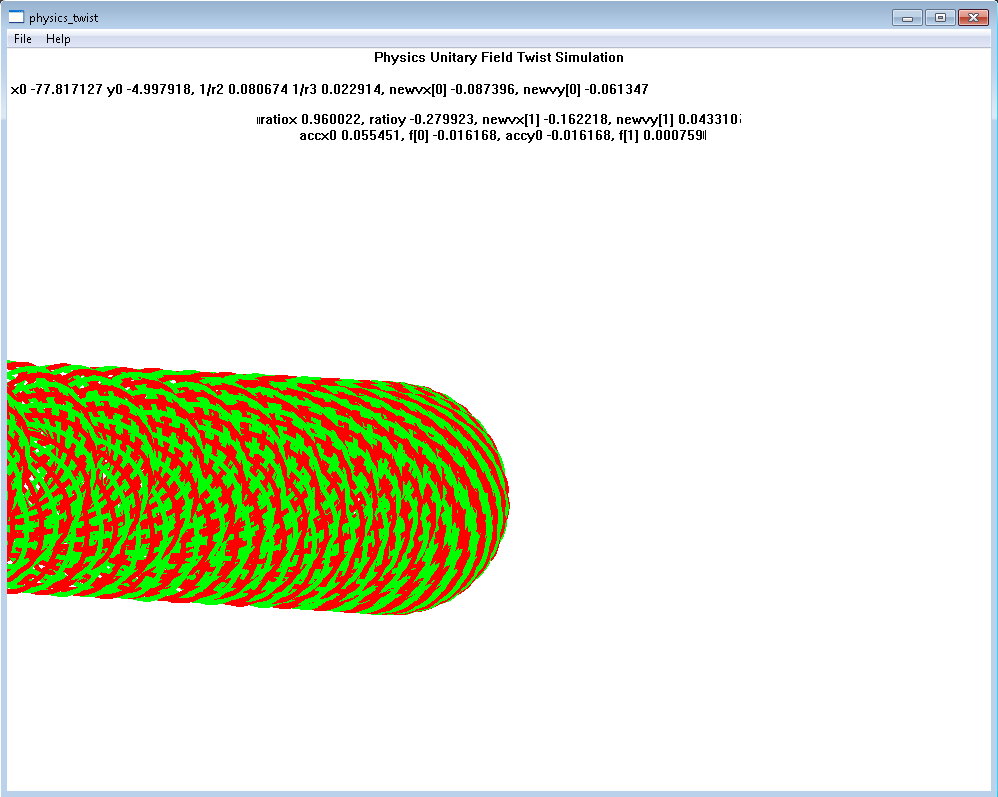
I have worked on my simulation that tests the acceleration concept that the unitary twist field predicts, and verified that it does what I expect qualitatively (quantitative calculations soon coming).  What is this?  The theory says that the twist ring of a particle twists from a real vector in R3 to I1 and back again.  If this is correct, then among other things, it should be possible to derive the acceleration of the twist ring in a 1/r^2 electrostatic field, because the twist will encounter a different distance from an electrostatic point source (I’m assuming far-field here).  The simulation without a remote field looks like this (the source field particle is to the left off screen (the real axis).  The vertical axis is the imaginary twist axis, this picture is showing a projection with one real dimension).

twist_ring_acc_nofield

But when the point source is added (it is located off-screen to the left), the twist ring moves away from the source as so:

twist_ring_acc_repulse

When the field polarity is reversed, the twist ring moves toward the source (to the left)

twist_ring_acc_attract

You can see the pattern of the rotating ring is changing, there is an acceleration as the particle moves to the left (toward the source) but when the particle moves to the right, the acceleration slows, eventually it appears to just have a constant velocity.  This sim set demonstrates how the theory explains electrostatic repulsion and attraction if particles are closed loop twists.

I used to have a charge loop theory which put the loop (twist ring) in real space (R3), but this didn’t work because the ring could have different orientations relative to a source field particle that would have to vary the electrostatic force, which is impossible.  In addition, the charge loop attraction would not compute correctly if there were three particles in a triangle.  Since the unitary twist field theory uses one common imaginary axis for twist rotation, and this is the axis of the 1/r^2 field, all particles will see an unvarying effect relative to each other regardless of their orientation in real R3 space.

Looks promising!  Next up is to quantitatively compute the acceleration, this should give the mass of the particle via the inertial factor.  From that, I should be able to show how mass results from the twist frequency, which is directly a function of the strength of the magnetic field relative to the electrostatic field, which comes from (or defined by) the fine structure constant.   If this collection of derivations matches reality, then maybe this theory is worth looking at!

Agemoz