Posts Tagged ‘twist ring physics’

Noncausal Characteristics of Quantum Interference Solitons

July 6, 2019

In physics I fully understand the need to filter out the crackpots and their onslaught of verbiage, whether wrong, vague, incomplete, or meaningless.  Real science is built on a very large collection of proven concepts–if any component is wrong but makes it into the collection, trust in the system as a whole is damaged.  If you look at Arxiv.com, there’s some junk that somehow got in there, and that means you need some system of qualifying what you see so you can trust what you use in your own work.  To avoid this, new papers submitted to journals always require verification by qualified reviewers.

The problem I am having is that I tried very hard not to be a crackpot, I think i proved something important, wrote a paper that got good qualified pre-reviews, and submitted 5 times and got 5 rejections.  Nobody looked at the proof and said I did something wrong, and nobody showed me why my conclusion was wrong.  Two of the journals were probably not the right target for the paper (this), but the other three did not see value in what I did.  The trouble is–I still think the idea is important, and that the proof is valid (confirmed by the pre-reviews).

Basically, in the paper, I proved that if a classical Newtonian particle is formed by a Fourier composition of a specific class of waves, the particle must obey the principles of special relativity.  The class of waves is simple–a phase change across any wave component is noncausal, that is, instantaneous across the length of the wave, but the rate of change of that phase is causal, or limited to some maximum change per unit of time such as the speed of light.

To me, this is incredibly important because it suggests the converse–if something obeys the principles of special relativity, it must *only* be composed of instantaneous phase waves.  I haven’t proven the converse–working on it–but if this is true, then this opens a big door into what causes the existence of subatomic particles.  A logical analysis of the two-slit experiment and the entangled particle decoherence behavior comes from the paper’s derivation (discussed in previous posts).  It also shows how a soliton (stable construct) could emerge due to quantum interference (see the last two posts).  And now, it shows specifically how the waves have to exist in the first place–very specifically showing what oscillations form the waves and where causality comes from.  From this, I see how the concepts of space and time might emerge out of something like the Big Bang.

You see, if a delta function of some sort is present in 3D space, and it is composed of these instantaneous phase waves, you *cannot* see the delta function do this:
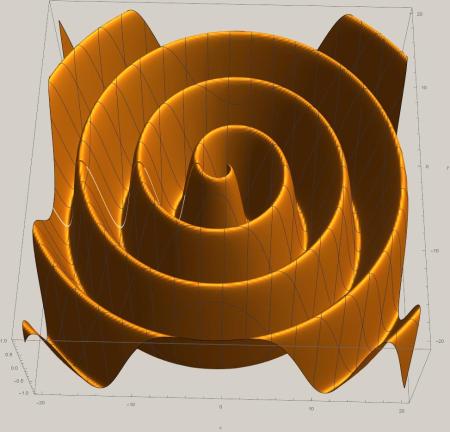
single_spiral

The waves are instantaneous!  Here you see variations in space (and time, if you were to make a movie of the particle).  But that’s not possible with one delta function–it does not oscillate.  Oh, ok, no problem, handwave it and make it oscillate from a + to – peak and back again.  You *still* would not see this first figure–the wave phases are instantaneous, but this picture has variations in space and time.  Even if you put two of these delta functions near each other, one that is Pi/2 out of phase with the other, you would see something like this, where the two delta functions oscillate up and down out of phase with each other (this shows the Pi/4 halfway point):double_deltaThere are no waves here, because the sum of the delta functions can never produce anything but a plane, no matter how fast they oscillate in time.  I realized that now I think I know why electrons are not deBroglie circular waves with a Compton radius size–they have to be infinitely small.  The waves shown in the first figure have to result from a non-causal sum of a rotating and infinitesimally spaced, oscillating pair (or more) of delta functions.  Space and time for a particle emerge in a non-causal way from the orbiting pair of oscillating delta functions to produce the spiral waves shown in the first figure.  Only then could you see non-causal spiral waves emerge.  There’s other work I’ve done that shows that the delta functions must reflect some sort of twisting vector field in R3 + I  (NOT an EM field vector, those are photons).  Along the same lines, I’m sure you’ve seen the recent experimental observation of twist momentum found in photons.  Can you see why I see so much exciting work emerging from the simple theorem proof I describe in the paper?  Frustrating not to be able to publish it–I think I have something there, but can’t convince anybody else of it!  And until someone else sees the validity of what I’ve done, there’s no science here.

Auuggh!

Agemoz


Lattice fields and Specular Simulation (latest work)

August 25, 2012

The latest work on the twist model is proceeding.  This work makes the assumptions noted in previous posts–EM interactions are mediated by photons as a quantized linear field twists.  The current work assumes these photons comprise the macroscopic electrostatic and magnetic field,  are unitary, and that they are sparse (do not interact).  It assumes that the twist has a common imaginary axis and three real dimensions on R3, similar but not the same as the QFT EM field, which is a complex value on R3 (t is assumed in both cases).  Electron-photon interactions occur when a twist ring captures a linear twist and absorbs it.  I am assuming that a photon twist is magnetic when the real axis of the twist is normal to the real dimension direction of travel, and is electrostatic when the real axis of the twist is tangent to the direction of travel (note how relativistic motion will alter the apparent axis direction, causing the expected shift of photons from electrostatic to magnetic or vice versa).

This set of assumptions creates a model where the linear twist of the photon will affect a twist ring electron in different ways depending on the photon twist axis direction.  Yes, this is a rather classical approach that ignores the fact that quantum interactions are probability distributions, among other things.  My approach is to create a model simulation environment to test the hypothesis that quantization can accurately be represented by field twists, the foundation of the unitary twist field theory.  It does not currently include entanglement, which I represent as the assumption that field twist phase information is instantaneous but that particles (twists) are group wave assemblies that propagate no faster than the speed of light.

These assumptions require that I make changes to my current simulator, which is a lattice approximation of a continuous vector field twist.  I was able to show in that simulator that a continuous twist solution could not work due to the unitary field blocking effect.  From that (and from QFT), I concluded that the twist field must be sparse and specular, where interactions are mediated by linear twist photons that do not interact.  I cannot use my existing simulator for this model but must make a new version, which is underway.  It will take a while so my posts will become less frequent until I get this working.

However, since I am now going away from a lattice simulator to a sparse model simulator, it did make me think about lattices as a representation of existence, and I concluded that that cannot be.  I have often seen theories that our universe is a quantum scale lattice of Planck length.  This supposedly would explain quantization, but I don’t think it works–the devil is in the details.  If the lattice is periodic, such as an array of cube vertexes or tetrahedral vertices, then there should be angles that propagate photons differently than others.  If our existence is spinning on a periodic lattice, we should see harmonics of that spin as background noise.  Within the range of our ability to detect such “radiation” from space, neither are happening.

So, suppose the lattice is not periodic but is a random clustering of vertexes, which solves the problem of periodicity causing background frequencies.  In that case, I would expect that photon propagation would have velocity variation as it propagated through varying spacing of vertexes.  There would have to be an upper bound to the density of vertexes to ensure apparent constant speed, and I struggle to think what would enforce that bound.  This is probably the most workable of the lattice ideas, but due to the necessity of a vertex spacing constraint, there would have to be an upper limit to the allowable energy of a photon, something we have no evidence for.  At this point, I think there is no likelihood that existence can be described as a lattice.  That hypothesis is attractive because we can easily imagine a creator God could build a computer that could most easily create a model of existence using a lattice of some form.  But even though the Planck length lattice is far too small for us to detect directly, I don’t think the evidence points that way.  (Side note:  it’s so interesting to look at early literature to see the historical evolution of what people thought formed the underlying basis for our existence–early on, God creating and controlling a mechanical model, then universe models were complex automated assemblies of gears and pullies, then the steam-engine or steam-punk type of machine, then mechanical computing engines, and now computer program driven machines simulating a lattice…  What is next? !)

Back to the lack of evidence for an underlying lattice to our existence.  This is a more important  realization than it might appear, especially from a philosophical standpoint.  If there was evidence that the universe was built on a lattice, that would strongly imply creation by a being, because a lattice is an underlying structure and constraint.  Evidence that there is no lattice, which is what I think I am seeing, would imply that there is no higher being because it is hard for me to imagine constructing a world without a lattice.  Of course, it would only be a mild implication, because my ability to imagine how a universe could be constructed without a lattice is limited.  Nevertheless, it is a pointer in the direction of existence coming from nothing rather than being constructed by a God.

Pretty interesting stuff!  More to come as the new simulator work gets underway.
Agemoz

twist ring

May 4, 2009

I spent some time thinking about the twist ring in the context of getting inertial mass from it. This is really important because this might point to an experiment that will for once and for all prove or disprove the ring idea for an electron–if a non-moving electron has a measurable ring size rather than the Standard Model point, relativistic collisions done in accelerators will distort the ring and make it look like a point. But if a non-linear field (for example) could show a motion explained by the ring components at different field points, a case could then be made for the ring model.

The old idea was that the process of applying an electrostatic force to a ring causes a change in path of the wave that might be found to be dependent on the frequency of the wave, and thus would be a connection to the ring’s momentum. When I did this analysis years ago, I ran into some issues. I did find a force proportionate to the field, but it was “close” rather than exact–and it depended on the field having a sinusoidal component at the frequency of the ring. There’s a number of problems here–the orientation and phase of the ring relative to the field, the quantum entanglement requirement that phase doesn’t behave causally, and worst of all–it doesn’t work in a multiparticle environment (the field will not be single sinusoidal anymore).

So, some more thinking lately, because I wanted to revisit the inertial mass idea. I thought that the inertial component might show up as the difference in field values or perhaps by computing the second order effect of a 1/r^2 non-linear field. However, this really doesn’t work, because since the ring has both a and – component, there cannot be a net effect. It is possible that there is a step effect depending on the ring phase–if the positive charge is closer to the field source, a step will go in that direction, then when the negative charge is there, there is a step in the opposite direction, and so on. In time, it is conceivable that there would be a net result, but I don’t think so–as soon as the step is taken, there will then be a *stronger* repulsion, hence a bigger step in the reverse direction, taking us back (literally) to square one. Even if there were a delta, why does an antiparticle move in the opposite direction–it also is a spinning particle with a positive and negative step.

Then it hit me–all these problems can be solved with a *twisted* ring! Now the scheme works in a uniform field–because the opposite side of the twist has the opposite twist–an unraveling that is necessary for the quantized ring energy (the wave vectors of each dipole element has to line up to connect). Now, the twist on the opposite side has the opposite spin and opposite direction, thus canceling each other out–resulting in both sides having the force applied in the same direction and working together to move the particle one way or the other. Electron rings then would spin one way or the other, whereas positrons would *twist* in the opposite direction. And this scheme has no dependency on a sinusoidal field or multiparticle field sources.

Let’s make sure that twist rings provide the right number of degrees of freedom:

a: spin up electron: ^ v, spinning clockwise (right hand rule twist in v dir)
b: spin down electron: v ^, spinning counterclockwise (right hand rule twist)
c: spin up positron: ^ v, spinning clockwise (left hand rule twist in v dir)
d: spin down positron: v ^, spinning counterclockwise (left hand rule twist)

This doesn’t work, because the spin up and spin down cases as shown are identical. Careful study will show that a clockwise spin from the top view looks like a counterclockwise spin from the bottom view, even the twists and spin moment will be the same. But if the twist pair is either a pair of identical twists or opposite twists (either a Pi/2 -Pi/2 twist or a Pi/2 Pi/2 twist) then the antiparticle spin-up and spin down will be geometrically different than the particle spin-up and spin down. The trouble with that is–only the twists that are opposite will have a net force in the same direction for both poles. But then there’s a problem with quantization–an unraveling does not have to be a multiple of Pi for a twist angle. Only the Pi twist followed by another Pi twist will enforce an integral momentum.

So–how do we get the required two degrees of freedom with a twist ring? By realizing that the twist has a complex phase component. There is a spin phase within the spin ring. When we look at *what* spins in the twist, we see a complex vector–so you could imagine, for example, that the twist has the real component first, then the imaginary component–or, vice versa. The necessary and sufficient two degrees of freedom are only provided by a ring–the direction of the twist relative to the ring spin direction, and the phase direction of the complex components of the twist. The standard model point electron cannot do anything with a point except say that we don’t know what distinguishes a spin up from a spin down electron or from a positron and an electron. Only the twist ring provides the exact model needed for the correct number of degrees of freedom.

Agemoz