Posts Tagged ‘twist theory’

New Papers on Speed of Light Variation Theories

April 28, 2013

A couple of papers to a European physics journal (http://science.nbcnews.com/_news/2013/04/28/17958218-speed-of-light-may-not-be-constant-physicists-say?lite –probably not the best place to get accurate reviews, but interesting anyway) attempt to show how the speed of light is dependent on a universe composed of virtual particles.  The question here is why isn’t c infinite, and of course I’ve been interested in any current thinking in this area because my unitary twist field theory posits that quantum interference results from infinite speed wave phase propagation, but that particles are a Fourier composition that moves as a group wave that forms a twist.  Group waves form a solition whose motion is constrained by the *change* in the relative phases of the group wave components.

Both theories were interesting to me, not because they posited that the speed of light would vary depending on the composition of virtual particles, but because they posit that the speed of light is dependent on the existence of virtual particles.  This is a match with my idea since virtual particles in the unitary twist field theory are partial twists that revert back to a background vector state.  Particles become real when there is sufficient energy to make a full twist back to the background state, thus preserving the twist ends (this assumes that a vector field state has a lowest energy when lining up with a background vector state).  But virtual particles, unlike real particles, are unstable and have zero net energy because the energy gained when partially twisting is lost when the twist reverts back to the background state.

These papers are suggesting that light propagates as a result of a constant sequence of particle pair creation and annhiliation.   The first glance view might be that particle pair creation is just a pulling away of a positron and an electron like a dumb-bell object, but because charged particles, virtual or real, will have a magnetic moment, it’s far more likely that the creation event will be spiralling out–a twist.  Yes, you are right to roll-your-eyes, this is making the facts fit the theory and that does not prove anything.  Nevertheless, I am seeing emerging consensus that theories of physical behavior need to come from, or at least fully account for, interactions in a sea of virtual particles.  To keep the particle zoo proliferation explanation simple, this sea of virtual particles has to be some variation of motions of a single vector field–and in 3D, there’s only two simple options–linear field variation, and twists.   Photons would be linear twists and unconstrained in energy–but particles with rest mass would be closed loops with only certain allowed energies, similar to the Schrodinger electron around an atom.  Twists in a background vector field also have the advantage that the energy of the twist has to be quantized–matching the experimental E=hv result.

Agemoz
Higgs and time for me to move on

March 18, 2013

The evidence for the recently found Higgs particle is starting to look pretty solid–the Standard Model made a successful prediction, which means any alternate physics viewpoint is going to have an especially high bar to clear–as if crackpot physics doesn’t already.

While my twist field idea doesn’t contradict anything in the Standard Model, the Higgs is an explanation for some portion of the mass of various particles.  The twist field approach has a different means to get mass, and I don’t see any overlap, which raises the question of whether it is worth my time to continue to work out twist field simulations and derivations.  The twist field approach gives rise to 3D+T solutions that form some  stable particles, and my thought has been that the other particles, including possibly the Higgs, are just more complex geometrical arrangements of twists.

Nevertheless, progress in finding an underlying geometry for the particle zoo now seems more likely to come straight from the Standard Model rather than this twist field idea, which came directly from the E=hv concept as a way to quantize a field structure.  A concept as basic as a twist field should have led to some new revelations similar to the magnitude of the Higgs particle find, but all I have found has been some degree of confirmation of stuff we already know.

I think the time has come to put aside this effort.  Not all paths lead to truth, and while this path has not ended conclusively, I think my travels on it have.  Others may find some validity to the ideas I’ve brought here and continue this line of thought, but not me.

Sayonara to all, I have new worlds waiting for me.

Agemoz


Gaussian Wave Packets

February 20, 2013

It’s been a little while since I’ve posted, mostly because I have an unrelated big project going on, so I’ve been focusing on trying to get that out the door.  And, I’m working on getting the twist ring inertial math to work, a laborious project since the Lagrangian equation of motion has too many variables for solving.  I’m trying to find ways to simplify.  In addition, I also have an iterative sim of the inertial response ready to go but haven’t had time to set it up and run it.  Hopefully with the other project almost done I’ll get to it this weekend.

One thought I’ve had in the meantime–many  quantum mechanics exercises involve modeling a photon with a wave packet that is described as having the Gaussian integral form.  The most basic variation of this form (Integral[Exp[-x^2]]) is a bell shaped curve with amplitude 1 at zero and asymptotically goes to zero at +/- infinity.  I’ve had lots of lectures where an oscillating squiggle is used to represent the magnitude of the quantized photon wave packet.

A very interesting thought occurred to me is that this integral is a great representation of the unitary twist version of a photon packet.  A one dimensional magnitude projection of a twist from the Unitary Twist Field Theory would be represented exactly by a Gaussian curve, and if we use a complex value r to completely represent the twist function, then the Gaussian integral becomes Integral[Exp[-r^2]] and then this can be interpreted as a working model of twists–and thus support the notion that the twist theory has a well proven basis in the math of quantum mechanics.  Do I buy that, or should my skepticism meter be dinging my thinking process?  Right now, the idea looks pretty workable–it seems pretty clear that the r form clearly would represent a twist as well as a Gaussian envelope packet over a frequency of oscillation of E and B fields–making the twist theory a viable alternative to the magnitude constrained wave packet interpretation.  For the twist theory to be acceptable, there has to be a path to the math of quantum mechanics, and I think I see how this could happen.

Agemoz

Noncausal Interactions, part II

December 11, 2012

I want to clarify the previous posting on how I resolve the noncausal paradox in unitary twist field theory–after all, this is the heart of the current struggle to create a quantum gravity theory.  Here, I’m continuing on from the previous post, where I laid out the unitary twist field theory approach for quantum interactions.  In there, I classified all particle interactions as either causal physical or noncausal quantum, and quantum interactions fall into many categories, two of which are interference and entanglement.  These two quantum interactions are non-causal, whereas physical interactions are causal–effects of physical interactions cannot go faster than the speed of light.

Many theories have attempted to explain the paradoxes that result from the noncausal quantum interactions, particularly because relativity theory specifies that no particle can exceed the speed of light.  The Copenhagen interpretation, multiple histories, string theories such as M theory, the Pilot wave theory, etc etc all attempt to resolve this issue–but in my research I have never found anyone describe what to me appears to be a simple solution–the group wave approach.

In my previous posting, I described this solution:  If every particle is formed as a Fourier composition of waves, the particle can exist as a group wave.  Individual wave components can propagate at infinite speed, but the group composition is limited to speed c.  This approach separates out particle interactions as having two contributors:  from the composite effect of changing the phase of all wave components (moving the center of the group wave) and the effect of changing the phase of a single fundamental wave component.  If the individual wave components changed, the effect is instantaneous throughout spacetime, but there is a limitation in how quickly the phase of any give wave component can be changed, resulting in a limitation of how quickly a group wave can move.

It’s crucial to understand the difference, because this is the core reason why the paradox resolves.  Another way to say it is that when a change to a wave component is made, the change is instantaneous throughout R3–but the rate of change for any component has a limit.  An analogy would go like this: you have two sheets of transparency paper with a pattern of parallel equally spaced lines printed on it.  If you place each sheet on top of each other at an angle, you will see a moire pattern.  Moving one sheet relative to the other will move the moire pattern at some speed limited by how quickly you moved the sheet.  But note that every printed line on that sheet moved instantaneously relative to every other line on that sheet–instantaneous wave component movement throughout R3.  Note that the interference pattern changes instantaneously, but the actual movement of the moire pattern is a function of how fast the sheets are moved relative to each other–exactly analogous to what we see in real life.  This is the approach that I think has to be used for any quantum gravity theory.

Agemoz

Noncausal interactions in the Unitary Twist Field Theory

December 10, 2012

It’s been a little while since I’ve posted, partly because of my time spent on the completion of a big work project, and partly because of a great deal of thinking before posting again (what a concept!  Something new!).  This blog has traveled through a lot of permutations and implications of the unitary twist field theory.  It starts by assuming that the Standard Model is valid, but then tries to create an underlying geometry for quantization and special relativity.  This twist vector field geometry is based on E=hv, and has worked pretty well–but when we get to entangled particles and other noncausal aspects of quantum theory, I’ve needed to do some new thinking.  While the noncausal construct is easily built on group wave theory (phase information propagates at infinite speed, but group Fourier compositions of waves that make up particles are limited to speed c), there are significant consequences for the theory regarding its view of the dimensional characteristics of the 3D+T construct of our existence.

As I mentioned, the unitary twist field theory starts with E=hv, the statement that every particle is quantized to an intrinsic frequency.  There really is only one way to do this in a continuous system in R3+T:  a twist within a background state vector field.  Twists are topologically stable, starting from the background direction and twisting to the same background direction with an integral turn.  Quantization is achieved because partial turns cannot exist (although virtual particles exist physically as partial turns for a short time before reverting back to the background state).  With this, I have taken many paths–efforts to verify this pet theory could really work.  For example, I tested the assumption of a continuous system–could the field actually be a lattice at some scale.  It cannot for a lot of reasons (and experiments appear to confirm this), especially since quantization scales with frequency, tough to do with a lattice of specific spacing.  Another concern to address with twist field theory occurs because it’s not a given that the frequency in E=hv has any physical interpretation–but quantum theory makes it clear that there is.  Suppose there was no real meaning to the frequency in E=hv–that is, the hv product give units that just happen to match that of frequency.  This can’t be true, because experimentally, all particles quantum interfere at the hvfrequency, an experimental behavior that confirms the physical nature of the frequency component.

So–many paths have been taken, many studies to test the validity of the unitary twist field theory, and within my limits of testing this hypothesis, it seems so far the only workable explanation for quantization.  I believe it doesn’t appear to contradict the Standard Model, and does seem to add a bit to it–an explanation for why we see quantization using a geometrical technique.  And, it has the big advantage of connecting special relativity to quantum mechanics–and I am seeing promising results for a path to get to general releativity.  A lot of work still going on there.

However, my mind has really taken a big chunk of effort toward a more difficult issue for the unitary twist field theory–the non-causality of entangled particles or quantum interference.  Once again, as discussed in previous posts here, the best explanation for this seems pretty straightforward–the particles in unitary twist field theory are twists that act as group waves.  The group wave cluster, a Fourier composition, is limited to light speed (see the wonderful discovery in a previous post that any confined twist system such as the unitarty twist field theory must geometrically exhibit a maximum speed, providing a geometrical reason for the speed of light limit).  However, the phase portion of the component waves is not limited to light speed and resolves the various non-causal dilemmas such as the two-slit experiment, entangled particles, etc, simply and logically without resorting to multiple histories or any of the other complicated attempts to mash noncausality into a causal R3+T construct.

But for me, there is a difficult devil in the details of making this really work.  Light-speed limited group waves with instantaneous phase propagation raises a very important issue.  Through a great deal of thinking, I believe I have shown myself that noncausal interactions which require instantaneous phase propagation, will specify that distance and time be what I call “emergent” concepts–they are not intrinsic to the construction of existence, but emerge–probably as part of the initial Big Bang expansion.  If so, the actual dimensions of space-time are also emergent–and must come from or are based on a system with neither–a zero dimensional dot of some sort of incredibly complex oscillation.  Why do I say this?  Because instantaneous phase propagation, such as entangled particle resolving, must have interactions in local neighborhoods that do not have either a space or time component.  Particles have two types of interactions–ones where two particles have similar values for R3+T (physical interactions), and those that have similar values only in phase space.  In either case, two particles will affect each other.  But how do you get interactions between two particles that aren’t in the same R3+T neighborhood?  Any clever scheme like the Standard Model or unitary twist field theory must answer this all important question.

Physicists are actively trying to get from the Standard Model to this issue (it’s a permutation of the effort to create a quantum gravity theory).  As you would expect, I am trying to get from the unitary twist field theory to this issue.  Standard Model efforts have typically either focused on adding dimensions (multiple histories/dimensions/string theories) or more exotic methods usually making some set of superluminal assumptions.  As mentioned in previous posts, unitary twist field theory has twists that turn about axes in both an R3 and a direction I that is orthogonal to R3 in time.  Note that this I direction does not have any dimensional length–it is simply a vector direction that does not lie in R3.  When I use the unitary twist field theory to show how particles will interact in R3+T, either physically or in entangled or interfering states, those particles would simply have group wave constructs with either a matching set of R3+T values (within some neighborhood epsilon value) or must have matching phase information in the I space.  In other words, normal “nearby”  interactions between two particles happen in a spacetime neighborhood, but quantum interference interactions happen in the I space, the land that Time and Space forgot.  There is no dimensional length here, but phase matches allow interaction as well.  This appears to be a fairly clean way to integrate noncausal behavior into the unitary twist field theory.

Obviously, there are still things to figure out here, but that is currently the most promising path I see for how unitary twist field theory will address the noncausal interaction construct issue.

Agemoz


Experimental Confirmation of Lattice-Free Spacetime

September 1, 2012

In my previous post, I posited that spacetime cannot be a lattice at Planck scale distances, and by sheer coincidence, this completely different experimental report also confirms the likelihood that spacetime is smooth at this scale:

http://www.space.com/17399-gamma-ray-photons-quantum-spacetime.html

A smooth spacetime means that Planck scale lumpiness (a lattice of one of the types I describe in the previous post) will not explain quantization.  I suspected that anyway, because quantization is scale independent.  Low energy photons are quantized over distances that are enormously vast (hundreds of orders of magnitude) compared to Planck scale distances, so I did not see how a lattice could induce that quantization.

The field twist is also scale independent, so is another nice arrow in the quiver for unitary twist field theory.  But I’m grappling with a big problem as I develop the specular simulator for the unitary field twist theory.  The probability of electron motion is affected by its ability to self absorb a virtual photon, and this probability is directly proportionate to the fine structure constant.  I believe that this number is the square of the probability to emit and the probability to absorb, making each have about an 8 percent chance of occurring.  Physicists have absolutely no clue why this probability is what it is.  QFT gives no guidance but uses the experimentally determined value of interaction probability as a foundation for every quantum interaction of particles and fields.

As usual, I am trying to find a geometrical reason that the unitary field twist theory might give that probability–some ideas, but nothing obvious.  I have to figure something out before I can even start constructing the specular sim.

Agemoz

Continuous Fields Cannot be Linear

June 10, 2012

A shocking revelation for me, in all my years both as a professional electrical engineer and as an amateur physicist.  I realize I have zero credibility out there with anyone, but at least for myself, I have discovered something fundamental about fields that I did not know.  Perhaps if I were a mathematician I would have worked this out.  Nevertheless, it is quite provable in my mind, and has enormous impact on how I must model the two particle interaction, whether by QFT or unitary twist field theory.

The concept of linear central force fields means that multiple potential sources create the field by means of linear superposition.  If you have two sources of potential, the effect on the field at any point is the sum of the effect due to either one.  There are potential corner cases such as if the potential is infinite at the point source, but in every finite potential situation, the field is the sum of all sources at that point.  Electrostatic fields are supposedly both continuous and linear, but this cannot be at the quantum scale.

I have been discussing in previous posts the concept of a median plane between two charged sources, and particularly enlightening was the attraction case of a positive and negatively charged particle.  Between these two particles will be a median plane whose normal runs through both particles.  This median plane can have no absolute potential (relative to the electrostatic field potential at infinite distance).  This field cannot pass any information, even about the existence of, one charged particle through this median plane.  In fact, it is well known in electrostatics that if you put a metal plane between two particles and ground it, you will get the same charge field distribution as if the second particle wasn’t there–it cannot be determined if the second particle actually exists or not.

The only way a field can pass information across this median plane is if the field is not continuous.  If the field  is created by a spaced array of quantized particles, such that they never, or almost never, interact, then the effect of the field can be made linear.  Indeed, shooting real photons at each other could collide, but that is exceeding rare, and modeling the field by photons, virtual or real, in either QFT or unitary twist field theory,  would produce a linear superposition of fields.  But there is no question now in my mind that if I simulate this, I cannot assume a continuous electrostatic field, such a thing cannot exist.  This field has to be almost entirely empty, with only very sporadic quantized particles, then I can see how linearity would be possible.  Every quantized particle that interacts with a quantized particle from the other source will distort the appearance of linearity, so the fact that deviations from linearity are experimentally unmeasurable strongly points to a extremely sparse field component density.

I had thought that QFT virtual particles could construct a continuous field in a Taylor or Fourier series type of composition, but it is clear that it cannot.  The QFT virtual particles must be exceedingly sparse, just like the twists in unitary twist field theory.  It also suggests that QFT virtual particles would have to clump in some way in order for localized neighborhoods in the field to obey conservation.

Now I see a workable model for twists.  The median plane problem cannot exist if the field is not continous.

Agemoz

What Electrostatics Tells Us

June 7, 2012

I am attempting to work out a viable unitary twist field approach for the attraction and repulsion of charged particles.  I’ve discovered symmetry requires that the vector field would have to have a median plane where there is only a background state, which leads to problems describing how one particle would communicate via the field to another particle (so that the particles, if identically charged, would experience a force of repulsion.   It appears that this problem would also be experienced by QFT since it mediates by virtual photons, which are best described as partial field components that mathematically sum to get the desired result, but individually do not obey various properties such as conservation of energy or momentum.

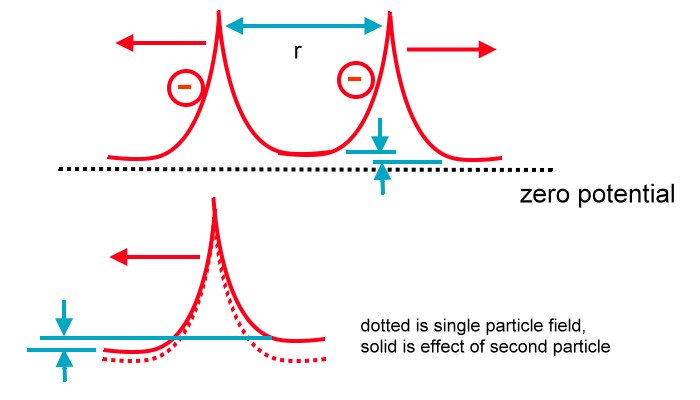
It will be instructive and potentially guiding to look at the two particle system from an electrostatics point of view.  Here are two figures, one for the two-electron case of repulsion, and one for the electron-positron case of attraction.  Note that the receiving particle experiences a force in the direction that is closest to the ground state potential in both cases.  If the field adjacent to a particle is radially unequal, the particle tries to move so that the field is closer to the ground state on every side of the particle.  It is interesting that in one case (the two electron repulsion state) the median plane is *not* at the ground potential, but in the attraction state, it is.  I see that from an electrostatics point of view, the median plane state, whether background or not, does not affect particle communication, whether by virtual photons in QFT or by bend of the imaginary vector in unitary twist field theory.  It is the field neighborhood, particularly the unequal, or unbalanced, aspect of the field near a particle that has to be responsible for forces on the particle.  It is not clear if the force is due to trying to minimize the overall field neighborhood to be close to the ground state, or if the force is merely trying to equalize the neighborhood (in fact, it is likely that both explanations mean the same thing given the relative nature of electrostatic potential).

The field near an electron when near another electron. Note how the force on a particle moves it toward a more equal field neighborhood.


Electrostatic field for the electon-positron attraction case. Once again, the particle moves to a field neighborhood closer to the ground state.

I will think on this, this means something for both QFT and unitary twist field theory–but exactly what is not clear in my mind yet.

Agemoz

It must be my Imaginary Imagination

April 28, 2012

This modification to the unitary twist theory has everything going for it.  Here’s what happened: the twist theory needs a background state for quantization to work–enforcing integer twists means that all twist rotations except for one (the background state) to be unstable.   I originally put this background state  in R3 along with the rest of the twist rotation, but this ran into problems trying to work out charge forces–the requirement for gauge invariance becomes a show stopper.

So, using the fact that EM fields and photons are mathematically described as a complex wave function in C3, I proposed that the background state direction be an imaginary axis.  The twist would reside in a plane defined by one real vector and the single background vector pointing in a direction orthogonal to R3.  Now the photon wave equation immediately falls out, but we still get the quantization and special relativity Lorentz transforms unique to the unitary twist field approach.  The problem with discontinuities vanish now, because the twist never appears in R3, only between R3 and I1–the real and imaginary parts.

Assigning the unitary twist field theory background state to an imaginary direction (note vector arrows are direction only, don't try to assign a physical distance to these arrows!)

What happens to the charge attraction problem?  Can we still do virtual photons, which in this variation of  the theory become partial twists (bends) from the imaginary background state to some basis vector in R3?  I am working out a generalized solution but at first glance the answer is yes.  Two particles near each other will increase the apparent bend of the background state, opposite each other cancel the bend, and 90 degrees apart generate a Sqrt[2] compounding effect, bending to between the two particles–exactly what I would expect.

So, finally, back to the original question.  Can this modification finally make a workable solution to the attraction conservation of momentum problem?  Having the background state be orthogonal to all of R3 makes this a much better problem.  Now there’s no symmetry problem regardless of electron ring orientation.  Unlike before, where the background state was in R3, now the twist moment vector is always in the plane of the ring, which means that regardless of the orientation of the ring, one side of the ring will always experience slightly less background bend than the other.  This delta bend causes a distortion in the ring path travel, making it do a motion to compensate for the shorter return path to the background state versus the other side–causing motion of the overall ring (see figure 1.)  Now there is no momentum problem due to photon energy emission for attraction–the difference in bend from one side to the other simply causes the particle to move.  Now it is easy to see how the field carries the energy.   And most importantly, the solution is symmetric, there is no R3 direction preference, so gauge invariance should hold.

Effect of a remote charge on a local particle ring. Note that regardless of ring orientation in R3 or direction of I0 bend, this drawing will be valid, uplholding rotation and spatial invariance (Lorentz invariance not shown here).

It looks to me that there is no question about it, this has to be the right way to go.

More to come…

Agemoz

The Quandary of Attraction

April 20, 2012

Hah!  You read that title and thought you were getting a socially interesting topic rather than the boring amateur physics I usually post about!  But I’m not all mean, let me help you out:  http://en.wikipedia.org/wiki/Twilight_%28series%29

OK, now that all those guys are gone, let’s talk physics.  Hello?  Anyone left?  Guess not.  Well, then I can make outrageous crackpot claims and no one will care.

Last week, Prof Jones started in on reviewing the Unitary Twist Field idea.  He’ll be back, but today I want to address a crucial question about unitary twist fields.  The basic premise is built on a geometrical model of quantization using E=hv.  I see three principles that create an underlying geometry for EM fields that gives us both quantization and special relativity (see many previous posts).  These three principles are:

1: The E=hv quantization for fields and particles  is enforced by a rotation in a vector field, that is, a twist.

2: To ensure that only single complete rotations can occur, the field must have a local background state that the rotation returns to.

3: To ensure that the energy of the rotation cannot dissipate, the vector field must be unitary.  Every field element must have constant magnitude but can rotate in 3D+T spacetime.

I have figured out that the special relativity relations hold in such a geometry–there will always be a maximum possible observable speed c, and the Lorentz equations for space and time will also hold.  The correct number of degrees of freedom for photons (linear twists) and electron/positrons (ring twists) exist.  I’ve found that the uncertainty relation will hold for particles in this system.  I’ve found a bunch of other things that appear to match reality as well.  Yes, I am guilty of massaging this theory to get the facts to fit, but I’m doing the best to do it without glossing over any obvious fallacies–and when I encounter one, I adjust the theory.  I keep waiting for one to really kill off the theory, but so far that hasn’t happened.  However here is one that could kill it:

How does the theory explain attraction and repulsion of charged particles?

Real QFT theory, unlike my la-la land unitary twist field theory, says that this is mediated by exchanges of photons.  On the surface, this has a momentum problem because there is no way a particle can emit something with momentum in such a way that a second distant particle *approaches* the emitting particle.  That violates conservation of momentum and hence conservation of energy.  The mathematically derived QFT solution uses virtual photons to have the field around the second particle change in such a way that the particle moves toward the first–but this seems disengenuous to me–contrived, just as much or worse as my theory.  Nevertheless, the math works and that is enough for real physicists.

However, I am positing a new theory, somewhat outrageous in its claims, and thus demanding outrageously thorough verification.  Unitary Twist Field theory must have a (hopefully better) explanation how attraction and repulsion would work.  This issue is part of the more general issue of electron-photon interactions, and there are a whole huge array of sub-issues that come with this one simple interaction.  For example, photons of all frequencies (energies) and polarizations can interact with an electron, so any geometrical solution must not assume any preferred orientation of the electron moment or photon polarization or external electrostatic or magnetic field (ie, nearby sets of photons).   If the electron is one of many in a region, and a low energy photon that is far “larger” than the array hits the array, how is it that exactly one and only one electron absorbs the photon?  I could go on and on, but let’s zero in on this attraction issue.  How do I claim that would work in unitary twist field theory?

Actually, let’s ask the attraction question in a slightly different way so you can see clearly what the dilemma is for real-world physics theory.  QFT says that attraction/repulsion of charged particles is mediated by exchanges of photons.  Arrays of photons form an EM field that causes charged particles to change their path of motion in space-time.  This means that in a given frame of reference, a photon must be an element of either a magnetic field or an electrostatic field.  Here’s the question:

What’s different about the photon generating an electrostatic field and a magnetic field?

Real-world theory says that photons are oscillating electrostatic and magnetic fields–a rather unsatisfactory way to describe a photon because it is self-referential.  Electrostatic and magnetic fields are themselves composed of photons.   Nevertheless, the math works, so let’s ignore that for now.  However, referring to the question about what is different, photons have only one degree of freedom, polarization.  There is no anti-particle for photons, it is its own anti-particle.   Not a lot to work with here!  So–what is a “magnetic” photon, and what is an “electrostatic” photon?  Or is there something magic about how the photons are arranged as a group that explains the field property?  And don’t forget, this is in one particular frame of reference!  Go to a different frame and the field state *changes* from electrostatic to magnetic or vice-versa.

Unitary Field Twist theory has a very novel explanation.  Let’s wait for the next post to see it.

Agemoz