 My work described on this blog can be summarized as trying to find and validate a field that could sustain a particle zoo. Previous posts on this blog detail the required characteristics and constraints on one such field, which I call a precursor field. When I began building the mathematical infrastructure needed to analyze this field, I made an absolutely critical discovery that strongly validates the whole field-to-particles approach.
I give it the “precursor” name because there are many fields in known physics, and this precursor field has to form a foundation for all of them. I’ve pursued many paths in my investigation, described in many of my previous posts, and in summary have determined the following:
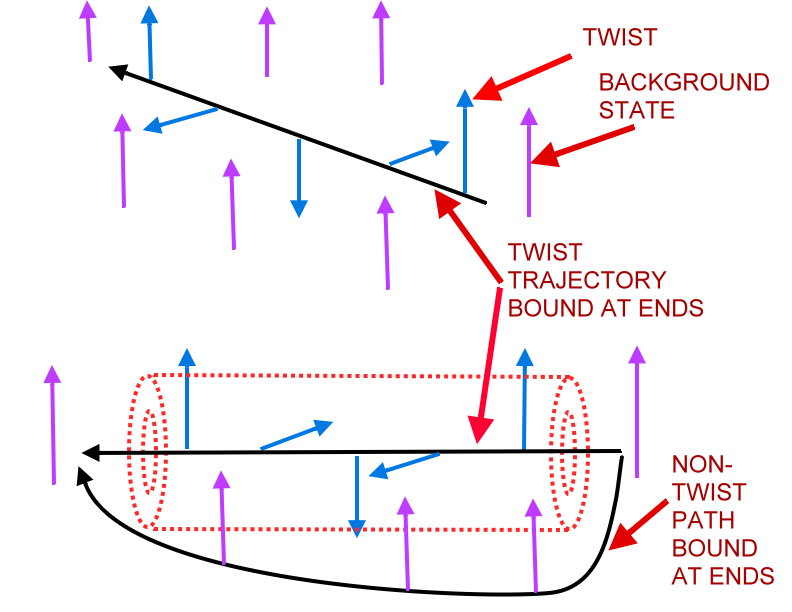
The precursor field must be single valued, unitary (directional only, no magnitude), continuous, but not necessarily analytic. It must form from a basis of three real (physical) dimensions but the field element can also point in an imaginary dimension. Because the field value is unitary with no magnitude component, it can be modeled as a rotation field. The field must have a background state pointing in the imaginary direction. I also discovered that the precursor field and its operators cannot be one of the existing fields in physics such as the EM field. It’s a new field that creates the basis for something like the quantized photon mediated EM field or the strong and weak force interactions in quarks.
If you question any of these requirements, I’d recommend looking back in previous posts where I justify my thinking–this simple paragraph just summarizes much of the work I have done in the past. I don’t want to revisit that right now, but to give you new news of a big discovery I have made about this field in the last few weeks.
I have been preparing both an analytic infrastructure and a computer sim that will hopefully provide some level of validation or refutation of the precursor field concept. The analytic work sets up the algebra that the sim will follow.
There are many issues with assuming that a continuous field will produce a particle zoo, but the biggest is what might be called the soliton problem. You can easily prove that Maxwell’s field equations cannot produce a stable particle, so historically, many efforts to quantize or otherwise modify these equations have been done without success. Compton and DeBroglie are famous for attempting this using an EM field (waves around a ring, sphere of charge, etc.) but no one has succeeded in a theory that successfully confines the EM field potentials into a stable soliton. I’ve long been convinced that you cannot use an EM field as a particle basis, and the QFT model of exchange particles (quantized photons in the case of EM field interactions) supports this way of thinking.
I discovered that the aforementioned precursor field can form either of two types of stable potential wells. The fact that the precursor field is directional only, thus field values cannot go to zero, combined with the omnipresent tendency to go to the default background state, leads both to quantization (only full integer twists out of and then back into the background state are stable) and to the formation of stable potential wells around either the background state or its opposite. I found that the background state tendency can be described as a force that is strongest when an element’s direction is normal to the background state, but is zero at either the background state or its opposite! It turns out it is nearly linear and thus forms a potential well near both zeroes. Thus a stable particle can form around a negative background state pole. You could also form a stable positive pole in a negative background state region (think antiparticles), and could even link together or overlap multiple particles in a chain or set of rings and have the result be stable. I can even visualize spontaneous formation of particle/antiparticle pairs so crucial to QFT, but that’s jumping the gun a bit right now.
It’s such an incredibly important step forward to find a field with a set of operators that could form stable particles, and I believe I’ve done that. The key is having the scalar field be unitary and having a preferential orientation–this set of field characteristics appears to succeed at producing solitons where all others have failed.
UPDATE: While this was an important finding, further work has shown that the background force has to be accompanied by a neighborhood connection, otherwise a discontinuity or possibly other cases may destabilize the particle. To truly prove that this field can produce stable particles, all issues and details need to be fully flushed out. I suspect that the idea is on the right path but I have more work to do.
Agemoz


 Agemoz's Physics Blog