CORRECTED UPDATE 19/08/10: further analysis shows that the proposed experiment isn’t going to work as proposed. I obtained a 1.1 nanometer electron wavelength for a static electron, but this is wrong. Unlike photons, fermions have a wavelength that varies as their kinetic energy, but I did this incorrectly. I recently recomputed the wavelength in a different way, simply by using E=hv. Using E=.511MeV, or 8.2^10-14 J, and Planck’s constant as 6.6^10^34 J*s, I get an electron wavelength c / v or 2.998 10^8 m/s / 1.2 10^20cyc/s, which gives a wavelength for the static electron as 0.024 nanometers. This is good news and bad news: This wavelength now means that quantum interference could be the confining property for solitons, as I originally proposed a few posts back. The bad news is that making a tilted two-slit experiment is probably not possible–the wavelength of the atoms composing the barrier is twice the length of the electron wavelength, so I think there is no realistic way to make an electron tilted two-slit barrier where the tilt could discern the electron interference pattern. Since a single slit has two edges which will cause diffraction of the electron wave on both edges, it might be possible to create a barrier of layers of cold solid hydrogen (such a barrier would have to require some sort of atomic sublayer as a base since hydrogen forms only one bond) with a single slit that generates two interfering electron diffraction waves. Tilting this barrier may be sufficient to discern whether electrons and positrons (or up-spin and down-spin electrons) produce two different interference patterns. I’m tempted to submit an NSF research grant for such a research project just to see if I get anything besides a desk rejection!
The good news part of it means I want to return to my work using quantum interference as the cause of soliton particle formation. This corrected wavelength computation now means quantum interference should produce self contained paths. I do have to assume that any particle such as the electron has to have a dipole (or more) structure, as there will be no interference pattern from a monopole. Waves, yes, but no interference that will define an orbiting path. It’s really too bad that the tilted slit experiment is beyond the reach my lab skills and equipment–it would have been great to try to answer whether the electron structure is a monopole (concentric circle waves) or a dipole (spirals or antispirals). My hunch based on all my investigative work is that it is a dipole, which means that the quantum interference redirection will produce sufficiently small paths to confine the electron waves. It’s clear to me that investigation is now the way to go.
Stay tuned!
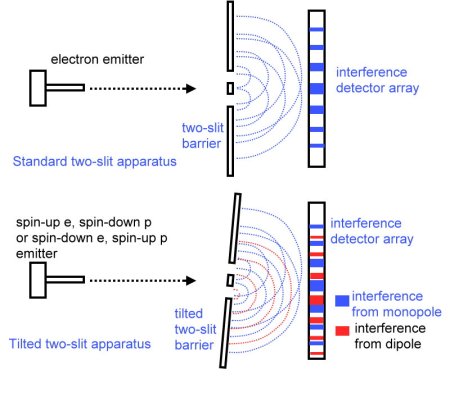 If you get two distinct interference patterns, one for each pair, the conclusion is unmistakable–the particles have a spiral wave pattern and form from a dipole. If the pattern is the same for all particles, they have concentric circle wave patterns and form from an oscillating or twisting monopole.
 Agemoz's Physics Blog