Posts Tagged ‘vector field’

Resolving the Rotation Field Contradiction

February 27, 2020

A while ago, I discovered a showstopper–a contradiction between two parts of the theory I’ve been working on that proposes an underlying unitary rotation field for the particle zoo.  The theory is based, in part, on two discoveries:  that any Fourier construction of particles (a sum of waves that results in a group wave delta function) will appear to move at constant speed regardless of observer frame of reference, thus providing a basis for special relativity, and secondly, that quantized energy states can emerge from an R3+I unitary rotation field.  Lots of work has resulted from this basic model of existence, including the quantized formation of stable solitons.

However, the showstopper problem needed to be resolved, and I think I have done so, although I’ve not proven it yet.  The problem is this:  how can a sum of waves exist in a unitary single valued vector field?  There is no magnitude component in such a field, so the only way to “sum” a Fourier composition of waves is to sum the rotations at any given point.  This doesn’t really work when you try to classically doppler shift the resulting field, there’s no wave components present in the resulting field and the special relativity behavior can’t emerge.  I’ve looked at abandoning the doppler shift approach, but there are only a few other ways that special relativity could emerge and so far they all seem unworkable as an underlying field for particles.

Coming back to the original premise, I can resolve the paradox if doppler shifting can occur on a single wave cycle (rather than requiring a sum of waves).  I believe that this should be true for this reason–when generating a Fourier sum of a delta function, normally waves of infinite span are used.  However, in the limiting case, all parts of the sum cancel out except in the region of the delta function, so the constant speed derivation is just as valid if you only use the sum of waves in the immediate region of the delta function.  A single cycle of oscillation will still doppler shift, and the apparent constant velocity of the resulting delta function is valid whether the infinite waves are summed or the region bounded (single cycle) waves are summed.  If there is only a single cycle wave present, its shape and velocity are still defined by the math of the original theorem with a different set of limits (described in this paper: group_wave_constant_speed) and now the contradiction is resolved.

There’s more work to do, I think it would be pretty easy to blow holes in this framework as it is.  Nevertheless, it’s the first time I’ve been able to work out a promising answer to the showstopper contradiction.

Agemoz


Rotation Field Momentum Transfer Induces Curvature

January 15, 2020

I am digging deep into the details of how an R3+I unitary vector field behaves.  I study this field because I’m hypothesizing that it is a good candidate for an underlying field that will produce the particle zoo of reality.  I’m not trying to figure out gravity or dark matter or any of that–I just want to find a workable underlying structure that could explain why there are stable and unstable particles, and why quantum creation operators evolve particle/antiparticle pairs.   If you take a look at some of my recent prior posts, you’ll see the thinking I used to come up with this field concept.

I really like this study, because it avoids the handwaving problem of trying to prove that some new idea represents actual reality.  Every amateur (and I’m sure most real-life physicists) have their pet idea of how things work, and the central problem in promoting that idea is not discovering new science, but rather the socio-political problem of convincing others, and in particular, professional researchers, that your idea is right.  That is a really hard problem that doesn’t involve actual science research.  I have attempted to publish papers in the past and have discovered that that activity is an exercise in futility.  What I love about my study of the R3+I unitary rotation field is that I leave that all behind–I’m just exploring how this field behaves, all the while keeping an eye out for something that might invalidate the field as a candidate for reality.

And to this end, I have discovered some great properties of this field.  The field so far shows the right degrees of freedom to produce linear and closed loop particles, shows why quantization occurs (the lowest energy state of the field is the +I rotation direction, confining twists to integer multiples of complete cycles) and clearly shows how the two types must interact.  Since (see previous posts) the field is blocking, a linearly propagating twist rotation through +I will propagate until it encounters a closed loop twist in this field.  Non-unitary fields such as an EM field permit varying vector magnitudes, including regions with zero magnitude.  In that type of field, there is no possible way that a linearly propagating twist can intercept and be absorbed by a closed loop through the center (think photon striking an electron).  But a unitary twist field, as shown in previous posts, has a very specific stable configuration of rotations that must exist in the center of the loop.  When a linearly propagating twist tries to collide with the closed loop, it cannot pass through (remember that unitary rotations cannot linearly combine, there is no magnitude other than 1).  It will pass its momentum components to the rotations in the loop, but cannot dissolve the loop unless the momentum of the linear particle approaches the momentum of the loop components and breaks the loop.  I know this sounds like handwaving, but I think if you do your own analysis of this field you will find this to be true.

Now on to the new findings:  as I dug deeper into the specifics of this interaction, I had to define exactly how rotation momentum would propagate through the rotation field, and in so doing discovered a very important principle, shown in the figure.  I described how momentum translates in spacetime with a single rule as follows–a delta rotation in R3+I propagates in the direction of rotation.  Quantization says that there must also be a background state restoration force (note that the momentum itself is not unitary, it can be zero or even infinite, and everything in between.  It’s only the vector magnitude that has to be unitary in the R3+I unitary vector field).  When looking at the geometry of this, I discovered something very important about the unitary rotation field R3+I–geometrically, if conservation of momentum is to hold, in certain circumstances, the momentum path must curve.

curved_momentum

Normally, if a quantized rotation twist propagates through the +I background rotation state, there is no reason why the momentum propagation rule wouldn’t ensure a straight line path.  However, suppose the twist passes through a region where the field is not at +I (the low energy state).  If this region is pointing orthogonal to the twist path, the resulting sum of the propagated twist rotation direction and the existing field direction would be linear and momentum magnitude and direction would be conserved.  But you cannot sum vector directions in this field–it is unitary, only rotations are allowed.  The only way the incoming momentum magnitude could be conserved is if the rotation follows a curved path (see illustration).

What this means is that in most circumstances, linear twists will propagate in a straight line since the default state for the path will be at the +I rotation direction.  But if it passes through a field region where there is an angle offset from +I (for example, in the neighborhood of a closed loop particle), it will curve in the plane of the angle offset and the direction of travel.  Two adjacent twists will curve antiparallel to each other and produce a sustained closed loop path, thus forming a field soliton.

In earlier posts, I hypothesized that quantum interference in an R3+I system would redirect a particle’s linear path and form a soliton–we know that to be true from experiments like the two-slit experiment, but I didn’t know why the curvature  would happen.  I was on the right path with quantum interference, but by breaking down how rotations must propagate, now I know geometrically that if we assume a unitary rotation vector field, then closed loop particles must occur.  Even better–the effect is contravariant.  That is, higher twist momentums lead to smaller closed loops.  In Newtonian physics’ descriptions of orbiting particles, the larger the momentum, the larger the resulting orbit.  The effect on path is covariant.  But you should be able to see (reference the figure) that in the R3+I unitary rotation vector space, the larger the momentum, the greater the curvature must be to conserve momentum magnitude, and the smaller the resulting path must be.  This field clearly provides the means for the contravariant relation between particle energy and particle wavelength–something no other theory that I know of has been able to explain.

Agemoz


Properties of a Unitary Rotation Field

January 6, 2020

The unitary rotation field in R3+I dimensions is part of a quantum interpretation that obeys special relativity.   Recently I was able to show that the field can produce both linear and closed loop soliton solutions that do not produce discontinuities in the field.  This is a big step forward in the hypothesis that this field is a good representation of how things work at the quantum/subatomic scale.   Note that this field is NOT the EM field, which under quantum field theory reduces to a system of quantized and virtual particles.

This unitary rotation vector field is derived from the E=hv quantization principle discovered by Einstein more than a century ago.  This principle only allows one frequency dependent degree of freedom, so I determined that only a field of unitary twists of vectors could produce this principle.  (I didn’t rule out that other field types could also produce the principle, but it’s very clear that any vector field that assigns magnitude to the vectors could not work–too many degrees of freedom to constrain to the E=hv property).  This has two corollaries:  first, no part of the field has zero magnitude or any magnitude other than unity, and, the field is blocking–you cannot linearly sum two such fields such that a field entity could pass through another entity without altering it.

Why did I determine that the rotation has to be in R3+I, that is, in four dimensions (ignoring time for now)?  Because of the discontinuity problem.  If the field were just defined as R3, you cannot have a quantized twist required to meet E=hv.  No matter how you set up the rotation vectors around a twist of vectors along an axis, there must be a field discontinuity somewhere, and field discontinuities are very bad for any reality based physical model.  That makes the field non-differentiable and produces conservation of energy problems (among many other problems) at the discontinuity.

However, all of quantum mechanics works on probability distributions that work in R3+I, so that is good evidence that adding a fourth dimension I for rotation direction is justified.  It doesn’t mean there is a spatial displacement component in I–unlike the R3 spatial dimensions, I is just a non-R3 direction.  And the I dimension does at least one other extremely important thing–it provides a default background state for all vectors.  In order for photons and particles to have quantized twists, a background starting and stopping vector rotation is necessary.  The unitary field thus normally would have a lowest energy state in this background state.

Aha, you say–that can’t work, the vacuum is presumably in this lowest energy state, and yet we know that creation operators in quantum mechanics will spontaneously produce particle/anti-particle pairs in a vacuum.  You would be correct, I have some ideas, but no answers at this point for that objection.  Nevertheless, I recently was able to take another step forward with this hypothesis.  As I mentioned, it is critical to come up with a field that does not produce discontinuities when vector twists form particles.  Unlike R3, the R3+I field has both linear and closed loop twist solutions that are continuous throughout.

This was very hard for me to show because four dimensional solutions are tough to visualize and geometrically solve.  I’m not a mathematician (whom would undoubtably find this simple to prove), so I used the Flatland two dimensional geometry analogy to help determine that there are continuous solutions for vector twists in four dimensions.  There are solutions for the linear twist (e.g., photons) and closed loop particles.  There are also solutions for linked closed loops (e.g., quarks, which only exist in sets of two or more).

I will follow up next post with a graphical description of the derivation process (this post is already approaching the TL;DR point).

Now, this is a very critical step indeed–there is no way this theory would fly, I think, if field discontinuities exist.  However, I’m not done yet–now the critical question is to show that the solitons won’t dissipate in the unitary rotation field.  If there are no discontinuities, then the solitons in a field are topologically equivalent to the vacuum field (all vectors in the +I background state).  What keeps particles stable in this field?  As dicussed in previous posts, my hypothesis has been to use the displacement properties of quantum interference–now that the discontinuity problem is resolved, a more thorough treatment of the quantum interference effects on the unitary rotation field approach is now necessary.

Regardless of how you think about my hypotheses that unitary rotation vector fields could represent subatomic particle reality, surely you can see how interesting this investigation of the R3+I unitary rotation field has become!

Agemoz

Details of the Linear Twist Sim

January 9, 2018

(Updates 1 and 2 below)

It’s been an amazing week working on the unitary twist field sim.  Most of the kinks in the sim coding are fixed, and what I’m finding in the sim results I think are astonishing.  Here’s what I’m finding:

a. There is now little doubt in my mind that there is a class of precursor fields based on a rotation (unitary) vector field that produces stable linearly propagating twist particles.  I’ve attempted a geometric proof, and within the limits of the assumptions I am making, the particles appear to have to be able to exist in this type of field and are stable, and so far the sim results are confirming this.

b.  An unexpected result from the sim–the particles have to move as a single rotation at the limiting speed of the sim.  This is exciting because photons cannot exist unless they move at the speed of light, and this sim shows linear twists match this behavior.  As I concluded in my last post, I realized that special relativity has to have a part to play here and in the sim it shows up as only one possible speed for the linear twist.

c.  You cannot form a stable linear twist unless you do one full rotation as defined by the local background state.  Any other partial twist dissipates (or has to be absorbed by something, e.g, virtual particles).  There is an asymmetry in the leading and trailing edge angular momentum of any linear twist–the only way to resolve this is if both ends have the same change of momentum (leading edge incurs a momentum in the next cell, the trailing edge cancels out that momentum).  This property prohibits a twist from being stable unless it completes a rotation, in which case the same change in momentum happens on both the leading and trailing edge.

d.  It is looking probable (but not proven yet) that you can curve the twist path depending on the change of rotation vectors in the path of the linear twist.  As mentioned in one my prior posts, a closed loop will create a changing tilt of rotation vectors internal and external to the loop, thus (in theory) sustaining the closed loop.  This is a big difference between this precursor field and attempts to create stable particles out of an EM field.  You cannot change the path of a photon with some EM field.  However, for the unitary twist field, I’ve already shown that this should be possible geometrically (see back a few posts), but now I need to confirm it with a sim.

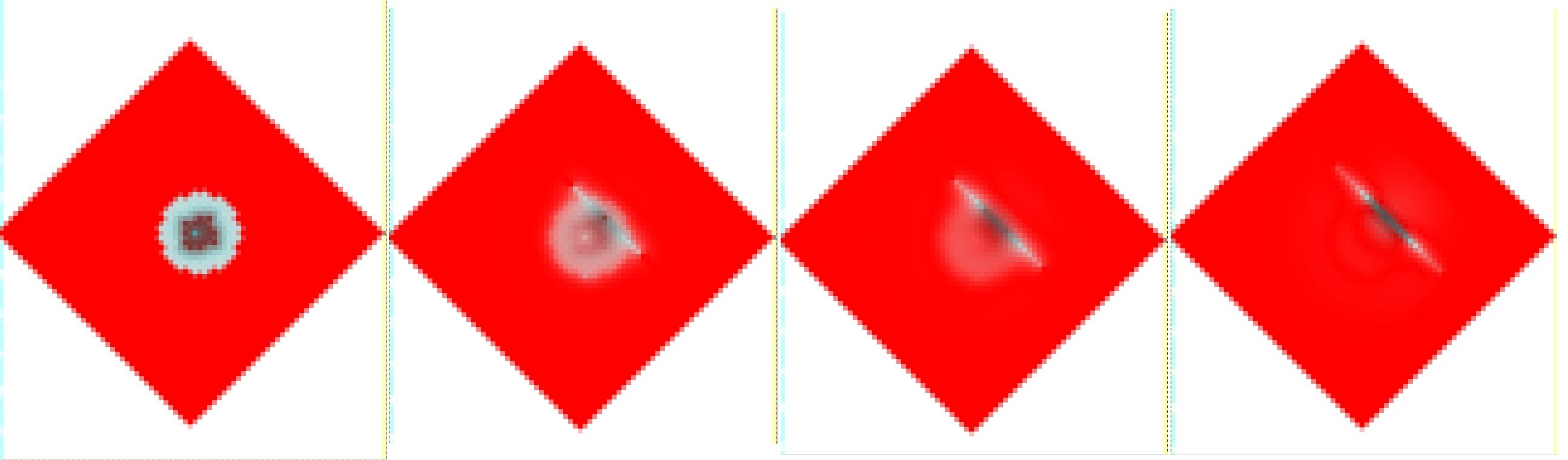
UPDATE 1:  here is a picture–probably the most unimpressive picture ever produced by a GPU graphics card!  Nevertheless, there’s a lot of computing that was done to generate it, and clearly shows both propagation and preservation of the emitted twist.  The junk to the upper left is left over from the initial conditions that emitted the twist, I’ll fix the startup code shortly, but I thought you’d like to see the early results that I thought were exciting…

UPDATE 2:  Better pictures coming.  Just like with real photons, I can make these particles any length, modeling the continuous range of frequencies available.  What is shown above is a fairly short “photon”, but I now have pictures of much lower frequency, hence longer, photon wave rotations.  I am still getting perfect reproduction of the photon model as it travels, thus solidifying the conclusion that this field yields stable solitons.  Next up–geometrically I can see that I should be able to get two parallel photons to lase–that is, phase lock.  I’ll start the sim with two out-of-phase photons near each other and see if they lock.  Stay tuned!

end of UPDATE 1 and 2

My biggest concern with thinking I have found something interesting as opposed to “not even wrong” or trivial is that I would have expected at least a few thousand real physicists would have already found this field behavior, perhaps fleshed this out a lot more than I have, and found it wanting as a theory underlying the formation of real-world particles.  This thing is simple enough that I just cannot believe that a lot of people haven’t already been here. I also still have a ton of unanswered questions (for example, issues with the background state concept, whether the +/-I state is necessary, and so on).

So–other than having a lot of fun exploring this, I don’t see anything yet that means I should write a paper or something.  I’ll keep plowing away.  As an uncredentialed amateur, I know it’s more likely I’ll win the lottery than being taken seriously by a professional researcher, and I’m fine with that.

One thing that’s going to be really fun is setting up a sim of a major collision of some sort–I hope I don’t induce a cybernetic singularity and wipe out the universe…. 🙂

Agemoz

Sim Works for Linear Twists

January 1, 2018

Happy New Year with hope for peace and prosperity for all!

I now have the sim working for one class of particles, the linear twist.  I fixed various problems in the code and now am getting reasonable pictures for both the ring and the linear twist.  Something is still not right on the ring, but the linear twist is definitely stable with one class of test parameters.  This is an important finding because my previous work seemed to be unable to create a model of a photon (linear twist), so I had focused on the ring case.  However, last night (New Year’s Eve, what a great way to start the New Year!) I realized the problem was my assumptions on how to set up the linear twist initial conditions.

Discrete photons are always depicted as a spiral rotation of orthogonal field vectors in a quantized lump.  I could not make my sim do this, both ends of the lump would not dissipate correctly no matter how I set up the initial conditions and test parameters–the clump always eventually disappeared.  I suddenly realized this picture of a photon is not correct–you have to go to the frame of reference of the photon motion to see what’s really going on.  The correct picture in the photon’s frame of reference is not a clump nor a spiral, but simply a column of vectors all in phase from start to finish (emission and absorption).  It’s the moving frame of reference at light speed that makes the photon ends appear to start and stop in transit.  The sim easily simulates the column case indefinitely.  It also should correctly simulate the ring case for the same reason–and in this case since the frame of reference goes around the ring, the spiral nature of the twist becomes apparent in the sim.  It should also create an effective momentum (wants to move in a straight line) to counteract the natural tendency to shrink into non-existence, but I don’t have the correct test parameters that that is happening yet.

One thing that should please some of you–all of you?  🙂   The background state so far is not necessary to produce these results!  That concept was necessary to produce a quantized lump for the linear photon, but as I noted, that’s not how photons work in their frame of reference.  That simplifies the theory–and the sim computation.  And, most importantly as I suggested in the previous post, seems to validate the concept of assuming that a precursor rotation (twist) vector field can form particles.

Agemoz

First Unitary Twist Field Sim Output–It’s a Three Ring Circus! (Update)

December 24, 2017

UPDATE:  errors in the sim calculations are distorting the expected output–it’s too early to make any conclusions yet.  Corrected results coming soon–the CUDA calculations work in 3D blocks over the image, including overlap borders.  As you might expect, the 4D computation gets complex when accounting for the overlap elements.  I had the blocks overlapping incorrectly, which left holes in the computation that caused the soliton image to be substantially distorted.  I still see strong indications that there will be stable solitons in the results, but need to correct a variety of issues in the sim before drawing any conclusions.  Stay tuned…

The first results from the Unitary Twist Field Theory are in, and they are showing a three ring circus! Here are the sim output pictures. The exciting news is that the field does produce a stable particle configuration that is very independent of the initial boundary conditions and strength of the background state and the neighborhood connection force–the same particle emerges from a wide variety of startup configurations. Convergence appears visible after about 20 iterations, and remains stable and unchanging after 200000 steps. So–no question that this non-linear field produces stable solitons, thus validating my hypothesis that there ought to be some field that can produce the particle zoo. Will this particular field survive investigation into relativistic behavior, quantum mechanics and produce the diversity of particles we see in the real world? I created this theory based on the E=hv constraint that implies a magnitude-free field and a background state, a rotation vector field that includes the +/-I direction, and many other things discussed in previous posts, so I think this field is a really good guess. However, it wouldn’t surprise me at all that I don’t have this right and that changes to the hypothetical field will be necessary.  As usual, as in any new line of research work, it’s quite possible I’m doing something stupid or this is the result of some artifact of how I am doing the simulation–it doesn’t look like it to me, but that’s always something to watch out for.  However, here I am seeing good evidence I have validated this line of inquiry–looking for a non-linear precursor field that produces the particles and force-exchange particles of the Standard Model.

It’s very hard to visualize even with the 4D to 2D projected slices I show here. I color coded the +I (background state) dimension as red, -I direction as black, and combined all three real dimensions to blue-green. Note there is no magnitude in a unitary twist field (mathematicians probably would prefer I call this a R3+I rotation unitary vector field), so intensity here simply indicates the angular proximity to the basis vector (Rx, Ry, Rz, or +/-I). For now, you’ll have to imagine these images all stacked on top of each other, but I’ll see if I can get clever with Mathematica to process the output in a 3D plot.

Studying these pictures shows a composite structure of two parallel R3 rings and an orthogonal interlocking -I ring, and something I can’t quite identify, kind of a bridge in the center between the two rings, from these images. These pictures are the 200000 step outputs.  You can ignore the image circles cursors in some of the screen capture shots, I should have removed those!

More investigation results to come, stay tuned!

Agemoz

Unitary Twist Field Sim Update

December 3, 2017

I have been developing and refining CUDA code that runs a simulation of the Unitary Twist Field theory. This theory essentially says that all particles and exchange particles have an underlying “precursor” field. Put another way, I’m positing that U(1) x SU(2) x SU(3) will emerge from a single unitary rotation field in R3 + I. The proposed field is non-linear because it also has a background state rotation vector potential. This quantizes twists in the field, and provides a mechanism for twist propagation to curve, thus enabling closed loop twists. The work on the simulation is designed to allow observation of the behavior of such a field in a variety of boundary condition situations.

This work is very much in its infancy, but has already yielded some very interesting insights. The crucial question I want to answer at this point is whether this field can yield stable closed loop twists. The background state potential is crucial for distinguishing this theory from any that are based on linear equations such as Maxwell’s field equations. The background state concept emerged from the need to quantize field behavior geometrically via unit twists in the field. Conceptualizing the behavior of a rotation space in two or even three dimensions appears to show that it should be possible to create stable solitons, but is this true in four dimensions over time–the R3 of our existence plus the +/- I dimension needed for the background state orientation.

I have been working hard to work out the rules for the R3 + I field, but four dimensions is very hard to visualize and work out a geometry of theorems. The simulation environment is designed to assist with this effort.

The sim work has already exposed some pretty critical understanding of what a twist ring would look like. I had originally envisioned a ring of twisting vectors surrounded by the background rotation state +I. However, it turns out things are a lot more complicated than that. If the twisting vectors are in R3 and not in I (the current hypothesis for the simplest closed loop particle), this cannot be stable unless the center of the ring is pointing to -I. The surprising result was that both the +I and -I are stable states when a +I potential is applied! By itself, the -I state would be metastable but any neighborhood connection would make both +I and -I stable–in 2 dimensions and possibly in 3 dimensions–still thinking through the latter case. But the theory requires 4 dimensions, is the ring stable in that case? My mind cannot swallow the 4 dimensional case, but the sim work showed some fascinating elaboration of the R3 + I case.

The -I center must be surrounded by a shell of real (R3) rotations (see illustration below). There must be a transition from +I to R3 to -I and back again, but in all dimensions of R3. There is only one possible way to create a surface of contiguous R3 vectors. I was able to rule out the normal vectors on the surface, because there appears to be no way to transition contiguously to +I or internally to -I without creating a discontinuity. But a surface of tangental vectors would work, provided that the tangental vectors at the equator of the sphere point in the same circumerential (eg, x-y) direction, gradually pointing up to the normal direction, which would be -I at the center, +/- Z at the poles of the surface, and +I outside of the surface. In essence, this work is showing there is only one possible way to form a ring and it actually is enclosing the -I center with a surface of real vectors. Essentially the ring looks like a complementary pair of vortexes with the ring being the common top of the vortexes. It should be possible to create more complex structures with multiple -I poles, but right now the important question is this: is this construct stable. I’m hoping that the sim will verify if this rotation vector model of the ring dissipates in some way. I can envision that the -I core cannot unwind, that it is locked and stable, but it is really hard to prove that in my mind in four dimensions. The sim should show it, I’ll keep you posted.

Agemoz

Renormalization

June 25, 2017

I’m working on the math for the Unitary Twist Field Theory sim. The first sim to run is the easiest I know of, the electron/photon interaction, and if the theory doesn’t yield some reasonably good results, the theory is dead, there’s no point in going further. If that happens, hopefully there will be an indication of how to modify it to make it work, but this will be a defining moment for my work. Just recently, something quite astonishing came out of this work to find the equations of motion for the precursor field of this theory.

In the process of working out the force computations, I’ve been able to winnow down the range of possible equations that will rule the components of the interaction. Note first that the sim I am doing is discrete while the theory is continuous, simply to allow a practical implementation of a computer sim. I can add as many nodes as I want to improve accuracy, but the discrete implementation will be a limitation of the approach I am taking. In addition, forces can be local neighborhood only since according to the theory there is only one element to the precursor field, you can’t somehow influence elements through or outside the immediate neighborhood of an element. The field is also incompressible–you cant somehow squeeze more twist elements into a volume.

To express a twist with all of the required degrees of freedom in R3 + I, I use the e^i/2Pi(theta t – k x) factor. Forces on these twists must be normal to the direction of propagation–you can’t somehow speed it up or slow it down. Forces cannot add magnitude to the field–in order to enforce particle quantization (for example E=hv) the theory posits that each element is direction only, and has no magnitude. I use the car-seat cover analogy–these look like a plane of wooden balls, which can rotate (presumably to massage or relieve tension on your back while driving), but there is no magnitude component. The theory posits that all particles of the particle zoo emerge from conservative variations and changes in the direction of twist elements. To enforce rotation quantization, it is necessary that there be a background rotation state and a corresponding restoring force for each element.

In the process of working out the neighborhood force for each field element, I made an interesting, if not astonishing, discovery. At first, it seemed necessary that the neighborhood force would have a 1/r^n component. Since my sim is discrete, I will have to add a approximation factor to account for distances to the nearest neighbor element. Electrostatic fields, for example, apply force according to 1/r^2. This introduces a problem as the distance between elements approaches zero, the forces involved go to infinity. This is particularly an issue in QFT because the Standard Model assumes a point electron and QFT computations require assessing forces in the immediate neighborhood of the point. To make this work, to remove the infinities, renormalization is used to cancel out math terms that approach infinity. Feynman, for example, is documented to have stated that he didn’t like this device, but it generated correct verifiable results so he accepted it.

I realized that there can be no central (1/r^n) forces in the unitary twist field (this is the nail in the coffin for trying to use an EM field to form soliton particles. You can’t start with an EM field to generate gravitational effects–a common newbie thought partly due to the central force similarity, and you can’t use an EM field to form quantized particles either). Central force fields always result from any granular quantized system of particles issued from a point source into Rn, so assuming forces have a 1/r^n factor just can’t work. The granular components don’t dissipate, after all, where does the dissipated element go? In twist theory, you can’t topologically make a twist vanish. Thus the approximation factor in the sim must be unitary even if the field element distance varies.

Then a powerful insight hit me–if you can’t have a precursor field force dependent on 1/r^n, you should not need to renormalize. I now make the bold assertion that if you need to renormalize in a quantized system, something is wrong with your model. And, of course, then I stared at what that means for QFT, in particular the assumption that the electron is a point particle. There’s a host of problems with that anyway–in the last post I mentioned the paradox of an electron ever capturing a photon if it is a point with essentially zero radius. Here, the infinite energies near the point electron or any charged point particle have to be managed by renormalization–so I make the outrageous claim that the Standard Model got this part wrong. Remember though–this blog is not about trying to convince you (the mark of a crackpot) but just to document what I am doing and thinking. I don’t expect to convince anyone of this, especially given the magnitude of this discovery. I seriously questioned it myself and will continue to do so.

The Unitary Twist Field theory does not have this problem because it assumes the electron is a closed loop twist with no infinite energies anywhere.

Agemoz

Preparing First Collision Sim

June 22, 2017

I’ve been working fairly consistently on the simulation environment for the unitary twist field theory. I’m getting ready to set up a photon/electron collision, modeled by the interaction of a linear twist with a twist around a loop. The twist is represented by e^I(t theta – k x), yes, the same expression that is used for quantum wave functions (I’ve often wondered if we’ve misinterpreted that term as a wave when in fact the math for a twist has been in front of our noses all along).

This is a great first choice for a collision sim because in my mind there’s always been a mystery about photon/particle interactions. If the electron is really a point particle as the Standard Model posits, how can a photon that is many orders of magnitude larger always interact with one and only one electron, even if there are a gazillion electrons within one wavelength of the photon? The standard answer is that I’m asking the wrong or invalid question–a classical question to a quantum situation. To which I think, maybe, but quantum mechanics does not answer it, and I just get this sense that refusing to pursue questions like this denies progress in understanding how things work.

In twist theory there appears to be an elegant geometrical answer that I’m pretty sure the simulation will show–counting my chickens before they are in my hand, to be sure–the downfall of way too many bright-eyed physics enthusiasts. But as I’ve worked out before, the precursor twist field is an incompressible and non-overlapping twist field. If the electron is a closed loop of twists, and within the loop the twists revert back to the I direction (see previous posts for a little more detailed description), then any linear twist propagating through the loop will add a delta twist to some point in the interior of the loop. Since you cannot somehow overlap twists (there’s only one field here, you can’t somehow slide twists through each other. Each point has a specific twist value, unlike EM fields where you linearly combine distinct fields). As a result, the twist of the loop can unwind the linear twist going through it, causing the photon to disappear and the close loop will pick up the resulting linear twist momentum. This isn’t really a great explanation, so here’s a picture of what I think will happen. The key is the fact that the precursor field has one twist value for every point in R3. It’s an incompressible and unitary field–you cant have two twist values (or a linear combination–it’s unitary magnitude at every point!) at a given point, so the photon twists have to affect the twist infrastructure of the loop if it passes through the loop. It really will act a lot like a residue inside a surface, where doing a contour integral will exactly reflect the number of residues inside.

At least that’s what I think will happen–stay tuned. You can see why I chose this interaction as the first sim setup to try.

Agemoz

Quantum State Superposition in the Precursor Field

January 1, 2017

I’ve been continuing to work on what a field would have to look like if it were the underlying mechanism for the particle zoo and force fields. One thing I haven’t discussed that will be noticed instantly by anyone who studies physics–this precursor field must allow quantum state superposition. I’ve so far posted a geometrical set of constraints, but I’ve always had an awareness that the model is incomplete–or won’t work at all–if I can’t provide some means for state superposition.

The trouble with inventing a theory like this is that the job is truly humongous. The number of details that have to be verified as correct is really beyond the reach of one person or even a team of people, so I’ve had to trudge on knowing that this whole thing will be laughed off in seconds by experienced theoreticians who spot a missing or wrong claim. This is definitely one of them, if I don’t provide a believable mechanism for quantum state superposition, nobody will bother to look.

So–I’ve spent some time thinking on this. I actually have enough worked out that I want to try a sim of the model, but then I thought–no, make sure quantum states can work with the model. Otherwise the sim will be a waste of time and probably not really even interesting. Probably the easiest and simplest quantum state superposition to think about is electron spin, which I’m going to take the liberty of modelling with a twist ring. There are two spin parameters in a twist ring, one of which is degenerate by rotation(*). To isolate the true degrees of freedom in a gauge invariant system, I will set the ring rotation direction as clockwise, for example, and then see just one degree of freedom in the axial twist direction along the rotation direction–it can be either clockwise or counterclockwise. I will call this the spin of the particle, either up or down.

Now, to specify a quantum state superposition, the particle spin can be either up or down or a linear combination of spin-up and spin-down. Does the unitary twist field theory precursor field allow this? I believe it is easy to say yes. Treat the loop as a transmission line with a discontinuity sheath surrounding the twist. The twist itself is a Fourier construction of standing waves that can encapsulate such a linear composition of the up and down spin. If the particle encounters a spin detector, an operator acts on the linear composition to filter the wave composition and resolve the spin state.

There’s my hand-wavy analysis, no proof by any stretch of the imagination. That is a chore that will have to wait. It looks viable to me, but I have so many other alligators in this swamp that this will have to do for now.

Agemoz

*Note that it’s only degenerate in R3 for purposes of this example. In reality, the R3 + I background state will be different for the two loop rotations, thus providing the required degrees of freedom for both spin and the particle/antiparticle duality.