Posts Tagged ‘vector field’

Basis Field For Particles

July 16, 2016

I think every physicist, whether real or amateur or crackpot, goes through the exercise of trying to work out a geometry for the field that particles reside in.  This is the heart of many issues, such as why is there a particle zoo and how to reconcile quantum theory with relativity, either special or general.  There are many ways to approach this question–experimental observation, mathematical derivation/generalization, geometrical inference, random guessing–all followed by some attempt to verify any resulting hypothesis. I’ve attempted to do some geometrical inference to work out some ideas as to what this field would have to be.

Ideas are a dime-a-dozen, so throwing something out there and expecting the world to take notice isn’t going to accomplish anything.  It’s primarily the verification phase that should advance the block of knowledge we call science.  This verification phase can be experimental observation such as from a collider, mathematical derivation or proof, or possibly a thorough computer simulation.  This system of growing our knowledge has a drawback–absolute refusal to accept speculative ideas which are difficult or impossible to verify (for example, in journals) can lock out progress and inhibit innovation.  Science investigation can get hide-bound, that is stuck in a loop where an idea has to have ultimate proof, but ultimate proof has become impossible, so no progress is made.

This is where the courageous amateur has some value to science, I think–they can investigate speculative possibilities–innovate–and disseminate the investigation via something like a blog that nobody reads.  The hope is that pursuing speculative ideas will eventually reach a conclusion or path for experimental observation that verifies the original hypothesis.  Unlike professional scientists, there are no constraints on how stupid or uninformed the amateur scientist is and no documentation or credentials that says that science can trust him.  The signal-to-noise is going to be so high that it’s not worth the effort to understand or verify the amateur.  The net result is that no progress in our knowledge base occurs–professional scientists are stuck as publishable ideas and proof/verification become more and more difficult to achieve, but no one wants to bother with the guesses of an amateur.  I think the only way out is for an amateur to use his freedom to explore and publish as conscientiously as he can, and for professionals to occasionally scan amateur efforts for possible diamonds in the rough.

OK, back to the title concept.  I’ve been doing a lot of thinking on the field of our existence.  I posted previously that a non-compressible field yields a Maxwell’s equation environment which must have three spatial dimensions, and that time is a property, not a field dimension as implied by special relativity.  I’ve done a lot more thinking to try to pin down more details.  My constraints are driven primarily by the assumption that this field arose from nothing (no guiding intelligence), which is another way of saying that there cannot be a pre-existing rule or geometry.  In other words, to use a famous aphorism, it cannot be turtles all the way down–the first turtle must have arisen from nothing.

I see some intermediate turtles–an incompressible field would form twist relations that Maxwell’s equations describe, and would also force the emergence of three spatial dimensions.  But this thinking runs into the parity problem–why does the twist obey the right hand rule and not the left hand rule?  There’s a symmetry breaking happening here that would require the field to have a symmetric partner that we don’t observe.  I dont really want to complexify the field, for example to give it two layers to explain this symmetry breaking because that violates, or at least, goes in the wrong direction, of assuming a something emerged from nothing.

So, to help get a handle on what this field would have to be, I’ve done some digging in to the constraints this field would have.  I realized that to form particles, it would have to be a directional field without magnitude.  I use the example of the car seat cover that is made of orientable balls.  There’s no magnitude (assuming the balls are infinitely small in the field) but are orientable.  This is the basic structure of the Twist Field theory I’ve posted a lot about–this system gives us an analogous Schroedinger Equation basis for forming subatomic particles from twists in the field.

For a long time I thought this field had to be continuous and differentiable, but this contradicts Twist Theory which requires a discontinuity along the axis of the twist.  Now I’ve realize our basis field does not need to be differentiable and can have discontinuities–obviously not magnitude discontinuities but discontinuities in element orientation.  Think of the balls in the car seat mat–there is no connection between adjacent ball orientations.  It only looks continuous because forces that change element orientation act diffusely, typically with a 1/r^2 distribution.  Once I arrived at this conclusion that the field is not constrained by differentiability, I realized that one of the big objections to Twist Field theory was gone–and, more importantly, the connection of this field to emergence from nothing was stronger.  Why?  Because I eliminated a required connection between elements (“balls”), which was causing me a lot of indigestion.  I couldn’t see how that connection could exist without adding an arbitrary (did not arise from nothing) rule.

So, removing differentiability brings us that much closer to the bottom turtle.  Other constraints that have to exist are non-causality–quantum entanglement forces this.  The emergence of the speed of light comes from the fact that wave phase propagates infinitely fast in this field, but particles are group wave constructions.  Interference effects between waves are instantaneous (non-causal) but moving a particle requires *changing* the phase of waves in the group wave, and there is a limit to how fast this can be done.  Why?  I don’t have an idea how to answer this yet, but this is a good geometrical explanation for quantum entanglement that preserves relativistic causality for particles.

In order to quantize this field, it is sufficient to create the default orientation (this is required by Twist Field theory to enable emergence of the particle zoo).  I have determined that this field has orientation possible in three spatial dimensions and one imaginary direction.  This imaginary direction has to have a lower energy state than twists in the spatial dimension, thus quantizing local twisting to either no twists or one full rotation.  A partial twist will fall back to the default twist orientation unless there’s enough energy to complete the rotation.  This has the corollary that partial twists can be computed as virtual particles of quantum field theory that vanish when integrating over time.

The danger to avoid in quantizing the field this way is the same problem that a differentiable constraint would require.  I have to be careful not to create a new rule regarding the connectivity of adjacent elements.  It does appear to work here, note that the quantization is only for a particular element and requires no connection to adjacent elements.  The appearance of a connection as elements proceed through the twist is indirect, driven by forces other than some adjacent rubber-band between elements.  These are forces acting continuously on all elements in the region of the twist, and each twist element is acting independently only to the quantization force.   The twist discontinuity doesn’t ruin things because there is no connection to adjacent elements.

However, my thinking here is by no means complete–this default orientation to the imaginary direction, and the force that it implies, is a new field rule.  Where does this energy come from, what exactly is the connection between elements that enforces this default state?


Oh, this is long.  Congratulations on anyone who read this far–I like to think you are advancing science in considering my speculation!

Agemoz
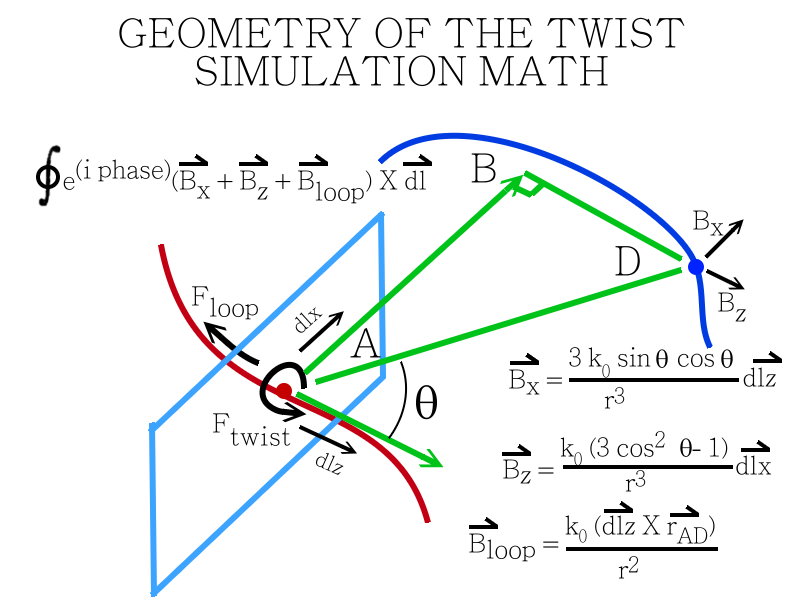
Geometry of the Twist Sim Math

January 5, 2015
Here is a drawing of the forces on the twist path that the simulator attempts to model.

Here is a drawing of the forces on the twist path that the simulator attempts to model.

I created a picture that hopefully shows the geometry of the simulation math described in the previous post (see in particular the PPS update).  This picture attempts to show a generator twist path about point A in red, with the two force sources F(loop) and F(twist), which are delta 1/r^2 and 1/r^3 flux field generators respectively.  The destination point D path is shown in blue.  The parametric integral must be computed for every source point on each destination point–this will give a potential field.  When the entire set of curves lies on an equipotential path, one of many possible stable solutions has been found (it’s already easy to establish that any topologically unique closed loop solution will not degenerate because the 1/r^3 force will repel twist paths from crossing each other).  There probably is a good LaGrange method for finding stable solutions, but for now I will work iteratively and see if convergence for various linked or knotted loops can be achieved.


Agemoz

Finally–A Particle Twist Solution Methodology

April 8, 2014

About six months ago, I was able to show qualitatively that the twist field had more than one stable solution, which implies that it could represent more than just the photon and electron variants.  I was easily able to show that any set of closed contours (twist paths) were topologically equivalent as long as no contour crosses, and the unitary field twist theory meets this constraint because twist paths are central force attractive (1/r^2 magnitude) but are repulsive by 1/r^3, so the sum is asymptotically repulsive as a twist path approaches another twist path.  This was a big breakthrough because now any interlinked loops or knots become unique and stable solutions, opening the door for representing the particle zoo.

I thought, great, now all I have to do is get some quantitative solutions and determine the relative mass to the twist field ring, and that would prove (or disprove, perhaps) the whole twist field concept.

Turns out, that is an extraordinarily difficult problem, and I’ve spent the last six months trying to figure out how to do it.  I finally figured out a crude iterative way to do it.

You would think this is a simple LaGrange mechanics problem, but my in-depth study seems to show this isn’t a workable approach.  The contour potential energy must be computed at every point, and is the integral of all other points of the entire contour set.  In fact, this problem has a stunning similarity to Feynman path integrals, with the complication that everything (all contour points) can move in 3D+T.  It cannot be assumed that the contours are symmetric, in fact if this indeed does model real particles, it’s easy to show that most solutions are not symmetric (contours are identical but displaced or rotated).  Worse, it’s likely many solutions are not stable in time, so methodologies invoking gauge invariance can’t be used here.

It was almost immediately obvious that trying to find a minimum path for the contour in the 1/r^2 – 1/r^3 field wouldn’t work (the field is an integral of all contours, but the contour path changes in each delta time), hence the LaGrange mechanics couldn’t be used in practice, the resulting differential equations would be phenomenally complex.  Simple iterative methods don’t work because there are constraints that are not really workable in an array  simulation–the energy of a loop must remain constant, so its length may not vary–but assuming constant spacing of simulation nodes doesn’t work for several reasons.  First, the solution loop length is not known, and fixing it defeats the goal of quantitatively finding that length.  Second, applying iterations to a chain of segments means that moving one segment means that a large set of adjacent segments also has to move instantaneously–not impossible, but each segment also has its own movement directives, which then would recursively affect the original movement directive.  I thought, well, let’s just make the segments stretchable, but adding that into the vector field complicates the computation significantly and appears to destroy the actual force balance between contour elements.  It’s a mess, believe me, I tried.

The approach I came up with is to just find any topologically equivalent set of contours and just start with that.  Compute the vector field neighborhood around each contour node and  then adjust each contour at each contour point until the vector field has minimal magnitude on each contour point.  Yes, there is considerable danger that doing this method of  iteration of contours will not be stable and converge, but I can see several outcomes that should yield valuable information anyway.  First, if nearly all vector field magnitudes point outwards (or all inwards), this means that the contour energies (and hence loop length) should be adjusted, so closure to a stable mass value should be possible regardless of the stability of the contour path shape iteration.  Second, there are many topologically unique solutions–that is already trivial to see.  If one contour set isn’t timewise stable or does not converge, either a different contour set could be tried or data from the iteration could be used to find a better starting point for the contour path.

I will put together a new sim (technically no longer a sim, but a generator) that does this contour vector field neighborhood and makes it easy to adjust the contour paths.  I have no doubt that over time I will come up with better and faster methods to arrive at solutions.

Agemoz

UPDATE:  Some additional thinking showed that taking a vector field derivative will yield the contour normal, and the direction will directly give the desired expansion directive.  It would be nice if the normal magnitude would also give the minima that would establish the optimized twist path, but it won’t–it will only give the minimum for that point given that the rest of the contour paths are unchanged.  As soon as any other portion of the paths change, this minimum will also change.  Perhaps there is a LaGrange multiplier scheme that will work to find the minima for all points on all paths.  I’m quickly sensing that there are a number of mathematical tools that can be brought to bear on this problem.

Yang-Mills Mass Gap

January 12, 2014

My study of vector field twists has led to the discovery of stable continuous field entities as described in the previous post (Dec 29th A Particle Zoo!).  I’ve categorized the available types of closed and open solutions into three broad groups, linear, knots, and links.  There’s also the set of linked knots as a composite solution set.  I am now trying to write a specialized simulator that will attempt quantitative characterization of these solutions–a tough problem requiring integration over a curve for each point in the curve–even though the topology has to be stable (up to an energy trigger point where the particle is annhiliated), there’s a lot of degrees of freedom and the LaGrange methodology for these cases appears to be far too complex to offer analytic resolution.  While the underlying basis and geometry is significantly different, the problem of analysis should be identical to the various string theory proposals that have been around for a while.  The difference primarily comes from working in R3+T rather that the multiple new dimensions postulated in string theory.  In addition, string theory attempts to reconcile with gravity, whereas the field twist theory is just trying to create an underlying geometry for QFT.

One thing that I have come across in my reading recently is the inclusion of the mass gap problem in one of the seven millenial problems.  This experimentally verified issue, in my words, is the discovery of an energy gap in the strong force interaction in quark compositions.  There is no known basis for the non-linear separation energy behavior between bound quarks or between quark sets (protons and neutrons in a nucleus).  Dramatically unlike central quadratic fields such as electromagnetic and gravitational fields, this force is non-existent up to a limit point, and then asymptotically grows, enforcing the bound quark state.  As far as we know, this means free quarks cannot exist.  As I mentioned, the observation of this behavior in the strong force is labeled the Yang-Mills Mass Gap, since the energy delta shows up as a mass quantization.

As I categorized the available stable twist configurations in the twist field theory, it was an easy conclusion to think that the mass gap could readily be modelled by the group of solutions I call links.  For example, the simplest configuration in this group is two linked rings.  If each of these were models of a quark, I can readily imaging being able to apply translational or moment forces to one of the rings relative to the other with nearly no work done, no energy expended.  But as soon as the ring twist nears the other ring twist, the repulsion factor (see previous post) would escalate to the energy of the particle, and that state would acquire a potential energy to revert.  This potential energy would become a component of the measurable mass of the quark.

The other question that needs to be addressed is why are some particles timewise stable and others not, and what makes the difference.  The difference between the knot solutions and the link solutions is actually somewhat minor since topologically knots are the one-twist degenerate case of links.  However, the moment of the knot cases is fairly complex and I can imagine the energy of the configuration could approach the particle energy and thus self-destruct.  The linear cases (eg, photons, possibly neutrinos as a three way linear braid) have no path to self destruct to, nor does the various ring cases (electron/positrons, quark compositions).  All the remaining cases have entwining configurations that should have substantial moment energies that likely would exceed the twist energy (rate of twisting in time) and break apart after varying amounts of time.

The other interesting realization is the fact that some of these knot combinations could have symmetry violations and might provide a geometrical understanding of parity and chirality.

One thing is for sure–the current understanding I have of the twist field theory has opened up a vast vein of potentially interesting hypothetical particle models that may translate to a better understanding of real-world particle infrastructure.

Agemoz

A Particle Zoo!

December 29, 2013

After that last discovery, described in the previous post, I got to a point where I wondered what I wanted to do next.  It ended the need in my mind to pursue the scientific focus described in this blog–I had thought I could somehow get closer to God by better understanding how this existence worked.  But then came the real discovery that as far as I could see, it’s turtles all the way down, and my thinking wasn’t going to get me where I wanted to go.

So I stopped my simulation work, sat back and wondered what’s next for me.  It’s been maybe 6 months now, and while I still think I was right, I miss the fun of thinking about questions like why is there a particle zoo and whether a continuous field could form such a zoo.  While I don’t sense the urgency of the study anymore, I do think about the problem, and in the recent past have made two discoveries.

One was finding a qualitative description of the math required to produce the field vector twist I needed for my Unitary Field Twist theory, and the second was a way to find the available solutions.  The second discovery was major–it allowed me to conceptualize geometrically how to set up simulations for verification.  The problem with working with continuous vector fields required by the twist theory is that solutions are described by differential equations that are probably impossible to solve analytically.  Sometimes new insights are found by creating new tools to handle difficult-to-solve problems, and to that end I created several simulation environments to attempt numerical computations of the twist field.  Up to now, though, this didn’t help finding the available solutions.

What did help was realizing that the base form of the solutions produce stable solutions when observing the 1/r(t)^3 = 1/r(t)^2 relation–the relation that develops from the vector field’s twist-to-transformation ratio.  Maxwell’s field equations observe this, but as we all know, this is not sufficient to produce stable particles out of a continuous field, and thus cannot produce quantization.  The E=hv relation for all particles led me to the idea that if particles were represented by field twists to some background state direction, either linear (eg, photons) or closed loops, vector field behavior would become quantized.  I added a background state to this field that assigns a lowest energy state depending on the deviation from this background state.  The greater the twist, the lower the tendency to flip back to the background state.  Now a full twist will be stable, and linear twists will have any possible frequency, whereas closed loops will have restricted (quantized) possibilities based on the geometry of the loop.

For a long time I was stuck here because I could see no way to derive any solutions other than the linear solution and the ring twist, which I assigned to photons and electrons.  I did a lot of work here to show correct relativistic behavior of both, and found a correct mass and number of spin states for the electron/positron, found at least one way that charge attraction and repulsion could be geometrically explained, found valid Heisenberg uncertainty, was able to show how the loop would constrain to a maximum velocity for both photons and electrons (speed of light), and so on–many other discoveries that seemed to point to the validity of the twist field approach.

But one thing has always been a problem as I’ve worked on all this–an underlying geometrical model that adds quantization to a continuous field must explain the particle zoo.  I’ve been unable to analytically or iteratively find any other stable solutions.  I needed a guide–some methodology that would point to other solutions, other particles.  The second discovery has achieved this–the realization that this twist field theory does not permit “crossing the streams”.  The twists of any particle cannot cross because the 1/r(t)^3 repulsion factor will grow exponentially faster than any available attraction force as twists approach each other.  I very suddenly realized this will constrain available solutions geometrically.  This means that any loop system, connected or not, will be a valid solution as long as they are topologically unique in R3.  Immediately I realized that this means that links and knots and linked knots are all valid solutions, and that there are an infinite number of these.  And I immediately saw that this solution set has no morphology paths–unlike electrons about an atom, you cannot pump in energy and change the state.  We know experimentally that shooting high energy photons at a free electron will not alter the electron, and correspondingly, shooting photons at a ring or link or knot will not transform the particle–the twists cannot be crossed before destroying the particle.  In addition, this discovery suggests a geometrical solution to the experimentally observed strong force behavior.  Linked loops modelling quarks will permit some internal stretching but never breaking of the loop, thus could represent the strong force behavior when trying to separate quarks.  And, once enough energy were available to break apart quarks, the resulting particles could not form free quarks because these now become topologically equivalent to electrons.

My next step is to categorize the valid particle solutions and to quantify the twist field solutions, probably by iterative methods, and hopefully eventually by analytic methods.

There’s no question in my mind, though–I’ve found a particle zoo in the twist field theory.  The big question now is does it have any connection to reality…

Agemoz

Atom Energy Quantization

July 30, 2013

I have taken a digression from my sim work to think about quantization of atomic energy levels.  These energy levels, to a first order in the simplest (hydrogen) atom, are defined by the Rydberg equation.  The rest energy of elementary particles such as the electron is defined by E=hv, and I have posited that field twists geometrically achieve this quantization.  I’ve then followed down a bunch of different paths testing this hypothesis.  However, it’s not just rest mass that is quantized.  The kinetic energy of electron orbitals in an atom are also quantized.  In the non-relativistic case we can look at the solutions of the Schrodinger equation, although refinement of the solutions for spin and other 2nd order and quantum effects has to be applied.  Ignoring the refinements, does this quantization also imply field twists?

I think so for the same reason as the E=hv rest mass case–to achieve a modulo energy value that quantizes, a geometric solution requires a twist in a background vector field state.  There has to be a lowest energy state called the background state.  You can imagine a plane of floating balls that each have a heavy side and a tenuous connection to adjacent balls.  Most balls will tend to the heavy side down state (obviously, this is a gravitational analogy, not a real solution I am proposing).  But if there is a twist in a string of balls, the local connection for this twist is stronger than the reverting tendency to the background state, and the twist becomes topologically stable.  Several geometrical configurations are possible, a linear twist could model a photon, while a twist ring could model an electron.  What could model the energy states of an electron around an atom?

One thing is pretty clear–the energy of the lowest state (S orbital) is about 8 orders of magnitude smaller than the rest mass energy of the electron, so there’s no way a single field twist would give that quantization.  The electron twist cannot span the atom orbital–the energy level is too far off.  The fact that the energy levels are defined by the Rydberg equation as 1/r^2 increments suggests either that each energy level adds a single twist that is distributed over the orbital surface (causing the effect of 1/r^2 over a unit area), or that the energy level is the result of n^2 new twists.  Since I cannot imagine a situation which would enforce exactly n^2 new twists for each quantized orbital energy level, I think the former is the right answer.  There is a constant energy twist being applied each time an orbital reaches another excitation level, distributed over a surface.

But what quantizes that first energy level (corresponding to the 1.2 10^-5 cm wavelength)?  This cannot be related to the electron wavelength (2.8 10^-13 cm) because the S orbital is a spherical cloud that is far larger than an EM field twist solution would give.  An EM twist about a charged stationary object would have about 4 times the classical radius of the electron–but the actual cloud is around 7 orders of magnitude larger.  The thing that causes the atom orbital size to be so large is the strong force, which prevents the electron and the positively charged nucleus from collapsing.  Trouble is, this is a complication that I don’t have any thoughts about how the Twist Field theory would work here, other than recognizing that any type of quantization requires a return to a starting state–implying a twist.  DeBroglie proposed that the probability function wave has to line up, but we don’t really have a physical interpretation of a probability distribution in quantum mechanics, so what does it mean physically for that wave to line up?  No such problem in Twist Field theory, and twists are so closely related to the sine waves involved (they are a reverse projection) that I don’t think it’s preposterous to propose field twists as an underlying cause.

But there’s a lot of gaping holes in that explanation that would require a lifetime of investigation.

Agemoz

Confirmed–Twist Model Now Functioning

July 26, 2013

sim_sample_r1_r2

Picture shows a sample run of the twist ring with an external field.  Red curve is displacement, black curve is twist ring velocity, blue is the acceleration of the twist ring (it decreases over time as the twist ring moves away from the source (located off image to the left).  The initial acceleration rise is not real, but an artifact due to a moving average getting enough data to compute.

I modified the model from a dipole approximation to an integrated sum of components on the ring, and got very clean results   I did a large number of runs with varying field strength and displacements, and am getting very clear correlation with the expected analytic behavior.  Looks like it is now working as expected–yayy!  There’s still a lot more to be done including characterizing the exact analytic acceleration factor and working out other solutions in R3.  Since this solution class is planar, the sim can get a valid solution in 2D, but other solutions will require expansion of the sim to handle 3D cases.  In addition, I’d like to further refine the model to operate in an atom (Schroedinger wave equation) and to investigate a relativistic model variation.

This may all be science fiction, but it is the only working geometrical model I know of that shows correct underlying attraction and repulsion in an external field.  QFT does mathematically derive attraction, but momentum conservation is an issue.  In electrostatic attraction, photons emitted by the source particle have to pull the destination particle toward it–an apparent violation of conservation of momentum.  I believe the QFT solution has the field absorbing the difference in momentum, but where does that momentum go once absorbed?  The Twist Field solution clearly successfully solves that issue, and this successful result also points out some other important question resolutions.

Previously, I have posted that I felt that a point size particle for the bare electron was not possible because then its active neighborhood could not detect a direction for field potential.  It would require a field vector and act on direction, which we know can’t be true–the electron is attracted to a charged source regardless of orientation.  The electron has to be able to sense a localized change in potential, and the Twist Ring model clearly shows how that would work.  There are still questions in my mind that the solution is clearly independent of either source or destination orientation, and there’s some real questions in my mind whether this works in relativistic environments, but one thing is for sure–this is the first time I’ve seen a working model that has the correct quantitative behavior.

Agemoz

Not So Fast, Model Might Work After All

July 19, 2013

I had decided (in the last post) that the model I was using couldn’t be right for several reasons in spite of some promising sim results. But upon thinking about it, I realized I was a little too hasty–I discovered a way that a potential (scalar) function could work in accelerating a twist ring in spite of the orientation problem and the curvature problem.    This is an important question because it gets at the heart of why a particle would move due to EM fields.  Conventional theory just asserts the Lorentz force laws, and this works under all relativistic situations.  Conventional theory also says that the electron is an immeasurably small particle.  I have worked out that the twist field particle, which would not be immeasurably small, shows that as it is accelerated relativistically, it stretches to approach the behavior of a linear twist–asymptotically approaching radius size zero.  My hypothesis is that scattering experiments make the electron appear to be infinitely small because of this stretching.  I do have to admit that this experimental result is the chief reason why other physicists discount any electron theories that require non-point like models.

Anyway, back to the sim conclusions–I’ve been trying to create a hypothesis as to why it moves as it does with the twist field theory, and created my simulation environment to test the hypothesis.  I needed to know how a particle knows which way to move when there is one or more nearby sources, and I need it to work right regardless of relativistic behavior.

A big question is whether the particle as a twist ring would sense a variation of field magnitude, or whether the field has to be a vector and the particle senses which way to move based on this vector (which would be a vector sum if there was more than one source).  The scalar field is preferable because then motion can result from the potential function, but I had thought that the orientation problem as well as the curvature problem of negative fields (see previous post) meant that the twist field ring would have to respond to a vector field, that the particle would have to accelerate independent of the orientation.  I also think the stretching of the ring in a relativistic situation might not hold up to correct behavior, but the scalar field is more likely to work than the vector field (simpler–fewer complications in different scenarios).

However, I realized that all of these reasons for thinking the twist sim model are wrong are not all-encompassing. There’s a way around them, which means I have to check those out.  First, the negative field situation, which uses curvature analysis to show a paradox (stronger curvature for a field component that is on the far side of the ring).  I had done the math and things worked correctly, but had reasoned that the math couldn’t be right because it implied a force that didn’t decay with distance.  Now I realize the math is right, because there are three components that add to create the normal acceleration that determines the local curvature of the ring.  The end result of this sum is that while a weaker far-side field cannot induce more curvature, a cancelling out of part of the sum of the near-side acceleration caused by the negated field would result in *less* acceleration there and would achieve the same acceleration (as the far-field stronger field)  for source particles that attract.  The sim was correct, I just wasn’t drawing the right conclusion.

Secondly, I realized that the orientation problem may cancel itself out.  I’ve reasoned that since some orientations cause every point on the twist ring to see exactly the same field, so a solution that depends on the particle sensing the delta field cannot work in that case, and thus invalidates that solution as a general one.  But it is possible that the potential is sensed whether or not the delta field is sensed.  There has to be different behavior between a constant potential field and a sloping potential.  If the orientation problem is real, then there would be no difference in what the particle sensed from source particles and what it would sense if there were no source particles.  The field component would be the same in the local neighborhood  in either case and there would be no information available that would indicate where the particle would move to.   But a solution that has acceleration also due to potential alone, regardless of a change in potential, would work–kind of a switching between normal and tangental effects.  I will pursue this more–this idea isn’t flushed out yet.

If the delta potential *is* sensed, then this means that particles like the electron must have non-zero size, otherwise the delta field that the particle sees would still be flat.  Then the only information where the sources were would come from a directional component resulting from the vector sum of source fields at that point (where the ring is located).  Current experiment appears to show that the base electron has no size, which means it cannot sense potential across the twist ring.  In addition, the notion that an electron is imeasurably small has a real problem with Heisenberg’s uncertainty relation.  It is fundamental to the twist ring theory that the electron does have physical size, the Lorentz transforms arise from that, and the E=hv quantization of the ring depends on that.  One way or the other, a determination has to be made whether we have a scalar or vector field inducing motion.  The sim model I have now depends on a scalar field (potential) and is qualitatively correct.

So, in summary–the question of whether motion results from travel through a potential is still possible–and unresolved.   More work ahead.

Agemoz

Sim Results Show Wrong Acceleration Factor

July 18, 2013

Well, it looked promising–qualitatively, it all added up, and everything behaved as expected.  But it’s a “close, but no cigar”.   The acceleration at each point should be proportional to 1/r^2, but after a large number of runs, it’s pretty clearly some other proportionality factor.  I’ve got some more checking to do, but looks like I don’t have the right animal here.  One thing is clear though–this model, which attracts and repels, is the first one that shows qualitatively correct behavior.  If twist rings have mass due to the twist distortion, this is the first model that shows it, even if the mass can’t be right.

So, I stepped back and ran through the list of assumptions, and see some flaws that might guide me to a better solution.  Many theories die in the real world because of the glossy effect, as in, I glossed over that and will deal with it later, it’s not a major problem.  I unintentially glossed over some problems with the model, and in retrospect I should have addressed them from the get-go.

First, twist rings (as modelled in my simulation) have a real planar component, but twist through an imaginary axis.  The twist acts as an E field in the real space and as a magnetic field in the imaginary space.  The current hypothesis is that the loop experiences different field magnitudes from the source particle, and this causes a curvature change that varies around the loop.  The part of the loop that is further away will experience less curvature, the closer part more curvature (curvature is a function of the strength of the magnetic field from the source particle).  This simulation shows that if that is the model, you do indeed get an acceleration of the ring proportionate to the distance from the source particle–and the acceleration is toward the source particle–attraction!  If you switch the field to the negative, you get the same acceleration away–repulsion.  So far, so good, and the sim results made me think–I’m on the right track!  I still think I might be on the right track, but the destination is further away than I thought.

First, as I mentioned, the sim results seem to show pretty clearly that the acceleration is not the right proportionality (1/r^2).  That might just be a computational problem or just indicate the model needs some adjustments.  But there are some things being glossed over here.  First, while the model works regardless of how many particles act as a source, there is always one orientation where every point on the ring is equadistant from the source particle–in this case, there is no variation in curvature.  The particle would have to act differently depending on orientation.  It could be argued that the particle ring will always have its moment line up with the source field, and so this orientation will never happen–fine, but what happens when you have two source particles at different locations?  The line-up becomes impossible.  OK, let’s suppose some sort of quantum dual-state for the ring–and I say, I suppose that is possible, some kind of sum of all twist rings, or maybe a coherence emerges depending on where the source particles are, but then we no longer have a twist ring.  In addition, the theory fixes and patches are building up on patches, and I’d rather try some simpler solutions before coming back to this one.  The orientation problem is a familiar one–it shoots down a lot of geometrical solutions, including the old charge-loop idea.

Here’s another issue:  I make the assumption that there is a “near side” and a “far side”, which has the orientation problem I just mentioned–a corollary to that is that it also could get us in trouble as soon as relativity comes in play since near and far are not absolute properties in a relativistic situation).  I then get an attraction by assuming the field is weaker on the far side and thus there is less curvature.  The sim shows clearly the repulsion acceleration away from the source when this is done.  Then I cavalierly negated the field and Lo! I got attraction, just like I expected.  But I thought about this, and realized this doesn’t make physical sense–a case of applying a mathematical variation without thinking.  This would mean that the field caused *greater* curvature when the twist point is further away (the far side).  Uhh, that does not compute…

While not completely conclusive, this analysis points out first, that a solution cannot depend on source field magnitude variation alone within the path of the ring.  The equidistant ring orientation requires (more correctly, “just about” requires, notwithstanding some of the alternatives I just mentioned) that the solution work even if all neighborhood points on the ring have exactly the same source field magnitude.  In addition, there’s another more subtle implication.  The direction a particle is going to move has to come from a field vector–this motion cannot result from a potential function (a scalar)  because within the neighborhood of the ring, the correct acceleration must occur even if the potential function appears constant over the range of the twist ring.

This is actually a pretty severe constraint.  In order for a twist ring to move according to multiple source particles, a vector sum has to be available in the neighborhood of the twist ring and has to be constant in that neighborhood.  The twist ring must move either toward or away from this vector sum direction, and the acceleration must be proportionate to the magnitude of the vector sum.  Our only saving grace is the fact that this vector sum is not necessarily required to lie in R3, possible I3–but a common scalar imaginary field of the current version of the twist theory is unlikely to hold up.

Is the twist field theory in danger of going extinct even in my mind?  Well, yes, there’s always that possibility.  For one thing, I am assuming there will be a geometrical solution, and ignoring some evidence that the twist ring and other particles have to have a more ghostly (coherent linear sum of probabilities type of solution we see in quantum mechanics).  For another, my old arguments about field discontinuities pop up whenever you have a twist field, there’s still an unresolved issue there.

But, the driving force behind the twist field theory is E=hv.  A full twist in a background state is the only geometrical way to get this quantization in R3 without adding more dimensions–dimensions that we have zero evidence for.   Partial twists, reverting back to the background state, are a nice mechanism for virtual particle summations.  We do get the Lorentz transform equations for any closed loop solution such as the twist theory  if the time to traverse the loop is a clock for the particle.  And–the sim did show qualitative behavior.  Fine tuning may still get me where I want to go.

Agemoz

New Papers on Speed of Light Variation Theories

April 28, 2013

A couple of papers to a European physics journal (http://science.nbcnews.com/_news/2013/04/28/17958218-speed-of-light-may-not-be-constant-physicists-say?lite –probably not the best place to get accurate reviews, but interesting anyway) attempt to show how the speed of light is dependent on a universe composed of virtual particles.  The question here is why isn’t c infinite, and of course I’ve been interested in any current thinking in this area because my unitary twist field theory posits that quantum interference results from infinite speed wave phase propagation, but that particles are a Fourier composition that moves as a group wave that forms a twist.  Group waves form a solition whose motion is constrained by the *change* in the relative phases of the group wave components.

Both theories were interesting to me, not because they posited that the speed of light would vary depending on the composition of virtual particles, but because they posit that the speed of light is dependent on the existence of virtual particles.  This is a match with my idea since virtual particles in the unitary twist field theory are partial twists that revert back to a background vector state.  Particles become real when there is sufficient energy to make a full twist back to the background state, thus preserving the twist ends (this assumes that a vector field state has a lowest energy when lining up with a background vector state).  But virtual particles, unlike real particles, are unstable and have zero net energy because the energy gained when partially twisting is lost when the twist reverts back to the background state.

These papers are suggesting that light propagates as a result of a constant sequence of particle pair creation and annhiliation.   The first glance view might be that particle pair creation is just a pulling away of a positron and an electron like a dumb-bell object, but because charged particles, virtual or real, will have a magnetic moment, it’s far more likely that the creation event will be spiralling out–a twist.  Yes, you are right to roll-your-eyes, this is making the facts fit the theory and that does not prove anything.  Nevertheless, I am seeing emerging consensus that theories of physical behavior need to come from, or at least fully account for, interactions in a sea of virtual particles.  To keep the particle zoo proliferation explanation simple, this sea of virtual particles has to be some variation of motions of a single vector field–and in 3D, there’s only two simple options–linear field variation, and twists.   Photons would be linear twists and unconstrained in energy–but particles with rest mass would be closed loops with only certain allowed energies, similar to the Schrodinger electron around an atom.  Twists in a background vector field also have the advantage that the energy of the twist has to be quantized–matching the experimental E=hv result.

Agemoz